%20(4).png)
![[background image] image of cityscape background (for an architect firm)](https://cdn.prod.website-files.com/68961ade6feff9cbdffc080d/69384e066e0e9a310b6817f8_061f6bac-48bf-44b8-a689-078dacd8009f.avif)
TL;DR:
- Notaries in Israel are qualified lawyers limited to authentication and certification roles.
- Israeli real estate lawyers manage the full transaction, including contract review and land registry checks.
- Proper notarization of powers of attorney is essential for overseas buyers and Jerusalem-specific property scenarios.
Most buyers walking into a Jerusalem property deal assume the notary is a central figure, someone who manages documents, oversees the transaction, and keeps everything legally tight. That assumption is wrong, and it can cost you time and money. In Israel, the notary’s role is narrowly defined and legally specific, quite different from what buyers familiar with American, British, or German systems expect. Understanding exactly where notaries fit, and where they don’t, is one of the most practical things you can do before signing anything in Jerusalem or the surrounding areas.
| Point | Details |
|---|---|
| Notaries’ main function | In Israel, notaries authenticate key documents like powers of attorney rather than managing real estate deals. |
| Lawyers’ critical role | Transaction oversight, due diligence, and problem-solving fall primarily to lawyers, not notaries. |
| Observant buyer needs | Religious buyers require attorneys familiar with Jerusalem complexities, but notaries handle POA authentication without halachic requirements. |
| Document accuracy | Errors in notarial documents can delay transactions, so careful preparation is essential for all buyers. |
In Israel, a notary is not a separate profession. Notaries are qualified lawyers with at least 10 years of experience, authorized under Notaries Law 1976, Section 7, to perform specific acts: authenticating signatures, certifying copies and translations, administering affidavits, and preparing documents for international use, including powers of attorney (POA) for foreign real estate transactions. That last point matters enormously for buyers coming from the United States or elsewhere.
Here is what notaries are authorized to do in Israeli real estate:
Now compare that to what a real estate lawyer does, because these two roles are frequently confused:
| Function | Notary | Real estate lawyer |
|---|---|---|
| Authenticate signatures | Yes | No (unless also a notary) |
| Manage the full transaction | No | Yes |
| Review purchase contracts | No | Yes |
| Check Tabu (land registry) records | No | Yes |
| Handle tax filings and reporting | No | Yes |
| Certify POA for overseas use | Yes | No (unless also a notary) |
| Negotiate deal terms | No | Yes |
| Liaise with mortgage lenders | No | Yes |
The single biggest misconception buyers bring into an Israeli deal is thinking the notary manages the transaction. They do not. Reviewing real estate documents and navigating Israeli real estate law is the lawyer’s job, not the notary’s. The notary’s role is precise, limited, and essential only at specific moments in the process.
Jerusalem’s property market has quirks that make notarial involvement more frequent than in other Israeli cities. Fragmented ownership histories, leasehold versus freehold complications, and a high proportion of overseas buyers all create situations where notarized documents become non-negotiable.
Notaries provide supplementary authentication for POAs that are critical for investors and homebuyers abroad or navigating Jerusalem’s fragmented market. If you are buying from New York or Los Angeles and cannot be physically present in Israel for every step, a properly notarized POA is what allows your designated representative to act on your behalf legally.

Here are the most common Jerusalem property scenarios that require notarial involvement:
| Scenario | Notary required? | Why |
|---|---|---|
| Overseas buyer granting POA | Yes | Title registration requires authenticated authorization |
| Company-owned asset purchase | Often yes | Corporate resolutions may need authentication |
| Unregistered property transfer | Sometimes | Affidavits may be needed for court registration |
| Mortgage approval for non-residents | Often yes | Lenders require certified identity documents |
| Documents prepared for foreign courts | Yes | Apostille certification is notary-specific |
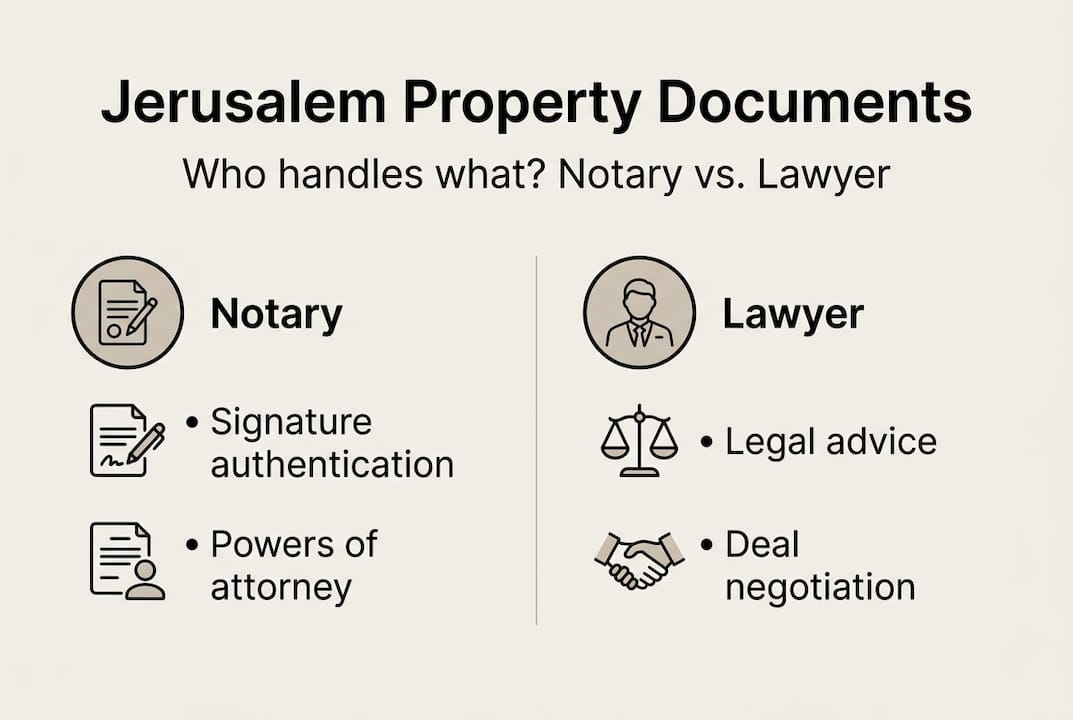
For Jerusalem residential purchases, lawyers verify Tabu records, liens, municipal permits, and zoning. Edge cases include unregistered properties, construction violations common in Jerusalem, leasehold versus freehold status, and company-owned assets requiring extra scrutiny. The notary supports this process at key authentication moments.
Here is a typical sequence for an overseas buyer purchasing in Jerusalem:
Pro Tip: Even if you are a U.S. buyer, consider using an Israeli notary for your POA whenever possible. Israeli notaries are already authorized for Israeli legal documents, which removes the apostille adaptation step and reduces the risk of technical rejection at the land registry.
Observant buyers often ask whether there are halachic requirements tied to the notarial process in Jerusalem real estate. The short answer is no. There are no halacha-specific notary roles or requirements recognized under Israeli real estate law.
What does matter for religious and observant buyers is choosing a lawyer with genuine experience in Jerusalem’s specific property landscape. For religious and observant communities, the priority is lawyers experienced in Jerusalem real estate who can navigate edge cases like building violations or Tabu issues. Notaries mainly handle POA and mortgage certification in this context.
Here is what observant buyers and their lawyers typically look for beyond the standard checklist:
The notary’s role in all of this is supporting authentication, nothing more. The importance of a real estate lawyer cannot be overstated here. Due diligence on religious community factors is legal and investigative work, not notarial work.
“Transactions rely on lawyers, not halacha-specific notary acts. The notary authenticates; the lawyer protects.”
Pro Tip: Before hiring anyone, confirm that your lawyer or notary has handled Jerusalem-specific hurdles before, not just general Israeli real estate. Jerusalem’s property registry, municipal codes, and neighborhood dynamics are genuinely different from Tel Aviv or Beit Shemesh. Familiarity with laws for U.S. buyers is also valuable if you are purchasing from abroad.
Most transaction delays tied to notarial documents are preventable. The mistakes are almost always the same: wrong language, missing apostille, or a POA that lacks specific instructions for the Israeli property being purchased.
Lawyers centralize transaction management in Israel unlike notary-heavy systems elsewhere. Notaries provide supplementary authentication for POAs that are critical for investors and homebuyers abroad. That means your lawyer should be guiding the notarial process, not the other way around.
Here is a step-by-step approach to preparing a proper notarized POA for an Israeli real estate deal:
Common mistakes that derail this process include submitting a POA in English only without a certified Hebrew translation, failing to get the apostille before sending, using a POA with vague authority that the land registry rejects, and sending a scan instead of the original.
Before your notary meeting, prepare this checklist:
Pro Tip: Always double-check the translation and the explicit instructions in your notarial documents when buying from abroad. A single vague phrase in a POA can give the land registry grounds to reject it, which means starting the authentication process over. Review real estate contracts for U.S. buyers and get comfortable with real estate terminology before your first meeting.
Here is the contrarian view most guides won’t say directly: over-relying on a notary in an Israeli real estate deal is a sign that something is wrong with your team structure. In the U.S., Germany, or France, notaries often sit at the center of property transactions. In Israel, that model simply does not exist. Lawyers centralize transaction management in Israel, not notaries.
When buyers misunderstand this, real problems follow. We have seen situations where buyers focused on getting notarial documents right while their lawyer skipped a full Tabu search. The notarized POA was perfect. The property had an unresolved lien. The deal collapsed.
The highest-value function in any Jerusalem property deal is smart, local legal guidance, not a rubber stamp. The role of real estate agents and lawyers working together, with notaries handling their specific authentication tasks, is what actually protects buyers. Think of the notary as a highly qualified specialist called in for one procedure. You would not ask your cardiologist to manage your entire health plan. The same logic applies here.
For Jerusalem buyers, especially those coming from communities where notaries carry more authority, recalibrating this expectation early saves real headaches later.
With these insights, here is how to move forward confidently on your Jerusalem property journey. At Yigal Realty, we work closely with observant and international buyers who need more than a property listing. We connect clients with experienced Jerusalem-area lawyers who understand both the legal landscape and the community priorities that matter to religious buyers. We also help coordinate the notarial documentation process so nothing falls through the cracks, whether you are purchasing from New York, Los Angeles, or locally in Israel. Our team knows the specific hurdles that come with Jerusalem-area deals and guides you through each step with clarity and care. Reach out today to start your property search with the right support in place.
No. Notaries are primarily needed when authenticating powers of attorney and certain documents for overseas buyers, not for every standard domestic transaction.
No. Israeli real estate transactions are governed by civil law, and no halacha-specific notary requirements exist for observant communities purchasing property.
Most commonly, powers of attorney, select affidavits, and documents for foreign title registration. Notaries authenticate signatures and prepare these documents for international use.
Yes, but only if the documents receive an apostille stamp. Using an Israeli notary for POA documents avoids apostille adaptation complications and reduces the risk of rejection at the land registry.