

If you are an oleh planning to buy in Beit Shemesh, start by working with a local specialist who understands both the neighborhoods and the rules unique to immigrant buyers, from purchase-tax brackets to bank loan limits. That single decision shapes everything that follows, including which developments fit your family, such as Neve Amim or Givaat Zeev, and how much cash you will actually need at signing.
TL;DR:
- Buyers should secure bank pre-approval early and confirm their oleh purchase-tax status before making an offer to avoid delays.
- Neighborhood selection should consider proximity to schools, synagogues, walkable shopping, and commute times, not just price.
- New construction offers lower prices during early sales but involves waiting for completion, while resale provides faster move-in at a higher cost.
- Loan-to-value caps limit financing to 75% for first homes and 50% for investment properties, affecting purchase options and leverage.
- Buyers must budget for additional costs like brokerage fees, legal fees, municipal transfer charges, and minimum own funds, which can start at approximately NIS 60,000.
Beit Shemesh is not one market. It is a patchwork of communities with different price points, religious character, and construction timelines, and matching the right one to your family matters as much as the mortgage math.
Weighing new construction against resale comes down to timeline and financing. A new-construction purchase usually spreads payments across a developer schedule and can offer better pricing during early sales phases, but you are buying a promise of a finished home rather than the home itself. Resale gets you keys faster and a known physical property, often at a premium for that certainty.
Beyond price and timeline, weigh the practical fabric of daily life: proximity to schools and synagogues matching your religious practice, walkable kosher shopping, and realistic commuting distance to Jerusalem or Tel Aviv if you or a spouse works outside Beit Shemesh. A neighborhood assessment framework built around these factors, rather than price alone, tends to produce fewer regrets a year after closing.
Pro Tip: Visit a shortlisted neighborhood on a Friday afternoon and again on a weekday morning. The rhythm of the street tells you more than any listing photo.
Two sets of rules do more to shape your budget than anything else: purchase-tax benefits for immigrants and Bank of Israel mortgage limits.
New immigrants are eligible for reduced purchase-tax rates on a home meant for residence, and the Knesset’s tax benefit summary lays out preferential brackets tied to your oleh status. The same summary flags an important split by arrival date: olim who arrived before August 2024 could choose between two statutory paths for purchase-tax treatment, while those arriving after that date follow a narrower statutory route. Because this distinction changes your actual tax bill, confirm which path applies to you before you make an offer, not after.
On the financing side, the Bank of Israel’s Supervisor of Banks guidance sets the loan-to-value ceilings every mortgage in Israel operates under.
The same guidance sets payment-to-income caps and limits on how much of a loan can carry a variable rate, and it requires banks to document a buyer’s declared dwelling status, sole home, replacement, or investment, before approving loan terms tied to that category.
Bank of Israel research on these limits found that LTV caps reduced borrower leverage and pushed some purchases toward smaller, less central homes, with investors affected more than first-time buyers.
For reduced-price development programs, banks may rely on an independent appraiser’s valuation and require minimum own funds, sometimes as little as NIS 60,000 for homes that received a grant, according to the same Bank of Israel guidance. Understanding your available tax benefits early lets you build a financing strategy around the actual cash you will need, not a guess.

Buying property as an oleh follows a sequence that rewards preparation and punishes improvisation, particularly around bank approvals and Tax Authority paperwork.
At each stage, a different professional carries the weight: a broker for neighborhood and project matching, an attorney for contract review and registration, a mortgage officer for the loan structure, and a notary or translator if you are signing from abroad using a power of attorney. Typical delays cluster around three points: new-construction completion slipping past the developer’s original date, bank processing taking longer than expected during high-demand periods, and Tax Authority valuation reviews for reduced-price units adding weeks to closing.
Pro Tip: Start your bank pre-approval before you fall in love with a specific unit. A pre-approved buyer moves faster when the right listing appears.
Banks and the Tax Authority move faster when you arrive with a complete file rather than assembling it piece by piece under deadline pressure.
For reduced-price programs, confirm your minimum own-funds requirement in advance and understand that the bank’s valuation may rely on an independent appraiser rather than the listed price. Keep a printed copy of this buyer’s cost breakdown on hand before your first call with a broker or bank.
Not every broker who lists Beit Shemesh properties understands what an oleh buyer needs. The right one should be able to explain, without hesitation, how purchase-tax brackets differ by arrival date and how bank LTV rules change depending on whether you are buying a first home or an investment property.
Ask direct questions before signing with anyone: How many transactions have you closed with olim in the past year? Can you walk me through the tax attestation process step by step? Which specific developments in Beit Shemesh do you have direct access to, and what is your relationship with those developers? A broker who cannot answer specifics, and instead offers vague reassurance, is a warning sign.
Credentials matter, but so does community fluency: a specialist familiar with observant and religious neighborhoods will know which developments have an eruv, which have a synagogue on-site or planned, and which school zones align with which communities. Red flags include pressure to sign before you have seen a written cost breakdown, reluctance to put payment schedules in writing, and an unwillingness to coordinate directly with your attorney and mortgage officer rather than working around them.
The purchase price is the headline number, but several other costs land on top of it before you get the keys.
Brokerage fees are typically negotiated as a percentage of the sale price and should be confirmed in writing before you view properties seriously. Legal fees cover your attorney’s contract review and registration work, a cost that applies whether you buy new construction or resale. Municipal costs include registration and transfer-related fees tied to the property’s classification, and new-construction buyers should also budget for any development-specific charges outlined in the purchase agreement. Add to that your minimum own funds, which for reduced-price programs can start around NIS 60,000 for grant-eligible homes, according to Bank of Israel guidance, though a standard first-home purchase without a grant will require substantially more equity given the 75% LTV ceiling.
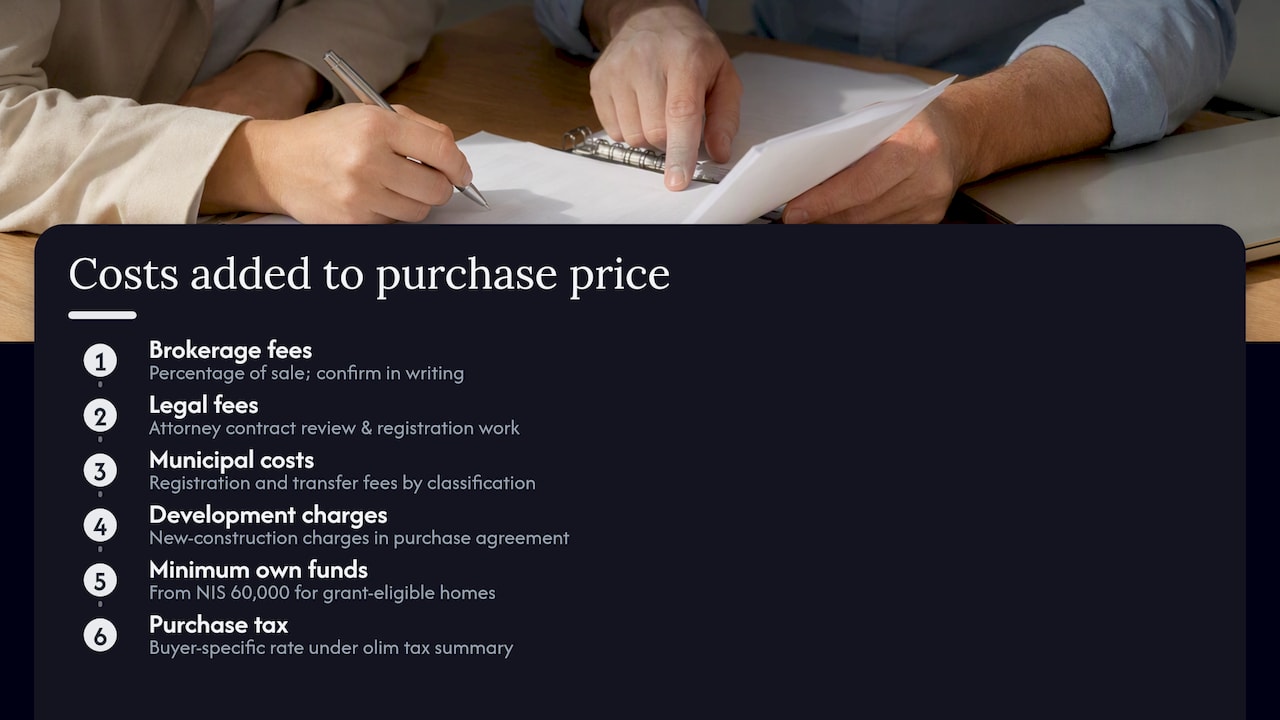
Layer your purchase-tax bracket on top of these figures once your attorney confirms your specific rate under the Knesset’s olim tax summary. A full cost breakdown by category before you make an offer prevents the most common surprise new immigrants report: underestimating the gap between the listed price and the total cash required at closing.
Buying property in a country you have just moved to, in a language you may still be learning, under tax rules that shift by arrival date, is not a transaction you want to learn by trial and error. The gap between a generic broker and one who specializes in olim in Beit Shemesh shows up in the details: knowing which developments have flexible payment plans structured for buyers still transferring funds from abroad, knowing which bank officers are comfortable working with oleh tax declarations, and knowing which neighborhoods actually deliver on their religious-community promise versus which ones are still building toward it.
Concierge-style guidance, in practice, means walking a buyer through neighborhood fit, securing early access to unit selection in developments like Neve Amim or Givaat Zeev, translating a developer’s payment schedule into plain terms, and staying in the loop with the buyer’s attorney and mortgage officer so nothing falls through a communication gap.
— Spiros
We work exclusively in Beit Shemesh and the surrounding area, which means our concierge project guidance is built around exactly the tax rules, bank timelines, and community details covered above rather than general market advice. If a development like Neve Amim, Givaat Zeev, Olmaya, or The Trilogy House fits your family’s needs, we can walk you through early unit access, payment-plan terms, and coordination with your attorney and bank. Reach out through our concierge page to set up a neighborhood match call and start narrowing your options with someone who knows the local projects firsthand.
This article is general information, not a substitute for advice from a qualified financial advisor. Consult a qualified financial professional about your own circumstances before acting on anything here.
New immigrants qualify for reduced purchase-tax brackets on a residential home, with the exact rate depending on your arrival date. Olim who arrived before August 2024 had a choice between two statutory tax paths, while those arriving after that date follow a narrower path, according to the Knesset’s tax benefit summary.
A first home purchase in Israel can typically be financed up to 75% loan-to-value under Bank of Israel guidance, meaning you need at least a quarter of the price from your own funds.
Neighborhoods like Sharei Chessed, home to The Trilogy House, and developments such as Neve Amim and Givaat Zeev each offer different combinations of community character, price point, and construction timeline. The right fit depends on your family size, religious practice, and whether you can wait out a new-construction schedule or need immediate occupancy.
Yigal Realty provides concierge project guidance for buyers relocating to or investing in Beit Shemesh, including international clients working through the process remotely. Overseas buyers typically coordinate through a power of attorney and certified documentation, as outlined in our overseas buyer guidance.
Beyond the purchase price, buyers should budget for brokerage fees, legal fees, municipal registration costs, and minimum own funds required by the bank, which can start around NIS 60,000 for grant-eligible reduced-price programs according to Bank of Israel guidance. Your purchase-tax bracket as an oleh adds another layer on top of these costs.