%20(4).png)
![[background image] image of cityscape background (for an architect firm)](https://cdn.prod.website-files.com/68961ade6feff9cbdffc080d/69384e066e0e9a310b6817f8_061f6bac-48bf-44b8-a689-078dacd8009f.avif)
Before you transfer a single shekel toward a luxury villa in Beit Shemesh, four things need to happen: an independent Israeli lawyer pulls and reviews the Tabu extract and contract, a licensed engineer completes a full bedek bayit inspection with a standards-referenced report, a formal valuation confirms the price against Mas Rechisha and financing realities, and every payment moves through a lawyer-managed Ne’emanut escrow tied to concrete milestones. Skip any one of these, and you’re negotiating blind.
TL;DR:
- Confirm the Tabu extract is recent, and verify land registration, ownership status, and any liens or caveats before making an offer.
- Ensure the municipal building file matches the physical property and check for unpermitted additions that could lead to costly fines or demolition orders.
- Hire an engineer for a detailed, standards-referenced inspection covering the envelope, drainage, electrical system, and hidden moisture, lasting one to three days.
- Use valuation reports that account for unique villa features, and confirm your Mas Rechisha tax bracket and financing limits based on residency status.
- Avoid signing legal documents like the Zichron Devarim or final escrow agreements before thorough review by experienced professionals, and do not rush the process.
A proper בדיקת וילה יוקרתית בית שמש starts long before you see a contract draft. It starts with paper, and the paper has to be current.
Your lawyer, not the seller and not the agent, should pull the Tabu extract dated within 30 days of signing. This document confirms who legally owns the property, whether there’s a mortgage lien attached, and whether anyone else, an ex-spouse, a creditor, a sibling with an inheritance claim, has a registered interest. An outdated extract is close to worthless; liens get added and removed constantly, and a stale document can hide a problem that surfaces only after you’ve paid a deposit.
Land status matters just as much as ownership. Some Beit Shemesh properties sit on land still registered through the Israel Land Authority rather than fully “converted” Tabu title. That distinction affects resale timelines and how easily a bank will approve a mortgage against the property later.
From there, work through this sequence:
Pro Tip: *Ask your lawyer for a written escrow schedule before you sign anything.
For a broader reference document you can hand to your advisors, Yigal Realty’s due diligence checklist for Israeli buyers walks through each stage in order.
A bedek bayit is not a quick walkthrough with a flashlight. For a villa the size of most luxury listings in Beit Shemesh, expect the engineer on site for one to three days, followed by a written report that commonly runs 30 to 150 pages once photos, standards references, and repair recommendations are included.
On a villa specifically, the inspection needs to cover:
Every finding should reference a specific Israeli standard, not just “looks fine” or “needs attention.” A report that names the standard, grades severity, and photographs the defect is what gives you actual leverage at the negotiating table, whether that means a price reduction, an escrowed repair fund, or the seller fixing it before closing. Verify the engineer’s license and ask for two recent villa reports before hiring anyone; not every home inspector has handled a property with a pool and a security gate system before.
Israeli property law protects buyers well, but only if someone actually uses the protections. The Tabu extract is the foundation of that protection, and your lawyer should be reading it, not glancing at it. Ask specifically whether the registered owner matches the seller, whether any mortgage or caveat appears, and whether the extract’s date is recent enough to be reliable.
Municipal building files are the second pillar. If the as-built structure doesn’t match what’s on file, you’re looking at potential Chrigot Bniya exposure, and a forensic architectural survey comparing drawings to reality is often necessary on larger, customized villas where additions accumulate over years of ownership.
The trap that catches even experienced buyers is the Zichron Devarim, a memorandum of understanding that feels informal but can be treated by an Israeli court as a binding contract if it contains the right elements. Never sign one before your lawyer reviews it. What looks like a friendly letter of intent can lock you into terms you never meant to finalize.
Pro Tip: If a seller’s agent pushes you to sign “just a simple letter” before lawyers are involved, that pressure is the warning sign, not a formality to brush past.
For the mechanics of how escrow protects your funds, Yigal Realty’s guide to escrow in Israel breaks down typical release structures in more detail.
A luxury villa appraisal has to account for more than square footage. Plot size, view lines, pool and landscaping quality, security features, and any income-generating guest units all move the number, and a generic comparable-sales estimate will usually undervalue or overvalue a property that doesn’t fit a standard template.
Mas Rechisha, Israel’s purchase tax, is tiered by residency status and whether this is your first Israeli property. Residency status materially changes both the tax bracket and the financing terms available to you, and timing decisions, such as making Aliyah before or after a purchase, can shift which bracket applies. Get exact figures from a tax advisor rather than relying on a rule of thumb; the difference between brackets on a luxury-priced property is not small.
Financing follows a similar residency split. Non-residents typically face lower loan-to-value ceilings than Israeli residents, and any unresolved inspection or title issue gives a lender a reason to delay or shrink an approval.
Sequencing matters as much as thoroughness. A realistic order looks like this:
Collect documents at each stage rather than scrambling at the end: Tabu extract, municipal building file, engineer’s report, tax advisor confirmation, and the signed escrow agreement.
A local real estate firm focusing on Beit Shemesh, including developments like Neve Amim and Olmaya, can provide insights on which villas have clean permit histories before a buyer schedules an inspection. The firm coordinates introductions to licensed engineers and independent attorneys, and helps buyers make sense of inspection findings against real local comparables rather than generic valuation benchmarks. For buyers navigating this from abroad, that coordination often matters more than any single document.
Size and customization cut both ways. A luxury villa gives you more space and more features, but also more surface area for something to go wrong, and more history of renovation work that may not have been done to code.
Foundation settlement shows up more in villas than apartments simply because they carry more weight over more variable ground, and any diagonal cracking near windows or door frames deserves a direct question to the engineer. Waterproofing failures around pools and roof terraces are common, since these are added features layered onto original construction and the seams where old meets new are exactly where leaks start. Retrofitted additions, a home theater, a guest suite, a home office, sometimes bypass permit requirements entirely, and an engineer needs to check whether the electrical panel was actually upgraded to handle the added load or just patched.
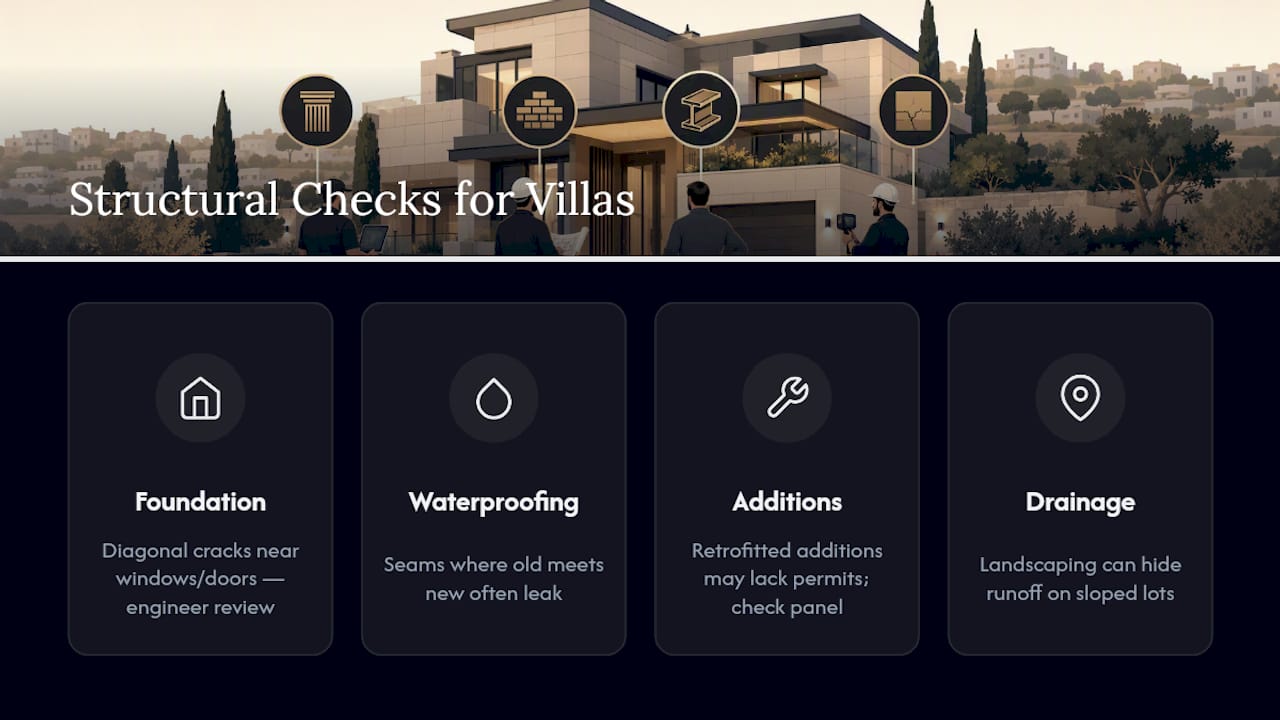
Smart home systems and automated pool equipment introduce a different kind of risk: they age fast and get expensive to replace, and a seller demonstrating them working on the day of viewing tells you nothing about long-term reliability. Ask for maintenance records, not a demonstration. Landscaping and grading around a large lot can also mask drainage problems that only surface in heavy winter rain, an issue worth flagging if the property has retaining walls or a sloped rear yard.
Beit Shemesh isn’t uniform, and a villa’s value depends heavily on which pocket of the city it sits in. Proximity to established religious community infrastructure, synagogues, schools, and communal amenities, drives demand in ways a pure square-footage comparison misses entirely.
Topography plays a role too. Hillside plots often command premium views but come with steeper driveways, more complex drainage engineering, and higher retaining wall maintenance costs over time. Flatter lots in newer development zones tend to have simpler infrastructure but less privacy from neighboring construction.
Ongoing development in surrounding areas matters for resale value in either direction. New infrastructure, roads, transit links, and municipal services, can lift values in a growing pocket of the city. Conversely, a villa backing onto an active construction zone or a planned future development may see noise and access disruption for years, something worth asking about before you fall for a view.
Check the municipal zoning map for anything planned adjacent to the property, not just its current state. A quiet lot today can look very different in three years if a permit already exists for a project next door.
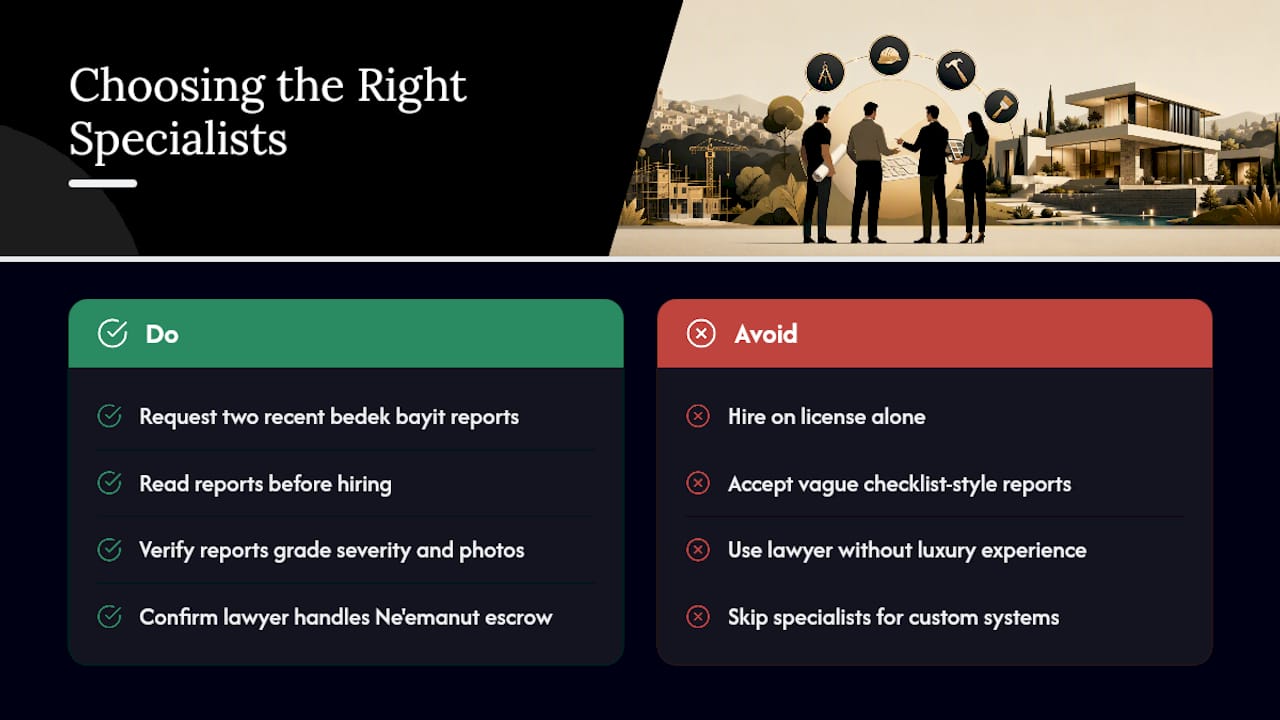
Not every licensed engineer or lawyer has handled a property with a pool, a security system, and a decade of additions. Credentials matter, but so does specific experience with homes at this scale.
Ask any engineer you’re considering for two recent bedek bayit reports on comparable villas, and read them before hiring, not just after. A report that reads like a checklist with vague notes is a warning sign; a strong one names the standard violated, grades severity, and includes clear photographic documentation, the kind of report an engineer’s inspection is designed to produce when done properly.
For legal representation, confirm the lawyer handles Ne’emanut escrow structures regularly and has experience with luxury transactions specifically, since the contract clauses protecting a $2 million villa purchase look different from a standard apartment sale. Ask how they structure release milestones and whether they’ve dealt with Chrigot Bniya disputes before; that experience is worth more than a generic real estate law background.
If the property has custom features, a pool, a home automation system, extensive landscaping, consider bringing in a specialist for that specific system alongside the general engineer. A pool contractor will catch filtration and structural issues a general inspector might miss entirely.
Costs scale with property size and complexity, and a luxury villa runs meaningfully higher than a standard bedek bayit on an apartment simply because there’s more to inspect and more pages in the resulting report. Budget for the engineer’s inspection itself, a separate legal due-diligence fee covering the Tabu search and contract review, and potentially a specialist inspection fee if the property has a pool or extensive smart home systems.
Layer onto that the valuation fee for a formal appraisal, which luxury buyers should treat as essential rather than optional given how much unique features can swing a property’s true market value. Legal fees for Ne’emanut setup and ongoing escrow management typically run as a percentage of transaction value or a flat fee, depending on the firm.
None of these costs are trivial, but weighed against the price of a luxury villa, and against the cost of discovering unpermitted construction or a foundation issue after closing, they’re a small fraction of the total transaction. Get itemized quotes from your engineer and lawyer before committing so there are no surprises mid-process, and treat any inspector offering a suspiciously fast, cheap report on a large property with skepticism.
Most guides on Israeli property due diligence treat every step as equally important, and that’s where they get it wrong. Two things carry outsized weight in a luxury villa purchase: the currency of your Tabu extract and the standards-referenced quality of your bedek bayit report. Everything else, valuation nuance, tax bracket optimization, matters, but those two documents are what actually protect you if something goes sideways after closing.
The conventional advice to “hire a lawyer and an engineer” undersells how much the quality of those professionals matters. A rushed Tabu pull or a vague, unstandardized inspection report gives you paperwork without protection. Ask pointed questions before hiring anyone, and don’t be afraid to walk away from a deal moving faster than your due diligence can keep up with.
If there’s one habit worth adopting: never let calendar pressure from a seller’s agent compress your inspection or legal review timeline. Beit Shemesh’s luxury market moves, but a rushed Zichron Devarim signed under pressure has cost buyers far more than a lost deal ever would.
— Spiros
Yigal Realty gives Beit Shemesh buyers something a checklist alone can’t: direct coordination with vetted local engineers and attorneys who already know how villas in Neve Amim, Olmaya, and surrounding developments are typically built and permitted. Instead of researching specialists from scratch, you get introductions to advisors familiar with the specific due diligence issues this article covers, along with local market comparables to sanity check any valuation. A first consultation typically walks through the document checklist, flags which vendors to bring in first, and gives you a scoped estimate for inspection and legal review costs before you commit to anything. If you’re weighing a luxury villa purchase in Beit Shemesh, reach out to Yigal Realty to schedule that first conversation.
This article is general information, not a substitute for advice from a qualified financial advisor. Consult a qualified financial professional about your own circumstances before acting on anything here.