%20(4).png)
![[background image] image of cityscape background (for an architect firm)](https://cdn.prod.website-files.com/68961ade6feff9cbdffc080d/69384e066e0e9a310b6817f8_061f6bac-48bf-44b8-a689-078dacd8009f.avif)
TL;DR:
- International real estate investment involves buying property abroad to earn rental income or capital gains, often requiring 6 to 12 months for completion. A structured process, including clear strategy, market research, legal setup, and due diligence, minimizes risks and increases success. Successful investors stay engaged, conduct regular reviews, and rely on local professionals to navigate legal and market complexities.
International real estate investment is the process of purchasing property in a foreign country to generate returns through rental income, capital appreciation, or residency benefits. A step by step guide to international real estate investment matters because the process spans 6–12 months and involves legal, financial, and cultural complexities that catch unprepared buyers off guard. Global markets deliver returns exceeding 12% compared to 5.7% average U.S. property appreciation. That gap makes the effort worthwhile, but only when you follow a structured process from strategy through closing.
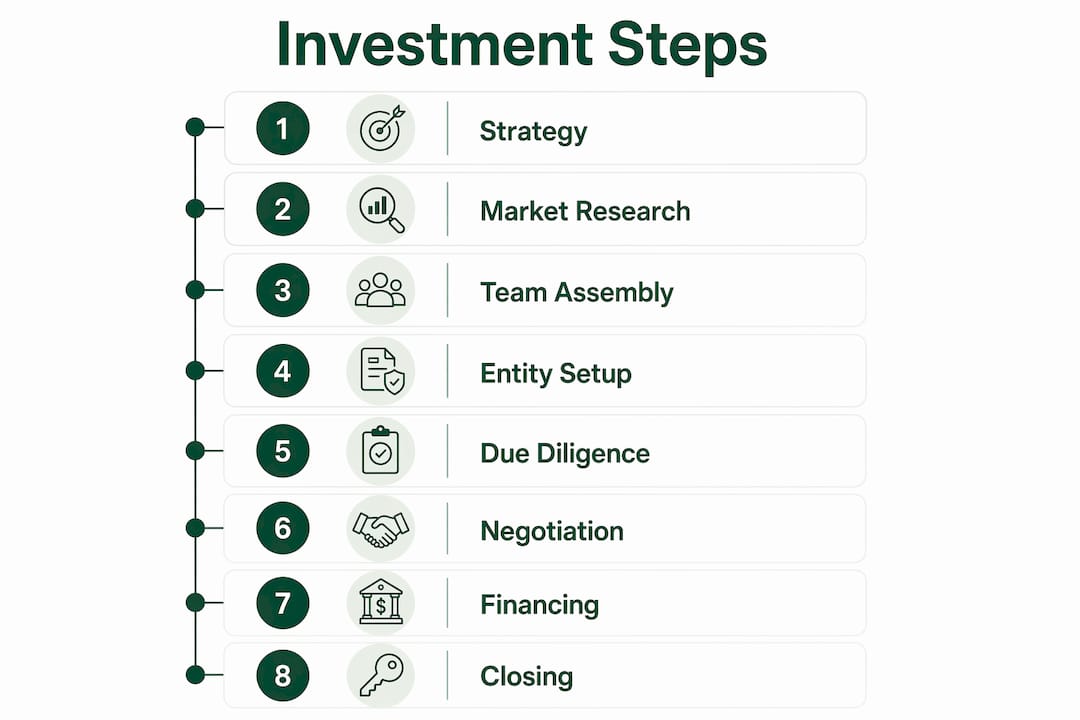
Eight core acquisition steps define every successful overseas purchase: strategy, market research, team assembly, entity setup, financing, property due diligence, negotiation, and closing. Each step has a defined timeline and task list. Skipping any one of them creates legal exposure or financial loss. Investors who treat this as a linear checklist close faster and with fewer surprises than those who improvise.

The full timeline breaks down as follows: strategy development takes 2–3 months, market research takes 1–2 months, and closing alone takes 3–8 weeks. Team assembly and financing arrangement run in parallel with other stages. Understanding this timeline upfront prevents the single most common mistake: rushing a purchase before the legal and financial groundwork is in place.
A strategy-first approach is the single most important step in the entire process. Investors who skip it often end up with lifestyle-driven purchases that deliver poor liquidity and low rental yields. Defining your income goals, risk tolerance, and investment horizon before you look at a single listing shapes every decision that follows, including which country, which property type, and which legal structure to use.
Start by answering four questions:
Tax and legal considerations belong in the strategy phase, not the closing phase. Investors must evaluate legal ownership, tax, currency, and financing risks across jurisdictions before committing capital. Failing these checks leads to disputes and financial liabilities that are expensive to unwind.
Pro Tip: Write a one-page investment thesis before you contact a single agent. State your target country, property type, expected yield, hold period, and exit strategy. This document will guide every professional you hire and every negotiation you enter.
Market selection is where most investors lose time and money. The right market for your strategy is not necessarily the most popular one. Use a structured framework to narrow your options before committing to any geography.
| Criteria | What to assess |
|---|---|
| Legal framework | Foreign ownership rights, restrictions, and required entity types |
| Economic fundamentals | GDP growth, inflation rate, and employment trends |
| Rental demand | Vacancy rates, average yields, and tenant demographics |
| Currency risk | Exchange rate volatility and capital repatriation rules |
| Infrastructure | Transport links, utilities, and proximity to employment centers |
Strong markets combine legal clarity for foreign buyers with genuine rental demand. Israel, for example, has a well-documented legal framework for foreign ownership and consistent demand in cities like Beit Shemesh, where population growth and community-driven housing needs create durable rental markets.
Once you select a market, narrow your property search using these steps:
Local administrative norms differ widely, and transparency levels vary significantly between countries. A local team of legal advisors, tax specialists, and property managers is not optional. It is the mechanism through which you access accurate data and avoid costly misreads of local regulations. The Yigal-realty blog covers practical approaches to FX risk and local financing that are specific to the Israeli market.
Legal structure and financing are the two areas where international buyers most often underestimate complexity. Getting both right before you sign anything protects your investment and your tax position for the entire hold period.
Direct personal ownership is the simplest structure but often the least tax-efficient. Common alternatives include:
Entity setup typically takes 3–6 weeks and adds complexity, but the tax efficiencies and liability protection justify the effort for most investors. Certified contract translations are not a formality. Native language versions of contracts carry legal precedence in most jurisdictions, so a mistranslated clause can override what you believed you agreed to.
Financing is a major hurdle for foreign buyers. Foreign buyers often face 30–50% down payment requirements and strict documentation standards that domestic buyers do not encounter. Start the financing process early, ideally in parallel with market research, not after you find a property.
Pro Tip: Ask your local legal advisor to confirm whether your chosen ownership structure affects your eligibility for capital gains tax exemptions or treaty benefits between your home country and the target market. This single question can save tens of thousands of dollars at exit.
For a detailed breakdown of entity setup, taxation, and local compliance steps specific to Israel, the Yigal-realty guide on overseas offices for U.S. buyers covers the process clearly.
Due diligence is where deals either get confirmed or killed. Skipping any check creates a liability that surfaces after closing, when it is far more expensive to resolve.
Effective negotiation depends on cultural awareness and legal safeguards. Price negotiation norms vary widely. In some markets, the listed price is a starting point. In others, it reflects a firm position. A local agent who understands both the market and the seller’s motivation gives you a significant advantage.
Certified contract translations are not optional. In most jurisdictions, the native language version of a purchase contract carries legal precedence. A single mistranslated clause can override your entire negotiated position.
Closing timelines run 3–8 weeks depending on the country, the complexity of the title, and the efficiency of local notaries or registries. Budget for closing costs that typically include notary fees, transfer taxes, registration fees, and agent commissions. These costs vary by jurisdiction but consistently run higher than buyers expect.
Successful international real estate investment requires a defined strategy, a local professional team, and disciplined due diligence at every stage of the process.
| Point | Details |
|---|---|
| Strategy before search | Define income goals, risk tolerance, and time horizon before contacting any agent. |
| Budget for total costs | Add a 10–15% buffer above purchase price to cover taxes, fees, and reserves. |
| Entity setup takes time | Allow 3–6 weeks for legal entity formation before you need to sign contracts. |
| Due diligence is non-negotiable | Verify title, permits, liens, and seller authority before any deposit changes hands. |
| Local teams reduce risk | Legal, tax, and property management professionals in the target market are the core of every successful deal. |
The most consistent mistake I see is investors who treat international property like a domestic purchase with extra paperwork. It is not. The legal frameworks, cultural negotiation norms, and financing structures are genuinely different, and the consequences of misreading them are severe.
The second mistake is timeline compression. Buyers who fall in love with a property push to close before their legal structure is in place or before due diligence is complete. Passive management in early stages increases the risk of underperformance, and rushed closings create the exact legal exposure that proper process is designed to prevent.
The investors who do this well share one habit: they conduct quarterly portfolio reviews and stay close to their local teams. Markets shift. Regulations change. A property that performed well in year one may need a different management approach by year three. The investors who adapt consistently outperform those who set and forget.
My practical advice: hire your legal advisor before you hire your real estate agent. The agent finds you a property. The legal advisor tells you whether you can actually own it, how to structure it, and what it will cost you to exit. That sequence matters more than almost anything else in this process.
— Spiros
Yigal-realty works with international buyers, including families based in the United States, who are purchasing residential property in Israel. The firm’s New York office bridges the gap between American buyers and the Israeli market, handling the coordination that makes cross-border purchases manageable. Services cover project guidance, local compliance, and direct agent access throughout the buying process.
For buyers focused on Beit Shemesh and surrounding communities, Yigal-realty provides early access to new developments, transparent pricing, and support through every stage from initial inquiry to closing. The step-by-step buying process guide on their site walks through each stage in detail. Reach out directly through info.yigal-realty.com to connect with an agent and get specific guidance for your situation.
The full process typically spans 6–12 months. Strategy and market research take 3–5 months combined, while closing alone runs 3–8 weeks depending on the country.
Foreign buyers commonly face down payment requirements of 30–50%, significantly higher than domestic buyers in most markets. Early financing planning is critical.
Not always, but a local LLC or equivalent structure often provides tax efficiencies and liability protection that direct personal ownership does not. The right answer depends on the target jurisdiction and your tax residency.
Skipping or rushing due diligence is the highest-risk decision a buyer can make. Title defects, unpermitted construction, and undisclosed liens are difficult and expensive to resolve after closing.
Start with referrals from established firms that already operate in the target market. Yigal-realty, for example, provides direct access to vetted legal, tax, and property management professionals for buyers in the Israeli market.