%20(4).png)
![[background image] image of cityscape background (for an architect firm)](https://cdn.prod.website-files.com/68961ade6feff9cbdffc080d/69384e066e0e9a310b6817f8_061f6bac-48bf-44b8-a689-078dacd8009f.avif)
Buying property in Israel from the US sounds complicated until you realize how many American families are already doing it, successfully, from their living rooms in New Jersey or California. The idea that you need to be physically present, fluent in Hebrew, or deeply familiar with Israeli bureaucracy is one of the most persistent myths in this space. The reality is that bilingual support and remote transactions have made the process far more accessible than most people expect. This guide walks you through exactly how overseas offices work, what the buying process looks like step by step, and which communities are drawing the most interest from US religious families right now.
| Point | Details |
|---|---|
| Overseas offices ease transactions | US-based branches guide buyers through every stage with bilingual support and legal expertise. |
| Remote buying is routine | Power of attorney and virtual tools make it simple to purchase property from abroad. |
| Top locations favor communities | Beit Shemesh, Jerusalem, and other cities offer vibrant religious communities and essential amenities. |
| Legal and tax rules are unique | Non-residents face higher purchase taxes and require careful compliance, but overseas offices handle the details. |
| Group buys and safety net trends | Many families invest collectively, seeking security, resilience, and the preservation of diaspora ties. |
The practical case for using a US-based overseas office is straightforward. You get people who work in your time zone, speak your language, understand your legal comfort zone, and know what questions to ask on your behalf. But for observant families, the value goes much deeper than logistics.
A good overseas office understands the difference between a neighborhood with a shul nearby and one that is genuinely built around a kehilla (community). They know which developments are within walking distance of mikvaot, which schools teach in English, and which areas have the kind of Shabbat-observant street culture that makes a neighborhood feel like home. That local knowledge, delivered through a US-based team, is what makes the difference.
US offices bridge time zones, language barriers, and legal gaps while enabling virtual tours, power of attorney closings, and targeted outreach through community events and expos. Here is what that support typically includes:
Pro Tip: Ask your overseas office specifically which kehillot they have relationships with in your target area. A well-connected agent can get you access to pre-market listings that never appear publicly.
“The gap between wanting to buy in Israel and actually closing is almost always about trust and process, not money. Once families have a team they trust on both sides of the ocean, deals move fast.”
For a deeper look at why this market makes sense right now, the advantages for US Jewish families are worth reviewing, along with the broader reasons to choose Israeli property in the current climate.
The actual purchase journey has clear stages, and knowing them in advance removes most of the anxiety. The full process for non-residents typically runs four to eight months from initial search to receiving keys.
| Stage | Typical timeframe |
|---|---|
| Property search and selection | 2 to 6 weeks |
| Due diligence and Tabu check | 1 to 3 weeks |
| Contract signing and deposit | 1 to 2 weeks |
| Tax payment | Within 60 days of signing |
| Financing approval | 4 to 8 weeks |
| Final registration | 2 to 4 weeks after closing |
Pro Tip: Secure your bilingual Israeli attorney before you start searching, not after you find a property. The best attorneys get booked quickly, and having one ready speeds up every stage that follows.
For a practical overview of navigating Israeli real estate as a foreigner, and a detailed breakdown of real estate transaction steps, those resources will fill in the finer details. You can also use this checklist for US buyers to track your progress at each stage. The foreign investor guide from RNC is another solid reference for understanding your obligations.
Choosing where to buy matters as much as how to buy, especially when community and lifestyle are top priorities. Foreign purchases have surged 119% since late 2024, and the areas drawing the most interest from observant US buyers follow a clear pattern.
| Area | Community profile | Key draw |
|---|---|---|
| Beit Shemesh | Anglo-Orthodox, large English-speaking population | Affordable prices, strong kehilla infrastructure |
| Jerusalem | Mixed religious and secular, premium pricing | Proximity to holy sites, prestige, group buys |
| Modi’in | Modern, mixed Anglo and Israeli | Family-friendly, newer construction |
| Netanya | Coastal, French and Anglo communities | Lifestyle appeal, international feel |
| Ra’anana | Established Anglo community | English schools, suburban comfort |
North American olim top destinations consistently include Jerusalem, Beit Shemesh, and Tel Aviv, with Beit Shemesh standing out for its combination of affordability and dense religious infrastructure.
What is driving this surge? A few factors stand out:
Recent high-profile deals, like the Syrian Jewish community in Brooklyn acquiring entire towers in Jerusalem, signal that this is no longer just individual families acting alone. It is organized, community-level investment. To see how different service providers stack up for US buyers, compare real estate services and see service comparisons before committing to a team.
With locations and processes clear, understanding the legal and financial environment is the next crucial step. Most US buyers are surprised by a few specific rules that do not apply back home.
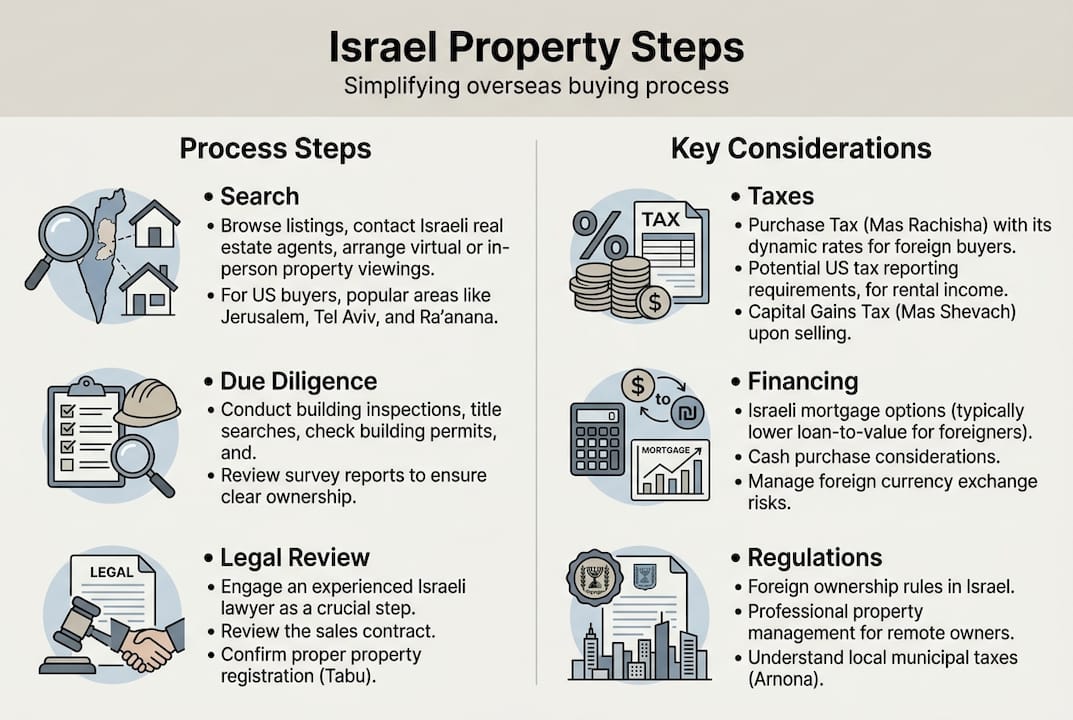
First, land ownership. No restrictions exist for foreigners on most private land purchases, but properties on Israel Land Authority (ILA) or Jewish National Fund (JNF) land operate under long-term lease structures rather than full ownership. Your attorney must confirm land status before you sign anything.
Second, taxes. Non-residents pay Mas Rechisha at 8% on the first approximately $2 million of the purchase price and 10% above that. Israeli residents who are first-time buyers pay significantly less. This is one of the most important numbers to factor into your budget from day one.
Third, compliance. Israeli banks and attorneys are required to conduct strict anti-money laundering (AML) and know-your-customer (KYC) checks on foreign buyers. You will need to document the source of your funds clearly. This is standard, but it can slow things down if you are not prepared.
“The most common surprise for US buyers is not the price or the process. It is the tax bill. Budget for Mas Rechisha from the start, and you will not be caught off guard at closing.”
Zoning rules in religious neighborhoods can also affect what you can build or modify. Height restrictions, exterior appearance standards, and community covenants vary by area. The 2025 investment climate report from the US State Department provides useful context on the broader regulatory environment. For a focused breakdown of real estate law for US buyers, that resource covers the key legal points in plain language.
Beyond individual buyers, a new wave of collective and strategic investments is remapping the religious overseas real estate landscape. Group purchases by US Jewish communities are growing fast, and for good reason.
When a kehilla buys together, they can negotiate better pricing, secure shared amenities like a shul or community center within the building, and guarantee that the social fabric of the development matches their values. The Syrian Jewish community purchase of two luxury towers in central Jerusalem is the most visible recent example, but similar deals are happening at smaller scales across Beit Shemesh and other Anglo-Orthodox strongholds.
What is motivating this shift?
Pro Tip: If your shul or community organization is considering a group purchase, start the conversation with your overseas office at least 12 months before you want to close. Group deals require more legal coordination and developer negotiation than individual purchases. For guidance on negotiating as a US buyer, that resource covers the key leverage points specific to foreign buyers.
Ready to explore your own opportunities or want personalized guidance for your family or group? Yigal Realty specializes in exactly this kind of work, connecting US families and investors with properties in Beit Shemesh and surrounding communities that match their religious lifestyle and financial goals. Whether you are looking for a family apartment, a group investment opportunity, or a luxury development like the Sharei Chessed Trilogy House, the team offers remote coordination, bilingual support, and deep community connections that make the process feel manageable from day one. You do not need to figure this out alone.
Yes. Contracts signed remotely via POA allow US buyers to complete the entire purchase without traveling to Israel, supported by bilingual legal teams and overseas offices.
Beit Shemesh, Jerusalem, Modi’in, Netanya, and Ra’anana lead the list, each offering strong religious infrastructure and English-speaking communities.
Yes. Foreign buyers pay 8% to 10% in purchase tax depending on the property price, compared to lower rates available to Israeli residents and first-time buyers.
Yes, but Israeli banks limit non-residents to 50% LTV, meaning you will need to bring a larger down payment than you might be used to in the US.
Currency fluctuations, unfamiliar legal structures, and AML compliance requirements are the most common challenges, but overseas offices provide legal coordination and due diligence support that significantly reduce those risks.