%20(4).png)
![[background image] image of cityscape background (for an architect firm)](https://cdn.prod.website-files.com/68961ade6feff9cbdffc080d/69384e066e0e9a310b6817f8_061f6bac-48bf-44b8-a689-078dacd8009f.avif)
TL;DR:
- Foreign buyers in Israel face higher taxes and costs, with total closing expenses reaching 10-16%.
- Choosing observant-friendly communities requires assessing religious infrastructure, schools, and community atmosphere.
- Partnering with experienced local agents and attorneys is essential to navigate Israel’s unique legal and procedural landscape.
Buying a home in Israel as an American is not like buying across state lines. The legal system operates differently, the tax structure surprises most first-timers, and the cultural landscape adds a layer of complexity that no online listing can prepare you for. Foreigners can buy property in Israel without legal restrictions, but they face higher purchase taxes and closing costs that can catch unprepared buyers off guard. If you are an observant family or investor looking to plant roots in a community that fits your values, this guide walks you through every critical step, from understanding taxes to finding the right neighborhood.
| Point | Details |
|---|---|
| Legal and tax knowledge | Foreign buyers in Israel face high purchase taxes and should have every contract reviewed by a local attorney. |
| Financing challenges | Securing an Israeli mortgage as a non-resident is possible but involves stricter requirements and planning. |
| Community fit matters | Choosing a religious-friendly neighborhood ensures a fulfilling experience for observant buyers. |
| Expert help is critical | Assembling an experienced team of local professionals is your best insurance against mistakes. |
With the groundwork set, let’s dig into the legal and financial realities you’ll face as a foreign buyer. The good news is that Israel places no outright ban on foreign property ownership. Americans, Canadians, and other international buyers can purchase residential real estate freely. The challenge is the cost structure, which is significantly higher for non-residents than for Israeli citizens.
Here is what you need to know about purchase taxes and closing costs:
When you add everything together, total closing costs run 10-16% of the purchase price. That is a significant number. On a $500,000 apartment, you could be looking at an additional $50,000 to $80,000 in fees before you even move in.
Statistic to know: A foreign buyer purchasing a property at NIS 7 million pays 8% on the first NIS 6 million (NIS 480,000) and 10% on the remaining NIS 1 million (NIS 100,000), totaling NIS 580,000 in purchase tax alone.
Every purchase agreement in Israel must be reviewed by a licensed Israeli attorney. This is not optional. Contracts are written in Hebrew, and even minor translation errors can have major legal consequences. Before you sign anything, make sure you review key questions for buyers and understand your rights under Israeli real estate laws.
Pro Tip: Request a full written breakdown of all anticipated fees from your attorney and agent before signing any agreement. Verbal estimates are not binding.
Once you understand the legal framework and expected costs, the next hurdle is securing the best way to fund your home purchase. This is where many international buyers run into unexpected friction. Foreign buyers face stricter banking requirements and often have access to fewer mortgage products than Israeli residents.
Here are the main financing paths available to you:
| Financing option | Approval speed | Key requirement | Main drawback |
|---|---|---|---|
| Israeli bank mortgage | 4-8 weeks | Proof of foreign income | 50% LTV cap for foreigners |
| US-based loan | 2-4 weeks | US credit history | Currency exchange risk |
| Full cash | Immediate | Bank transfer docs | Ties up large capital |
| Hybrid | 4-6 weeks | Both income and savings | More complex coordination |
For money transfers into Israel, you will need to document the source of funds clearly. Israeli banks are strict about this. Work with a licensed currency exchange service to get better rates than standard bank transfers. Explore your financing options in Israel before committing to any single path.
Pro Tip: Start your mortgage pre-approval process before making any offer. Sellers in competitive markets will not wait weeks for you to figure out your financing.
Now that you know your budget and financial path, let’s pinpoint the type of community that will support your family’s values and lifestyle. For observant buyers, location is not just about price per square meter. It is about whether you can walk to shul on Shabbat, whether your children have access to quality religious schools, and whether the neighborhood feels like home.
What makes a community genuinely observant-friendly?
Community fit is essential for long-term satisfaction. Buyers who overlook this often find themselves isolated or mismatched, even in a beautiful apartment.
Here is a quick comparison of three popular locations for observant international buyers:
| Community | Synagogues | Anglo presence | Religious schools | Kosher dining |
|---|---|---|---|---|
| Beit Shemesh (Ramat Beit Shemesh) | Very high | Very high | Extensive | Strong |
| Jerusalem (Har Nof, Givat Shaul) | Very high | High | Extensive | Very strong |
| Modi’in Illit | High | Moderate | Extensive | Moderate |
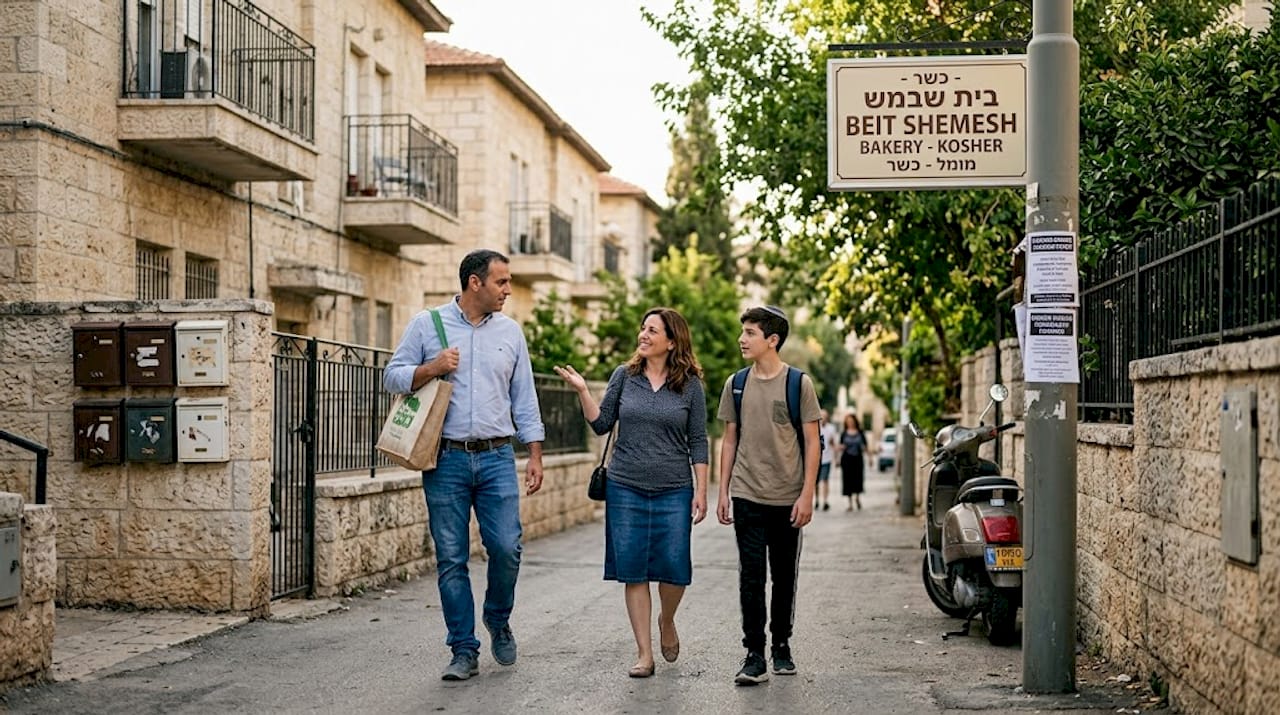
Beit Shemesh, particularly the Ramat Beit Shemesh neighborhoods, stands out for American buyers. The Anglo community there is large, English is widely spoken, and the infrastructure for religious life is mature. Cultural integration is smoother when you are surrounded by people who share your background and your schedule.
With your target community chosen, you’ll need an experienced local team to guide your search and safeguard your interests. This is not a step to rush. The professionals you hire will determine whether your purchase goes smoothly or becomes a months-long headache.
Using a local expert is essential for navigating contracts, government offices, and local customs that differ significantly from the American system. Here is how to vet and hire the right people:
“The biggest mistakes foreign buyers make are trusting verbal promises and underestimating how different the Israeli contract process is from what they know at home. Get everything in writing, and hire people who have done this before with buyers like you.”
Learn more about choosing a real estate agent in Israel and why using a local agent protects your investment.
Pro Tip: Prioritize English-speaking agents who specialize in your target community. Fluency in both the language and the culture makes a measurable difference.
Here is what typical guides miss: Americans who have bought homes before, even multiple times, often assume the process will feel familiar. It does not. The Israeli real estate system has its own pace, its own paperwork culture, and its own relationship with government timelines. Even seasoned buyers miss hidden costs or delays that are unique to Israel.
The three biggest causes of regret we see are language barriers in contracts, ambiguity in purchase agreements that seemed clear at signing, and slow government offices that add weeks or months to registration timelines. These are not rare edge cases. They are common experiences for buyers who did not prepare.
The buyers who come out ahead are the ones who partner early with professionals who know the observant buyer niche specifically. They ask the essential buyer questions before they fall in love with a property. They treat every quoted timeline as an estimate, not a promise.
Pro Tip: Double every timeline you are quoted. If your agent says three weeks, plan for six. If the attorney says registration takes a month, budget for two. Delays are not failures; they are the norm.
Ready to move forward? Here’s how you can get support for your homebuying journey. Navigating the Israeli real estate market is genuinely easier when you have the right partner by your side. At Yigal Realty, we specialize in helping international and observant buyers find the right home in the right community, with the right team around them. From Beit Shemesh to surrounding areas, we bring local expertise, English-language support, and deep familiarity with what religious families need from a neighborhood. Whether you are just starting your search or ready to make an offer, reach out to us for personalized guidance tailored to your goals and timeline.
Yes, foreigners can legally purchase property in Israel with no restrictions on ownership, though they pay higher purchase taxes and closing costs than Israeli citizens.
Foreign buyers pay an 8% purchase tax on the first NIS 6 million and 10% above that amount, with total closing costs typically reaching 10-16% of the purchase price.
Look for neighborhoods with multiple synagogues, religious schools, kosher amenities, a mikveh, and a strong Anglo or English-speaking observant population, such as Ramat Beit Shemesh.
Absolutely. An experienced local agent helps you interpret contracts, navigate government offices, and avoid costly mistakes that are especially common for international buyers.