%20(4).png)
![[background image] image of cityscape background (for an architect firm)](https://cdn.prod.website-files.com/68961ade6feff9cbdffc080d/69384e066e0e9a310b6817f8_061f6bac-48bf-44b8-a689-078dacd8009f.avif)
The 20/80 deferred-balance model is worth considering for Israeli buyers purchasing U.S. pre-construction units, but only with the right financial cushion, written lender commitments, and airtight contract protections. Without those three, it is a gamble, not a strategy.
Handover on U.S. pre-construction projects typically takes 3–4 years from contract signing, and the Bank of Israel has flagged deferred-payment marketing as carrying systemic risk. Yigal-realty works with Israeli buyers navigating exactly this structure across U.S. and Israeli markets.
The 20/80 deferred-balance model offers real cash-flow advantages for Israeli buyers of U.S. units.
| Point | Details |
|---|---|
| Get lender pre-approval in writing | Confirm the lender will underwrite the full 80% balance under specific conditions before you sign the purchase contract. |
| Insist on escrowed deposits | Deposits must be held by a licensed U.S. title company or secured by an unconditional, irrevocable bank guarantee. |
| Secure explicit assignment rights | The purchase agreement must name the right to assign the contract and define the procedure for transferring guarantees to the assignee. |
| Budget for indexation and closing costs | A fixed headline price with an open-ended CPI clause is not a fixed price; cap or eliminate indexation exposure in the contract. |
| Plan for the 3–4 year timeline | Handover typically takes 3–4 years; stress-test your income, credit, and reserves against that horizon before committing. |
| Work with Yigal-realty for cross-border deals | Yigal-realty vets projects, introduces Israeli buyers to U.S. lenders, and coordinates legal review for pre-construction purchases. |
The logic is simple: the developer gets enough capital to demonstrate buyer commitment, and the buyer avoids carrying a full mortgage during the construction period.
The lower the upfront percentage, the more the developer is essentially extending you credit, and the more that credit tends to be priced into the deal.
In U.S. pre-construction practice, the equivalent structures go by different names. “Deferred-balance purchase agreements,” “reservation deposits with deferred closing,” and “pre-construction contracts with final payment at certificate of occupancy” all describe the same basic mechanic. The deposit is held in escrow, the buyer qualifies for a construction-to-permanent loan or a standard mortgage at closing, and the developer draws on project financing during the build.
| Milestone | Typical Timing |
|---|---|
| Contract signing and 20% deposit | Month 0 |
| Permits and groundbreaking | Months 3–9 |
| Construction phases | Months 9–24 |
| Certificate of occupancy issued | Months 24–48 |
| Handover and 80% balance due | Months 24–48 |
| Mortgage funding and closing | Same day as handover |
Understanding this timeline matters because your financial life does not pause during construction. Income changes, credit scores shift, and interest rates move. The contract you sign today locks a price; the financing you secure at handover reflects the world as it is then.
Developers use deferred-payment structures to move inventory during slow markets. That keeps the developer’s construction lender satisfied and the project on schedule.
The catch is that this financing convenience rarely comes free. Developers commonly price the deferred-payment financing into the apartment price, either through a headline premium over comparable units sold on a standard schedule, or through indexation clauses that tie the final 80% payment to a construction-cost index or CPI. Either way, you pay for the deferral, just not transparently.
Here is a simple framework for spotting the premium:
Pro Tip: Ask the developer’s sales team for the price list for units sold under a standard payment schedule in the same project. Developers often maintain two price tiers and will share them if asked directly. The gap between tiers is your real cost of the 20/80 structure.
The cash-flow case for the deferred-balance model is real, and for Israeli investors buying U.S. units from abroad, it is often the deciding factor.
None of these advantages disappear if you plan carefully. They do disappear if you sign without a lender commitment and hope the financing works out later.
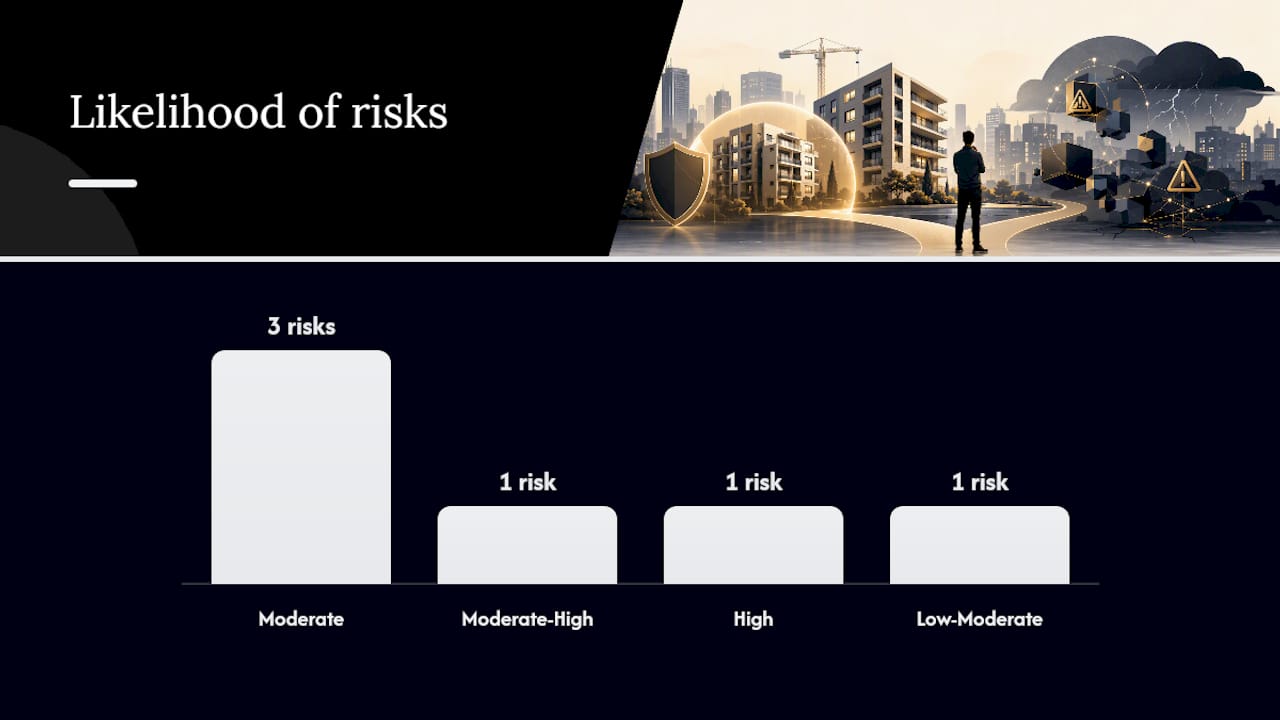
Mortgage professionals warn that the deferred 80% functions like a balloon loan: the full balance arrives at a single moment, and if you cannot fund it, the consequences range from deposit forfeiture to breach-of-contract liability. The risks below are not theoretical.
| Risk | Likelihood | Impact | Mitigation |
|---|---|---|---|
| Developer insolvency or project stall | Moderate | Loss of deposit, legal costs | Escrowed deposits, bank guarantees |
| Mortgage approval failure at handover | Moderate | Deposit forfeiture, breach liability | Written lender pre-approval now |
| Interest-rate spike at handover | High | Higher monthly payments, reduced affordability | Rate-lock options, stress-test at higher rates |
| Indexation raising the final price | Moderate-High | Effective price increase of 5–15%+ | Fixed-price clause or indexed cap |
| Construction delays (6–12 months) | Moderate | Alternative housing costs, lost income | Liquidated-damages clause in contract |
| Assignment blocked by developer | Low-Moderate | Inability to exit before handover | Explicit assignment rights in contract |
The balloon risk deserves extra attention. Buyers who experience income changes or face stricter bank lending rules at handover can find themselves unable to close, which means losing the 20% deposit and potentially facing a developer claim for additional damages. A 3–4 year horizon is long enough for a job change, a divorce, a health event, or a regulatory shift in mortgage underwriting to change your qualification picture entirely.
Regulators have noticed. TheMarker reported that Bank of Israel commentary has flagged deferred-payment marketing as resembling subprime-era risk structures, where buyers take on financing exposure they do not fully price at signing. Treat the 20/80 offer as a credit arrangement with embedded risk, not a promotional discount.
U.S. lenders do not have a single standard approach to pre-construction financing, and that variability is itself a risk for Israeli buyers who assume the mortgage will be straightforward at handover.
For any of these paths, you need to understand how lenders compare mortgage options and underwriting variables before you commit to a purchase contract. The key questions to get in writing from any lender now:
Mortgage advisers recommend securing a written lender policy now that confirms the lender will underwrite an eventual mortgage for the pre-construction purchase subject to specific conditions. “We’ll probably be able to help you” is not a commitment. Get the conditions in writing, or treat the financing as unconfirmed.
For Israeli buyers specifically, review cross-border property financing options and the mortgage approval process for Israeli buyers before approaching U.S. lenders, so you understand what documentation gaps to close in advance.
The purchase agreement is where most buyers lose leverage. Developers present contracts as standard, but almost every clause is negotiable if you have counsel and you ask before signing.
The single most important principle in any deferred-balance contract: your deposit must be held in a third-party escrow account or secured by an unconditional bank guarantee. A developer promise to return your money if the project fails is worth nothing if the developer is insolvent. The escrow or guarantee must be unconditional, irrevocable, and payable on demand.
| Clause | What to Insist On |
|---|---|
| Deposit protection | Escrow with a licensed U.S. title company or unconditional irrevocable letter of credit |
| Construction timeline | Specific completion date with liquidated damages (e.g., per-day penalty) for delays |
| Price fixation | Fixed contractual price with no indexation, or a clearly capped indexation formula |
| Assignment rights | Explicit right to assign the contract to a third party, with defined developer-consent procedures |
| Guarantee transfer | Mechanism to transfer bank guarantees and escrowed deposits to an assignee |
| Warranty retention | Escrow of a portion of the final payment for post-handover defect remediation |
| Performance bond | Developer-provided bond or bank-backed guarantee covering project completion |
On assignment specifically: the purchase agreement must permit a clean assignment of rights before handover, and the mechanism for transferring guarantees and escrowed deposits to the assignee must be spelled out in the contract itself. Without that language, a developer can block or delay your exit, or charge fees that eliminate your profit.
A U.S. real estate attorney experienced in pre-construction contracts should review every clause before you sign. This is not optional for cross-border buyers.
Due diligence on a pre-construction deal is different from buying a completed unit. You are evaluating a promise, not a building.
On the developer:
On the project:
On the documents:
Reviewing the workflow for securing investment property can help you organize these steps into a timeline before your first developer meeting.
Assigning a pre-construction contract before closing is a legitimate exit strategy, but it is more complicated than selling a completed unit, and lenders treat it differently.
| Step | Who Acts | Key Consideration |
|---|---|---|
| Review contract for assignment clause | Buyer and attorney | Must be explicitly permitted; check developer-consent requirements |
| Notify developer and request consent | Buyer | Developer may charge an assignment fee (1–3% of price is common) |
| Find assignee and negotiate price | Buyer (seller) | Price reflects contract price plus any appreciation premium |
| Transfer bank guarantees and escrow | Attorney coordination | Must follow the mechanism written into the original contract |
| Assignee qualifies for mortgage | Assignee | Lender underwrites against contract price or appraised value |
| Close assignment and release proceeds | Title company | Tax consequences triggered for original buyer |
On lender valuation of assigned contracts: when an assignee applies for a mortgage, U.S. lenders often finance against the lower of the contract price or the appraised value at the time of the assignee’s application. If the market has risen significantly, the assignee may need to bring more cash to close than expected, which can limit the pool of buyers willing to take your assignment.
For tax purposes, the gain on an assignment is typically treated as a capital gain if you held the contract as an investment. However, if a pattern of pre-completion flips suggests a business activity, the IRS may reclassify the income as ordinary business income, which is taxed at a higher rate. Short holding periods increase that risk. Consult a U.S. tax attorney before you sign any assignment agreement.
The professional consensus on deferred-balance deals is not that they are bad, but that they are frequently misunderstood at the point of sale.
Regulator framing from Bank of Israel commentary: deferred-payment marketing structures raise systemic risk concerns because they allow buyers to enter contracts without confirmed financing, creating a pipeline of future mortgage demand that may not materialize if credit conditions tighten. Buyers should treat these offers as credit arrangements with priced risk, not promotional discounts.
TheMarker’s analysis of 20/80 marketing drew an explicit parallel to pre-2008 subprime structures, where the gap between contract signing and financing qualification was a systemic vulnerability.
Mortgage professionals make a specific practical point: the deferred 80% acts like a balloon loan, and buyers must remain creditworthy across the entire construction period. A job change, a new debt obligation, or a tightening of bank underwriting standards can all make the final mortgage unavailable at handover, even for buyers who qualified comfortably at signing.
Legal practitioners add a third layer. Real estate attorneys who specialize in pre-construction contracts consistently recommend three non-negotiables: escrowed deposits with a licensed third party, unconditional bank guarantees or letters of credit, and explicit assignment rights in the purchase agreement. These are not nice-to-haves. They are the difference between a recoverable situation and a total loss if the project stalls.
Yigal-realty supports international buyers through project vetting, lender introductions, and coordination with U.S. counsel on contract review, so Israeli investors are not navigating cross-border complexity alone.
Israeli buyers entering U.S. pre-construction deals face a specific challenge: the contract is in English, the lender is American, the escrow rules are state-specific, and the tax consequences span two jurisdictions. Getting one piece wrong can cost more than the deal is worth.
Yigal-realty offers a concrete path through that complexity. The firm vets projects before recommending them to clients, introduces buyers to U.S. lenders experienced with foreign-national borrowers, and coordinates contract review with U.S. real estate counsel. A free initial consultation covers your buyer profile, the specific project you are evaluating, and the financing gaps you need to close before signing.
Explore flexible payment plans and deferred-balance options or contact Yigal-realty directly through the firm’s project guidance page to start your evaluation.
For jurisdictional questions specific to U.S. state law, escrow requirements, and lender underwriting rules, consult a U.S. real estate attorney licensed in the state where the project is located.
This article is general information, not a substitute for advice from a qualified financial advisor. Consult a qualified financial professional about your own circumstances before acting on anything here.