%20(4).png)
![[background image] image of cityscape background (for an architect firm)](https://cdn.prod.website-files.com/68961ade6feff9cbdffc080d/69384e066e0e9a310b6817f8_061f6bac-48bf-44b8-a689-078dacd8009f.avif)
TL;DR:
- Investing in religious area property offers stable, long-term returns driven by community loyalty and demand. These assets benefit from strong social capital, lower vacancy risk, and appreciation near religious sites, especially in growing spiritual hubs. Proper documentation, community engagement, and understanding zoning and renovation costs are essential for successful faith-based real estate investment.
Religious area property investment is defined as acquiring or developing real estate in proximity to active places of worship, faith institutions, or spiritually significant sites, with the goal of generating long-term financial and social returns. The case for why invest in religious area property is stronger than most investors realize. Properties near religious sites benefit from stable community demand, mission-driven stewardship, and a growing wave of faith-aligned buyers who prioritize neighborhood cohesion over short-term market swings. This guide breaks down the real advantages, the honest challenges, and the practical steps you need to make a confident decision.
Religious area properties offer a combination of benefits that conventional real estate simply does not replicate. The foundation is what HomeSight experts describe as the intersection of land, legitimacy, patience, and mission, four factors that together produce long-term social stability rather than short-term profit cycles. That stability translates directly into lower vacancy risk, stronger tenant retention, and neighborhoods that resist the kind of rapid deterioration seen in purely speculative markets.

The data supports this. Properties within one mile of historic religious sites show roughly 15% value appreciation over five years, driven by their dual role as community hubs and tourist attractions. A 15% gain over five years may not sound dramatic, but it arrives with far less volatility than comparable urban investment zones.
The benefits of religious property investment also include social capital that money cannot buy outright:
Pro Tip: When evaluating a property, check whether the nearest religious institution has an active congregation and growing membership. A thriving community center within walking distance is a stronger demand signal than any market report.
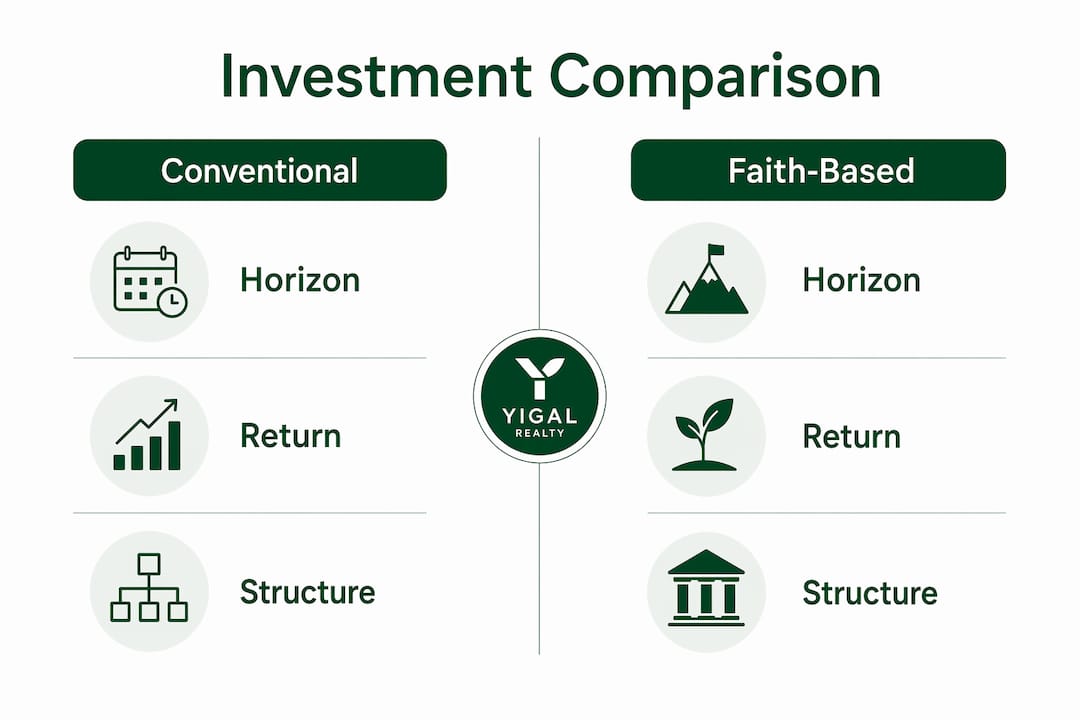
The operational philosophy separates faith-based real estate from standard property investment more than any financial metric does. Conventional real estate investing optimizes for the fastest path to maximum return. Faith-based real estate, by contrast, operates on stewardship timelines measured in decades, not quarters.
Steven Libman, an industry expert cited in the faith-based investing space, calls the traditional screening-only definition of faith-based investing “lazy” and outdated. The real distinction lies in community orientation, operational philosophy, and long-term stewardship. That shift in philosophy changes how projects are designed, financed, and managed.
| Factor | Conventional Real Estate | Faith-Based Real Estate |
|---|---|---|
| Investment horizon | 3–7 years | 10–30 years |
| Primary return driver | Market appreciation, rent yield | Community stability, mission alignment |
| Land acquisition | Market rate purchase | Donation, discount, or ground lease |
| Financing structure | Leverage-heavy, debt-financed | Debt-free or compliance-oriented models |
| Tenant selection | Income and credit screening | Community fit and stewardship alignment |
Land contribution structures deserve special attention. When a faith institution contributes land through donation, a discounted sale, or a ground lease, the financial feasibility of a project changes significantly. Land contribution documentation directly affects appraised value, lender comfort, and future development control. Get this wrong and you can trap equity or lose operational flexibility for years.
Mohsin Siddiqui, CEO of Wahed, points to another structural shift: faith-compliant, debt-free investment structures are gaining real traction, targeting annual net returns of 5–7% without requiring investors to compromise their principles. That return range is competitive with many conventional residential investments, especially when you factor in the reduced vacancy and turnover costs common in faith-community properties.
Pro Tip: Before committing to any faith-based real estate structure, consult a real estate attorney who specializes in ground leases and nonprofit land agreements. The documentation details determine whether your investment grows or stalls.
Investing in faith-based real estate is not without real friction. The challenges of religious property investments are specific, and underestimating them is the most common investor mistake in this niche.
Capital requirements are higher than they appear. Repurposing historic religious buildings requires far more than acquisition cost. Experienced developers consistently cite the need for specialized HVAC, plumbing, and code compliance upgrades that can double or triple initial cost estimates. A building that looks structurally sound may require a complete mechanical overhaul before it meets modern occupancy standards.
The numbers from real projects confirm this. A 2023 renovation project in Missouri achieved an approximate 15% IRR and 50% cash-on-cash return over three years by repositioning a religious property. The all-in cost was roughly $2.2 million. That return is strong, but it required significant upfront capital and a clear exit strategy from day one.
Key challenges to prepare for include:
The Israeli real estate market trends for 2025 show that even in high-demand religious community markets like Beit Shemesh, investors who skip due diligence on land use agreements face the steepest losses. Local market knowledge is not optional in this asset class.
Religious tourism is one of the most underappreciated demand drivers in real estate. Spiritual hubs benefit from government-driven infrastructure improvements that attract sustained visitor flows and trigger development across housing, retail, and hospitality sectors.
India’s temple towns offer the clearest current example. Government-backed infrastructure projects in Indian temple towns are expected to produce over 9,000 new hotel rooms by 2030, creating a broader real estate boom that extends well beyond the religious sites themselves. That scale of hospitality investment pulls residential and retail development behind it.
The growth sequence in spiritual hubs follows a recognizable pattern:
| Development Stage | Primary Opportunity | Typical Investor Profile |
|---|---|---|
| Infrastructure announcement | Land acquisition at pre-boom prices | High-risk, high-reward speculators |
| Hospitality buildout | Branded accommodation development | Institutional and experienced developers |
| Residential expansion | Plotted developments, family housing | Individual investors and homebuyers |
| Mature market | Rental yield and long-term appreciation | Income-focused, long-term holders |
For investors focused on the Israeli market, Beit Shemesh represents a comparable dynamic. The city’s growing observant population, combined with government-supported housing development, creates the same demand sequence seen in international spiritual hubs. Local market insights in Beit Shemesh have been linked to measurably stronger returns for investors who understand the community’s specific needs.
A structured evaluation process separates successful religious area property investors from those who get burned by avoidable mistakes. Religious property as a long-term investment rewards preparation more than speed.
Start with community alignment. Analyze the local religious community’s goals and stewardship philosophy before you analyze the financials. Investors who understand what a community values, whether that is walkability to synagogues, proximity to schools, or access to kosher services, can identify properties that will hold demand regardless of broader market conditions.
Follow these steps when evaluating any religious area property:
Working with real estate agencies for religious communities gives you access to off-market opportunities and community relationships that general brokers cannot provide. That access is often the difference between buying at market price and buying before the market catches up.
Pro Tip: Ask any prospective real estate partner how many transactions they have closed specifically within observant or faith-based communities. Generic market experience does not transfer to this niche. Specialized knowledge does.
Religious area property investment delivers stable, long-term returns when investors combine community alignment, precise documentation, and realistic capital planning from the start.
| Point | Details |
|---|---|
| Proximity drives appreciation | Properties within one mile of religious sites show roughly 15% value growth over five years. |
| Documentation is non-negotiable | Land contribution agreements must be formally documented to protect financing and future control. |
| Capital costs run high | Religious building conversions regularly exceed initial estimates; budget for full mechanical upgrades. |
| Tourism multiplies returns | Government infrastructure investment in spiritual hubs triggers residential and hospitality demand. |
| Community alignment is the edge | Investors who understand local faith community goals consistently outperform those who rely on market data alone. |
Most articles on this topic treat religious area property as a niche curiosity. I see it differently. The investors I have watched succeed in this space share one trait: they treat the community as a partner, not a backdrop.
The biggest myth I encounter is that faith-based investing means accepting lower returns in exchange for doing good. The Missouri case study alone disproves that. A 15% IRR on a repositioned religious property is not charity. It is disciplined investing in an underserved asset class.
What I find genuinely underappreciated is the demand floor that active faith communities create. Observant families do not relocate based on interest rate cycles. They relocate based on community access. That behavioral difference insulates religious area properties from the volatility that punishes speculative investors in conventional markets.
The mistake I see most often is investors who skip the community engagement step because it feels slow. It is not slow. It is the research phase. Understanding a congregation’s five-year growth plan takes one meeting. Missing that information can cost you years of misaligned expectations.
For investors considering Israel specifically, the advantages of new developments for religious families in cities like Beit Shemesh are real and measurable. The demand is structural, not cyclical. That is exactly the kind of investment thesis worth building a portfolio around.
— Spiros
Yigal-realty specializes in properties within Beit Shemesh and surrounding areas, serving observant families and international investors who want to buy in established religious communities. The firm provides direct market access, project-specific guidance, and local knowledge that general brokers cannot match in this niche. Yigal-realty’s team works with buyers from initial inquiry through closing, including flexible payment structures and early access to new developments before they reach the open market. If you are evaluating religious area properties in Israel and want guidance grounded in real community knowledge, explore current listings and connect with the Yigal-realty team directly.
Religious area properties benefit from consistent demand driven by observant communities that prioritize proximity to places of worship above most other location factors. That behavioral loyalty reduces vacancy and supports steady appreciation over time.
Faith-compliant investment structures target annual net returns of 5–7%, while well-executed repositioning projects have achieved IRRs near 15% over three-year periods. Returns depend heavily on capital expenditure planning and community alignment.
The primary risks are underdocumented land agreements, underestimated renovation costs, and zoning restrictions that limit conversion options. Thorough legal due diligence before purchase eliminates most of these risks.
Yes, particularly in markets like Israel where government-supported development in religious communities creates structural demand. International buyers benefit most when they partner with locally specialized agencies like Yigal-realty that understand community-specific dynamics.
Government infrastructure investment in spiritual hubs triggers a development sequence that raises land values across housing, retail, and hospitality sectors. In Indian temple towns alone, over 9,000 new hotel rooms are projected by 2030, illustrating the scale of that ripple effect.