%20(4).png)
![[background image] image of cityscape background (for an architect firm)](https://cdn.prod.website-files.com/68961ade6feff9cbdffc080d/69384e066e0e9a310b6817f8_061f6bac-48bf-44b8-a689-078dacd8009f.avif)
Fair market value (FMV) is the price your home would sell for between a willing buyer and a willing seller, neither one pressured, both reasonably informed about the property. That’s the working definition every homeowner needs. The fastest way to get a ballpark: run your address through two or three online estimators right now, then cross-check with recent nearby sales. If you’re planning to list soon, request a free comparative market analysis (CMA) from a local agent before you settle on a number.
When to skip the quick check and go straight to a professional:
Online estimators run on automated valuation models (AVMs), which pull from public records, tax rolls, recent MLS sales, listing data, and property characteristics to generate an instant estimate. The three you’ll encounter most often are the Zillow Zestimate, the Redfin Estimate, and the Realtor.com instant estimate. Each is an algorithmic ballpark, not a certified valuation, and none of them has walked through your front door.
What an estimator typically shows you:
Accuracy matters here. Zillow’s published data shows a nationwide median error notably smaller for on-market homes than for off-market homes. That gap exists because on-market listings come with fresh photos, agent-entered details, and active buyer feedback. Off-market homes rely entirely on what’s in the public record, which is often months or years out of date.
Redfin and Realtor.com use similar AVM logic, with their own proprietary weighting. None of them can see your renovated kitchen, your cracked foundation, or the fact that your lot backs up to a highway. Experts consistently recommend treating these tools as a starting range, not a final price.
Pro Tip: Run your address through Zillow, Redfin, and Realtor.com on the same day and note the spread. A tight cluster suggests strong local data. A wide spread is a signal to dig deeper with comps or a CMA.
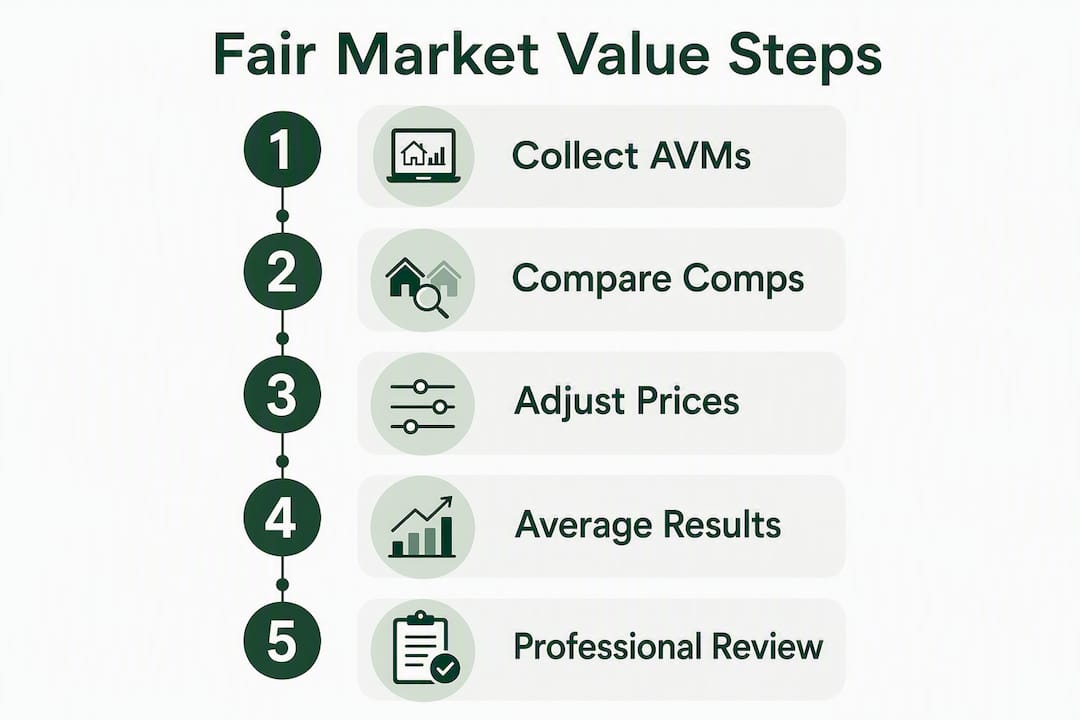
The sales comparison approach is the most widely accepted method for determining residential FMV, and you can run a simplified version yourself in under an hour. Here’s how.

Step 1: Find 3–5 recent comparable sales
Pull sold listings from Zillow, Redfin, or your county assessor’s website. Filter for:
Step 2: Adjust for differences
Raw comp prices need adjustment before you average them. Work through this checklist for each comp:
Step 3: Average your adjusted values
Once you’ve adjusted each comp up or down, average the results. That midpoint is your DIY FMV estimate. A moderate spread across your comps is normal; a wider spread usually means you need more similar sales or a professional eye.
Example: Three comps adjust to $415,000, $428,000, and $422,000. Your DIY range is roughly $415,000–$428,000, with a midpoint near $422,000.
Pro Tip: County public records often omit seller concessions, which can make a comp look $5,000–$15,000 higher than the true net price. Ask a local agent to pull the MLS history on your comps — the agent remarks field frequently shows concessions that never appear in public data.
| Comparative Market Analysis (CMA) | Licensed Appraisal | |
|---|---|---|
| Who produces it | Licensed real estate agent | State-licensed or certified appraiser |
| Typical cost | Free (agent seeks your listing) | — |
| Typical timeline | 1–3 days | 1–2 weeks |
| Primary use | Pricing a home for sale | Mortgage underwriting, refinance, legal/tax disputes |
| Defensibility | Not legally binding | Accepted by lenders, courts, and the IRS |

A CMA is the right call when you’re deciding whether to list and at what price. Agents pull recent MLS data, apply local knowledge, and deliver a pricing recommendation, usually at no charge because they’re competing for your listing. The limitation is that a CMA is an opinion, not a certified document.
A licensed appraisal is the gold standard when the number has to hold up under scrutiny. Lenders require one for most mortgages and refinances. The IRS requires a qualified appraisal for charitable deductions above certain thresholds. Estate attorneys and divorce courts rely on them because appraisers apply standardized methods and carry professional liability for their conclusions.
Questions to ask before you order either:
Watch for add-on costs: some appraisers charge extra for large properties, multi-unit homes, or distant locations. Inspections for structural or environmental issues are separate from the appraisal fee and can add significant costs.
AVMs and quick comp checks work well in active, homogeneous neighborhoods. They break down fast in several situations:
A practical decision rule: if two or more of these conditions apply to your property, skip the DIY estimate and go directly to a CMA or appraisal.
Timing adds another layer of risk. In a fast-moving market with active bidding wars, a FMV snapshot can go stale within days. In a rapidly cooling market, last month’s comps may already be optimistic. Market conditions can push sale prices above appraised values in heated markets, creating a gap that can derail a transaction. Re-verify your comps within a week of any listing or offer decision.
Your next step depends entirely on why you needed the number.
Immediate one-two action plan for most homeowners:
Understanding the factors that affect property value in your specific market will sharpen every estimate you get, whether from an algorithm or a professional.
The authoritative U.S. definition comes from the Legal Information Institute at Cornell Law School:
That definition, sourced from LII’s Wex legal dictionary, is the same standard the IRS applies across tax contexts, from charitable deductions to estate valuations.
Three values homeowners frequently mix up:
Conflating these three leads to real mistakes: pricing a home based on the tax assessment (usually too low), assuming an appraisal equals what a buyer will pay (not always), or using a Zestimate as a legal document (never appropriate).
For tax deductions over certain thresholds, IRS Publication 561 requires a qualified appraisal, not a CMA or an AVM printout. If your situation involves a charitable contribution of real property, an estate, or a legal dispute, confirm the current IRS threshold with a tax professional before proceeding.
This article provides general information, not legal or tax advice. Confirm current IRS rules and thresholds with a qualified tax professional or the IRS directly.
The most reliable path to your home’s fair market value combines a free AVM range, a DIY comp check, and a professional CMA or appraisal matched to your specific goal.
| Point | Details |
|---|---|
| Start with three AVMs | Run Zillow, Redfin, and Realtor.com on the same day; a tight cluster signals reliable data. |
| Verify with comps | Pull 3–5 sales from the past 90 days, adjust for differences, and average the results for a DIY range. |
| Match the tool to the goal | Use a free CMA for listing decisions; order a licensed appraisal for refinancing, tax, or legal needs. |
| Know when estimates fail | If multiple red flags apply (unique home, low inventory, recent renovation, concessions), go straight to a professional. |
| Yigal-realty | Yigal-realty offers personalized guidance for buyers and investors navigating property valuation in specialized residential markets. |
There’s a tendency to treat the Zestimate as the starting point and then argue with it. That’s the wrong frame. The Zestimate is one data point in a range, and its accuracy depends entirely on how much recent, similar sales data exists in your area. In active suburban markets with many comparable sales, it’s often close to what a buyer will actually pay. In a neighborhood with six sales in the past year, it’s essentially a guess dressed up in a confidence interval.
What actually works is the reverse sequence: start with the comps yourself, form your own range, and then check whether the AVM lands inside it. If it does, you have confirmation. If it doesn’t, you have a question worth asking an agent. That question is almost always more productive than accepting the algorithm’s number and working backward.
The other thing worth saying plainly: a free CMA from a good local agent is genuinely underused. Agents have MLS access, they know which comps had concessions, and they’ve walked through homes in your neighborhood recently. The CMA is free because they want your listing, but the data is real. Use it before you pay for an appraisal, unless you already know you need the appraisal for a lender or a legal proceeding.
Knowing your home’s fair market value is the first move. Acting on it accurately is where most homeowners need a professional in their corner.
Yigal-realty works with buyers and investors in residential markets where neighborhood-specific knowledge makes the difference between a well-priced decision and an expensive mistake. The team brings direct access to local market data, comparable sales analysis, and the kind of on-the-ground context that no algorithm captures. Whether you’re evaluating a purchase, planning a sale, or assessing an investment, Yigal-realty offers personalized guidance that goes well beyond what any online estimator can provide.
Ready to get a grounded read on what a property is actually worth? Connect with Yigal-realty for a direct conversation with a specialist who knows the market.