%20(4).png)
![[background image] image of cityscape background (for an architect firm)](https://cdn.prod.website-files.com/68961ade6feff9cbdffc080d/69384e066e0e9a310b6817f8_061f6bac-48bf-44b8-a689-078dacd8009f.avif)
TL;DR:
- Recording a deed with the county creates public notice and establishes property priority, but it does not guarantee clear title.
- Title search and title insurance are essential protections against hidden risks that public records cannot reveal.
Property registration in the United States means recording a signed, notarized deed with your county recorder or register of deeds, creating a public record that the property has changed hands. That single act establishes your legal priority over anyone who might later claim an interest in the same property. Here is what you need to do before you leave the closing table:
Sign the deed in the presence of a notary, using the exact legal names that will appear on title.
Get the required notarizations — every state has specific statutory language for the notary acknowledgment block; missing or incorrect wording is the most common reason clerks reject a deed.
Pay transfer taxes and recording fees at or before closing, either directly or through your closing agent.
File the deed with the correct county office (or confirm your closing agent or attorney will do it immediately after closing).
Verify the recording by obtaining the instrument number and checking the county’s online index.
One critical limit to understand upfront: recording creates public notice and establishes priority, but it does not guarantee a clean title. A forged deed can be recorded. An undisclosed lien can survive. Title search and title insurance are the separate protections that cover those risks.
Recording a deed does two concrete legal things. First, it creates constructive notice: once your deed is in the public index, the law treats every future buyer or lender as if they knew about your ownership, even if they never looked it up. Second, it establishes priority by timestamp: in a race-notice or race jurisdiction, the party who records first generally wins a competing claim. County-level rules govern the specifics; for example, the priority rules in Texas differ from those in New York.
What recording does not do is verify that the transaction was legitimate. County recorders perform an administrative review for format, notarization, and fees. They stamp the document with a recording date and instrument number, then move on. They do not check whether the grantor actually owned the property, whether signatures are genuine, or whether a prior lien was properly discharged. A forged deed can pass that review and sit in the public record as if it were valid.
This is why the U.S. recording system is fundamentally different from a state-guaranteed Torrens registration system, where a government authority vets title before issuing a certificate. In the U.S., private due diligence carries the weight that the public record does not. A recorded deed can still be challenged in court. That is exactly why title search and title insurance exist alongside recording rather than as replacements for it.
Pro Tip: Check your county recorder’s website before closing to see whether eRecording is available. Many buyers and even some closing agents default to mail or in-person submission without realizing eRecording can cut processing time from weeks to days.
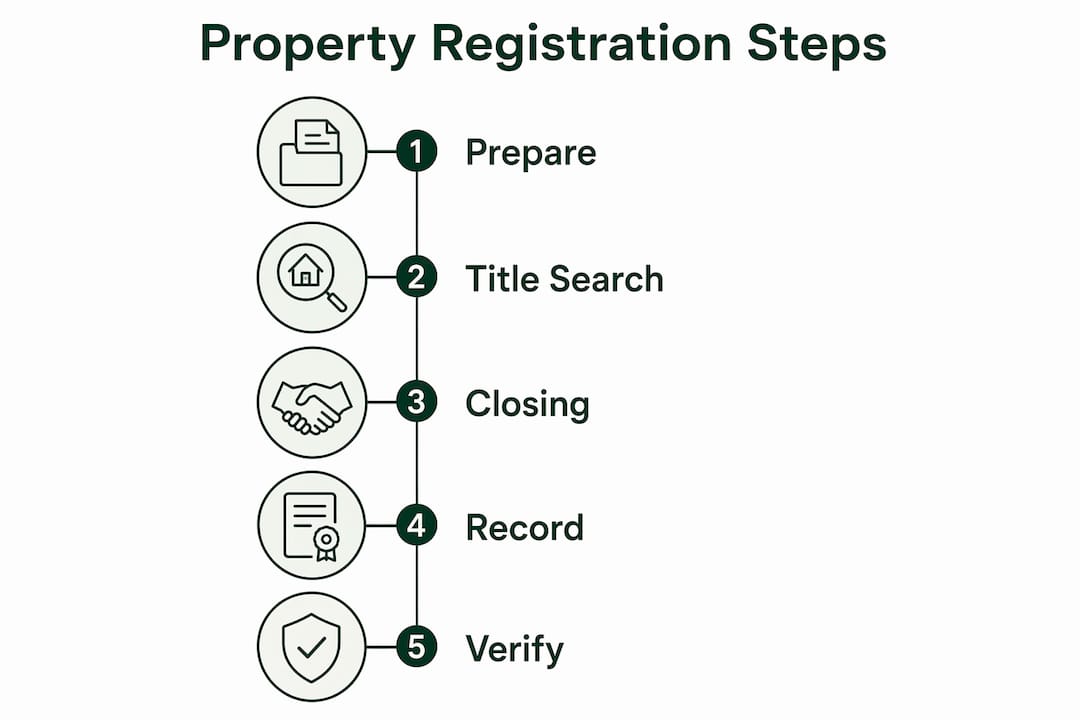
Offer accepted and due diligence opens. Once the purchase contract is signed, the buyer’s agent or attorney orders a title search. A licensed title examiner traces the chain of ownership through county deed books, mortgage records, judgment liens, and probate filings. Any clouds on title — unpaid liens, boundary disputes, missing heirs — must be resolved before closing.
Escrow or closing prep. The closing agent (an escrow officer, title company, or attorney depending on the state) drafts the deed using the correct legal description from the survey or prior deed. Both parties confirm the vesting language — how the buyer will hold title (sole owner, joint tenants, tenants in common). Existing mortgages are paid off, and payoff statements are confirmed in writing.
Closing day. The buyer and seller sign the deed and all closing documents. The notary witnesses the grantor’s signature and completes the acknowledgment block using state-required statutory language. Closing costs, including recording fees and transfer taxes, are collected. The buyer receives a copy of the signed deed.
Filing and recording. The closing agent submits the deed to the county recorder or register of deeds, either in person, by mail, or through an eRecording platform. The clerk reviews the document for formatting, correct notary wording, and payment. Once accepted, the clerk stamps the deed with the recording date, book and page number or instrument number, and returns a copy to the submitter.
Post-recording confirmation. The county images and indexes the deed in the public record. The original instrument is typically mailed back to the buyer or their attorney within days to weeks. The buyer should verify the entry in the county’s online index using the instrument number and keep the original deed and title insurance policy in a secure location.
Getting the paperwork right the first time matters. Clerks reject filings for missing items, and a rejection delays your priority date.
Core documents every county requires:
Supporting documents that may be required:
Common rejection reasons and fixes: Incorrect notary wording is the single most frequent rejection trigger. Notary acknowledgments must follow state-required statutory language; a missing seal or outdated block gets the deed sent back. Other frequent issues include wrong party names (a nickname instead of a legal name), an incomplete legal description, or a missing spousal signature. The fix is usually an affidavit of correction filed alongside a re-recorded corrected deed, though serious defects may require an attorney.

Costs fall into four buckets, and the proportions often surprise first-time buyers.
| Fee Type | Typical U.S. Range | Who Pays |
|---|---|---|
| County recording fee | Typically a modest fee per instrument or per page | Buyer (usually) |
| State/local transfer tax | Varies widely by state and locality | Seller or buyer (varies) |
| Notary fee | Usually a small fee per signature | Buyer or seller |
| Escrow/closing agent fee | Often several hundred to a few thousand dollars | Split or negotiated |
| Owner’s title insurance premium | Varies widely based on purchase price | Buyer (usually) |
| Lender’s title insurance premium | Varies widely depending on loan terms | Buyer |
Recording fees are typically modest — often a small flat fee or a per-page charge — while transfer taxes and title insurance are the larger line items. Transfer taxes alone can range from zero (some states have none) to 2% or more of the purchase price in high-tax jurisdictions like New York or Maryland.
Example for a $350,000 residential purchase (illustrative ranges):
Total closing-related costs beyond the purchase price vary significantly, largely depending on the transfer tax rate and title insurance premium in your state.
Pro Tip: Request an itemized Loan Estimate or Closing Disclosure from your lender and closing agent at least three business days before closing. Federal law requires lenders to provide this document; use it to spot unexpected fees before you’re at the table.
Recording and title assurance are related but entirely separate. Recording puts your deed in the public record. A title search reads that record to find problems. Title insurance pays if a problem surfaces later that the search missed.
A title examiner traces the chain of ownership backward through the county’s deed index, checking for gaps, liens, judgments, unpaid taxes, and probate claims. The challenge is that many U.S. counties index records by grantor/grantee name and chronology rather than by parcel number. That makes reconstructing a clean chain of title a specialty skill. Title insurers often maintain private title plants — proprietary databases that aggregate county records — which can dramatically shorten examination time compared with searching raw public records.
Your lender will almost certainly require a lender’s title insurance policy as a condition of the mortgage. That policy protects the bank, not you. An owner’s title insurance policy is separate and protects your equity for as long as you or your heirs hold an interest in the property. It is a one-time premium paid at closing. Title insurance provides defense and indemnity coverage against hidden risks — forged prior deeds, undisclosed heirs, clerical errors in the public record — that even a thorough title search can miss.
The American Land Title Association (ALTA) sets the industry standards for title insurance policies in the United States. ALTA owner’s and lender’s policies define the coverage terms, exclusions, and endorsements that title companies like First American Title, Fidelity National Title (part of Fidelity National Financial), and Old Republic National Title Insurance Group use as the baseline for their policies. When you receive a preliminary title report, it will reference ALTA standards and list specific exceptions to coverage — review those exceptions carefully before closing.
The practical rule: always insist on an owner’s policy. The lender’s policy alone leaves your equity exposed.
Deeds in the United States are filed at the county recorder or register of deeds for the county where the property is physically located — not where the buyer or seller lives. If you are buying a home in Cook County, Illinois, you file in Cook County regardless of where you are moving from.

To find the right office, search “[county name] recorder of deeds” or “[county name] register of deeds” on your state’s official government portal. Most county websites list office hours, required forms, fee schedules, and whether eRecording is accepted.
Submission options:
What to bring for in-person filing:
| Stage | Typical Duration | Common Delay Triggers |
|---|---|---|
| Title search and clearing | 3 days | Unresolved liens, missing heirs, complex chain of title |
| Closing scheduling | 1–3 weeks after clear title | Lender delays, appraisal issues, scheduling conflicts |
| Closing day | 1–3 hours | Missing signatures, last-minute payoff issues |
| Recording (in-person or eRecording) | Same day to 3 business days | County backlog, formatting errors |
| Recording (mail submission) | 1–3 weeks | Transit time, county processing queue |
| Return of original instrument | 1–4 weeks after recording | County imaging and mailing schedule |
The title search phase is where most deals slow down. An undischarged mortgage from a prior owner, a judgment lien against the seller, or a gap in the chain of title can add days or weeks while the title company works to clear the defect. Once title is clear and the lender is ready, closing itself is fast. Recording, if done via eRecording, is often confirmed within 24–72 hours.
To confirm completion, ask your closing agent for the instrument number assigned at recording. You can then search the county’s online index directly to verify the entry, the recording date, and the book/page reference.
Clerical errors before filing:
Fraud and title risks:
Prevention:
If you find an error after recording: File an affidavit of correction with the county recorder, or re-execute and re-record a corrected deed. Serious defects — a forged signature, a competing claim — may require a title insurance claim or litigation. Call a title professional or real estate attorney immediately; do not wait.
Before closing:
At closing:
After closing:
Pro Tip: Ask your closing agent to confirm the instrument number or pull up the county index on a laptop before the closing meeting ends. Thirty seconds of verification at the table beats weeks of uncertainty afterward.
Recording a deed with the county recorder creates public notice and priority, but a professional title search and an owner’s title insurance policy are the only protections against hidden defects the public record cannot reveal.
| Point | Details |
|---|---|
| Recording creates notice, not guarantee | A recorded deed establishes priority and public notice but does not prove the title is free of defects or fraud. |
| Notarization wording is critical | Missing or incorrect statutory notary language is the most common reason county clerks reject a deed at filing. |
| Owner’s title insurance is separate | An owner’s policy covers risks the title search missed; the lender’s policy protects only the bank, not your equity. |
| Verify recording by instrument number | Ask for the instrument number at closing and confirm the entry in the county’s online index before assuming the deed is recorded. |
| Yigal-realty guides buyers through the process | Yigal-realty provides transaction guidance and documentation support for buyers navigating property purchase and registration steps. |
Most buyers spend weeks negotiating price and days reviewing inspection reports, then spend about four minutes on the deed itself. That is backwards. The deed is the document that actually transfers ownership, and the notary acknowledgment block buried at the bottom is the part that gets filings rejected.
Here is what I’d tell any buyer before they sit down at the closing table: read the legal description on the deed out loud and compare it to the one in your purchase contract. They should match exactly. If they don’t, stop the closing. A transposed lot number or a missing subdivision reference is not a minor clerical issue — it can mean the deed describes the wrong parcel.
Ask your closing agent two direct questions: “Are you eRecording this deed today?” and “Can you give me the instrument number before I leave?” If the answer to the first is no, ask why. If the answer to the second is that they will send it later, get a specific timeline in writing. The moment the deed is recorded, you have a timestamped public record of your ownership. Until then, you have a signed piece of paper.
The other thing buyers consistently skip is the preliminary title report. It arrives a week or two before closing, runs several pages, and lists every exception to coverage — meaning every risk the title insurer will not cover. Most buyers sign the acknowledgment without reading it. Those exceptions are the fine print that matters. An easement you didn’t know about, a restriction on use, a prior deed of trust that wasn’t properly released — they’re all in there.
Yigal-realty’s documentation guidance and transaction resources are built around exactly this kind of pre-closing review. Getting the details right before closing is always cheaper than fixing them after.
Navigating the recording process, title search, and closing documentation on your own is manageable — but the buyers who avoid costly mistakes are almost always the ones who had experienced guidance at each step. Yigal-realty offers hands-on transaction support for buyers who want clarity on documentation requirements, fee structures, and the sequence of steps from signed contract to recorded deed.
Whether you are purchasing your first home or adding to an investment portfolio, the team at Yigal-realty walks you through what to prepare, what to verify, and what questions to ask your closing agent before you sign anything. That kind of specific, deal-level guidance is what separates a smooth closing from one that stalls over a correctable error.
These are the authoritative resources to consult when you need county-specific rules, ALTA policy standards, or deed formatting guidance:
This article is general information about U.S. property recording procedures, not legal or financial advice. Confirm current rules, fees, and requirements with your county recorder’s office, a licensed title professional, or a qualified real estate attorney for your specific transaction.