%20(4).png)
![[background image] image of cityscape background (for an architect firm)](https://cdn.prod.website-files.com/68961ade6feff9cbdffc080d/69384e066e0e9a310b6817f8_061f6bac-48bf-44b8-a689-078dacd8009f.avif)
TL;DR:
- Dual agency occurs when one agent or brokerage represents both the buyer and the seller, eliminating exclusive advocacy. It often leads to conflicts that prevent agents from sharing confidential negotiation strategies, risking buyers’ and sellers’ financial outcomes. Most states permit dual agency with disclosure, but it can significantly impact your ability to get the best deal.
Dual agency means one agent, or one brokerage, represents both the buyer and the seller in the same real estate transaction. The moment that happens, you lose exclusive advocacy. Your agent cannot tell you the seller’s bottom line, cannot push hard for your best price, and cannot give you the confidential strategic advice a dedicated agent would. A Zillow analysis found home sellers lost a combined $1.49 billion over three years in same-agent dual agency transactions.
Before you read further, here is what you need to know:
Dual agency, in its simplest form, is a situation where one real estate agent personally represents both the buyer and the seller in the same deal. It sounds efficient. In practice, it creates a structural conflict that limits what the agent can legally do for either party.
The NAR consumer guide on agency relationships makes clear that consumers can request their own buyer’s agent at any time. Most buyers and sellers don’t realize that, which is why dual agency persists.
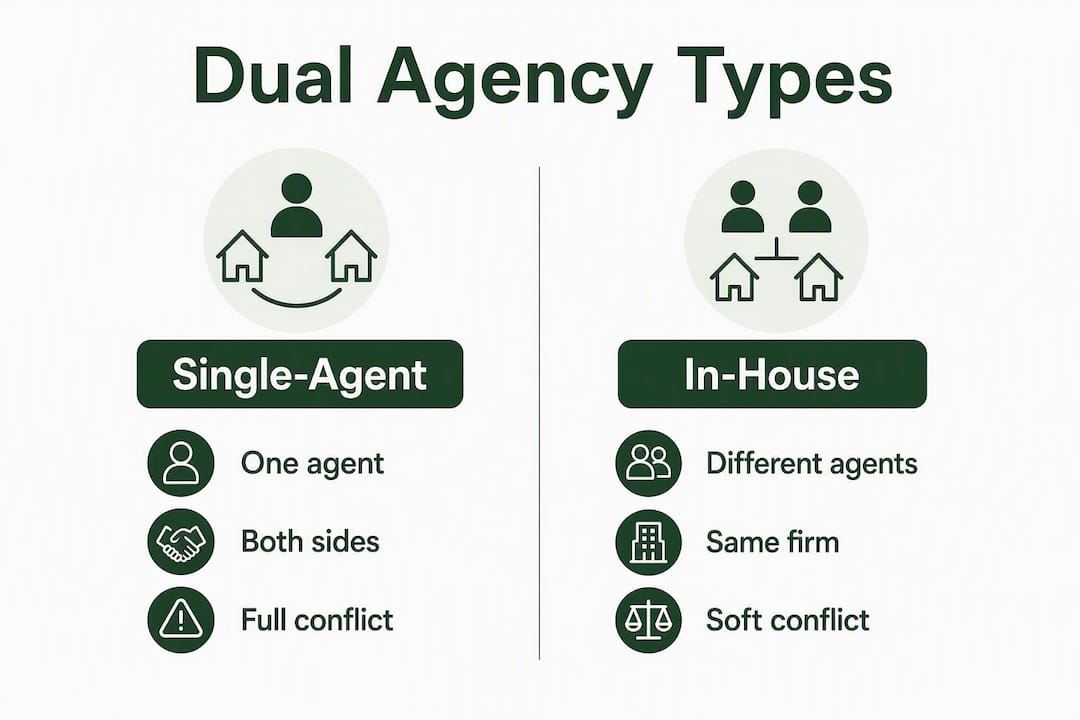
Single-agent dual agency is the most direct version: one licensed agent personally represents both sides. This agent knows the seller’s minimum acceptable price and the buyer’s maximum budget. They cannot share either piece of information with the other party.

In-house or brokerage-level dual agency occurs when two different agents at the same firm represent the buyer and seller separately. Legally, the brokerage itself is the dual agent even though the clients have different agents. The firm’s managing broker has access to both files.
Designated agency (also called appointed agency) is a variation some states allow to soften the conflict. The brokerage assigns one agent specifically to the buyer and a different agent specifically to the seller, with a firewall between them. It still raises concerns because both agents work for the same broker, who ultimately supervises both sides.
Transaction broker or facilitator is a distinct model used in states that restrict or ban dual agency. The broker assists both parties but is not a fiduciary to either one. They handle paperwork and logistics without advocating for anyone’s price or terms.
| Arrangement | Who the agent/firm represents | Fiduciary duties owed | State legal status | Compensation |
|---|---|---|---|---|
| Single-agent dual agency | Both buyer and seller (one agent) | Neutral; no undivided loyalty to either party | Legal with written consent in most states; banned in a few | One agent collects full or split commission |
| Brokerage dual agency | Both buyer and seller (different agents, same firm) | Firm owes limited duties to both | Legal with written consent in most states | Commission stays within the brokerage |
| Designated agency | Buyer and seller each have a dedicated agent from same brokerage | Agents advocate for their assigned client; broker remains neutral | Permitted in many states as a partial safeguard | Commission split within the brokerage |
| Transaction broker / facilitator | Neither party (neutral facilitation only) | No fiduciary duty; limited to honest dealing | Required in some states (e.g., Colorado) instead of dual agency | Flat or negotiated fee; no advocacy obligation |
Dual agency rarely starts with a formal announcement. It usually creeps in through one of three common situations.
The open house scenario. You walk into an open house, love the property, and start asking the listing agent questions. That agent is already under contract to represent the seller. If you decide to make an offer and don’t have your own agent, the listing agent becomes your agent too. You’ve entered dual agency without signing a single document yet.
The buyer who skips representation. Some buyers, especially in competitive markets, contact the listing agent directly to avoid what they think is a slower process. The listing agent is happy to help. What the buyer doesn’t realize is that the agent’s primary obligation was always to the seller.
The in-house sale. You call a brokerage to ask about a listing. The agent who answers works at the same firm that listed the property. Even if that agent seems to be working for you, the brokerage is now representing both sides. This is brokerage-level dual agency and it is far more common than most buyers expect.
Once dual agency is established, the process typically looks like this:
On commission: in a standard transaction, the seller pays a total commission that is split between the listing agent and the buyer’s agent. In dual agency, one agent or one brokerage collects both sides of that commission. That financial incentive to close the deal, rather than to maximize price or push for repairs, is the core behavioral problem.
The conflict is not hypothetical. An agent cannot fully advocate for both parties simultaneously. That is not a matter of effort or ethics. It is a structural impossibility. Telling the buyer the seller will accept $20,000 less is a breach of duty to the seller. Telling the seller the buyer will go $30,000 higher is a breach of duty to the buyer. The dual agent’s only legal option is silence on both counts.
What you lose in practice is the confidential pricing guidance that makes negotiation work. Without knowing the seller’s floor, a buyer cannot make a strategic low offer. Without knowing the buyer’s ceiling, a seller cannot hold out for a better number. The NY DOS legal memorandum LI12 states this directly: clients who consent to dual agency give up their agent’s undivided loyalty.
“Clients who consent to dual agency are giving up their right to undivided loyalty and should be cautious before doing so.” — NY Department of State, Legal Memorandum LI12
The financial consequences are documented. Zillow’s analysis attributed significant seller losses to same-agent dual agency over a recent multi-year period. Sellers tend to accept lower offers faster, and buyers tend to skip repair requests or contingency pushes because the agent has no incentive to fight for either outcome.
Pro Tip: If you find yourself already in a dual agency situation before you realized it, you can still protect yourself. Put every negotiating position in writing directly to the agent. Request that the agent confirm in writing what they can and cannot share. And consult a real estate attorney before you sign anything binding.
The short answer: it depends on your state. Most states permit dual agency with written disclosure and consent. A few ban it outright or replace it with a transaction-broker model.
“The written consent form for dual agency is legal protection for the agent, not a resolution of the conflict of interest for the consumer.” — Dual Agency State Laws Buyer Guide
The state-by-state variation is significant. Colorado, for example, prohibits dual agency and requires all brokers to operate as transaction brokers unless a single-party representation is explicitly requested. Florida defaults to transaction broker status. New York permits dual agency with written consent but its Department of State has published explicit warnings about the risks.
| State | Dual agency status | Key requirement |
|---|---|---|
| Colorado | Banned | Transaction broker model required by default |
| Florida | Restricted | Default is transaction broker; single agency requires opt-in |
| New York | Permitted | Written informed consent required; NY DOS memo warns of risks |
| California | Permitted | Written disclosure and consent required before offer |
| Texas | Restricted | Intermediary model used; agent must get written consent from both parties |
| North Carolina | Permitted | Written disclosure required; NCREC guidance addresses when dual agency is appropriate |
Timing matters. In many states, disclosure must happen before an offer is made, not after. If an agent hands you a dual agency consent form at the closing table, that is a red flag, not a formality.
The NY DOS memorandum LI12 is one of the clearest official statements on what consumers actually give up. It is worth reading before you sign any consent form in New York or using as a reference point for understanding what similar forms mean in other states.
One more thing worth knowing: signing a consent form does not fix the conflict. As the state laws buyer guide notes, the form protects the agent legally. Your interests remain unprotected.
Rarely. But there are situations where experienced buyers or sellers sometimes accept it, and where the risks are lower than average.
Even in these cases, the pros and cons are real:
Potential advantages: faster communication through one point of contact, slightly simplified logistics, and in some cases a seller willing to negotiate commission savings.
Concrete disadvantages: no confidential pricing advice, no aggressive negotiation on repairs or contingencies, and an agent whose financial incentive is to close the deal rather than to optimize your outcome.
If you do accept dual agency, demand these safeguards in writing:
The most reliable protection is also the simplest: hire your own agent before you start looking. An independent buyer’s agent owes you undivided loyalty, can share the seller’s negotiating signals, and has no financial reason to push you toward a faster close at a lower price.
Other alternatives worth knowing:
Ask these before you sign a buyer representation agreement or a dual agency consent form:
Pro Tip: Ask question 2 at the very first meeting, before you tour any property the agent’s firm has listed. Once you’ve toured and expressed interest, the dual agency dynamic is already forming.
If you discover dual agency mid-transaction, understanding your buyer representation rights is the first step. Then: insist on single-agency in writing, get independent legal counsel, and document every communication from that point forward.
In a standard transaction, the seller pays a total commission that is split between two agents representing opposite sides. In dual agency, one agent or one brokerage collects both sides of that commission.

Here is why that matters behaviorally. Suppose the total commission is 5% on a $500,000 home. In a standard deal, the listing agent gets roughly half and the buyer’s agent gets the other half. In dual agency, one agent or firm collects the full amount by closing the deal. The financial incentive now points directly at closing, not at maximizing the seller’s price or securing the buyer’s best terms.
Zillow’s analysis makes this concrete: the documented $1.49 billion in seller losses over three years tracks directly to this incentive misalignment. An agent paid to close has less reason to push back on a low offer, fight for repair credits, or hold out for better contingency terms.
Questions to ask about commission in any dual agency situation:
Some high-end brokerages proactively prohibit dual agency within their own policies to avoid liability. That internal policy is a practical signal of a firm’s consumer-protection posture, and it’s worth asking about before you sign a representation agreement.
Dual agency is a structural conflict that limits your agent’s ability to advocate for you, and the financial consequences for sellers are documented in the billions.
| Point | Details |
|---|---|
| Dual agency definition | One agent or brokerage represents both buyer and seller, eliminating undivided loyalty for either party. |
| Financial risk is documented | A Zillow analysis found that home sellers lost a combined $1.49 billion over three years in same-agent dual agency transactions. |
| Consent forms don’t fix the conflict | Written consent discloses the conflict legally but does not restore the agent’s duty to advocate for you. |
| State rules vary significantly | Colorado bans dual agency; New York permits it with written consent but the NY DOS warns of the risks explicitly. |
| Your best protection | Hire an independent buyer’s agent before touring any property listed by the same brokerage. |
Most articles on dual agency treat it as a disclosure problem. Sign the form, understand the conflict, move on. That framing misses the real issue.
The problem isn’t that buyers and sellers lack information. It’s that the incentive structure of a dual agency deal is designed around closing, not around your outcome. An agent who collects both sides of a commission by getting a deal done has a fundamentally different job than an agent who gets paid only when you get the best possible result. No disclosure form changes that math.
What I’ve seen in practice is that the buyers and sellers who fare worst in dual agency situations are not the ones who didn’t read the form. They’re the ones who assumed the agent’s professionalism would override the financial incentive. It usually doesn’t, not because agents are dishonest, but because the structure makes full advocacy impossible.
Yigal-realty’s approach to representation is built on transparency from the first conversation. Clients know exactly who their agent represents, what information can and cannot be shared, and what alternatives exist before any form is signed. That clarity isn’t a legal formality. It’s the foundation of a transaction where you can actually trust the advice you’re getting.
If you’re buying or selling and want to understand what exclusive representation looks like in practice, the Yigal-realty blog covers agency, buyer rights, and market guidance in plain language.
Before you sign any agency disclosure or consent form, verify the rules in your state. Here is where to look:
To look up your state’s specific rules: go to your state real estate commission’s website, search for “agency disclosure” or “dual agency,” and download the official consumer disclosure form. That form will tell you exactly what your agent is required to tell you and when.
This article is general information, not legal or professional advice. Verify current rules with your state real estate commission or a qualified real estate attorney before making decisions about representation in your transaction.