%20(4).png)
![[background image] image of cityscape background (for an architect firm)](https://cdn.prod.website-files.com/68961ade6feff9cbdffc080d/69384e066e0e9a310b6817f8_061f6bac-48bf-44b8-a689-078dacd8009f.avif)
TL;DR:
- In U.S. home transactions, the agent’s role depends on their specific agency relationship, ranging from full representation to limited facilitation. Clear, written agreements and understanding fiduciary duties protect buyers and sellers, especially after recent changes requiring upfront disclosures. Effective agents manage deadlines, negotiations, and coordination, while legal issues should be handled by a qualified attorney.
In a U.S. home sale, the role of agents in transactions comes down to one question: whose side are they on? A buyer’s agent represents the buyer, a listing (seller’s) agent represents the seller, and a dual agent or transaction broker sits in the middle with limited or no advocacy for either party. That distinction shapes every negotiation, every disclosure, and every deadline from the first showing to the closing table.
Fiduciary duties attach only when a formal agency relationship exists. State law and NAR guidance define which duties apply, how they are created, and what happens when one agent tries to serve both sides.
At a glance:
Six distinct agent roles appear in U.S. residential transactions, and confusing them is one of the most common mistakes buyers and sellers make.

Buyer’s agent. Represents the buyer exclusively. Owes full fiduciary duties to the buyer and typically enters the picture when a buyer begins searching for homes.
Listing (seller’s) agent. Represents the seller exclusively. Signs a listing agreement with the seller before the property hits the market and stays involved through closing.
Dual agent. One agent (or one brokerage) represents both buyer and seller in the same transaction. Where permitted, it requires written disclosure and informed consent from both parties. Full advocacy for either side becomes impossible.
Transaction broker (or facilitator). Assists both parties without representing either as a client. Colorado and Florida have long used this model. The transaction broker coordinates paperwork and deadlines but does not negotiate on anyone’s behalf.
Subagent. An agent who works with a buyer but legally represents the seller through a cooperative arrangement with the listing broker. Subagency is rare today but still appears in some markets, most often when a buyer tours a home at an open house without their own agent.
Designated agency. Two agents within the same brokerage are each assigned to one party. Each agent owes full fiduciary duties to their assigned client, even though both work for the same firm. This is a common solution in larger brokerages.
State law determines which of these models are permitted. A few states restrict or prohibit dual agency entirely. Always confirm the rules in your state before signing any representation agreement.
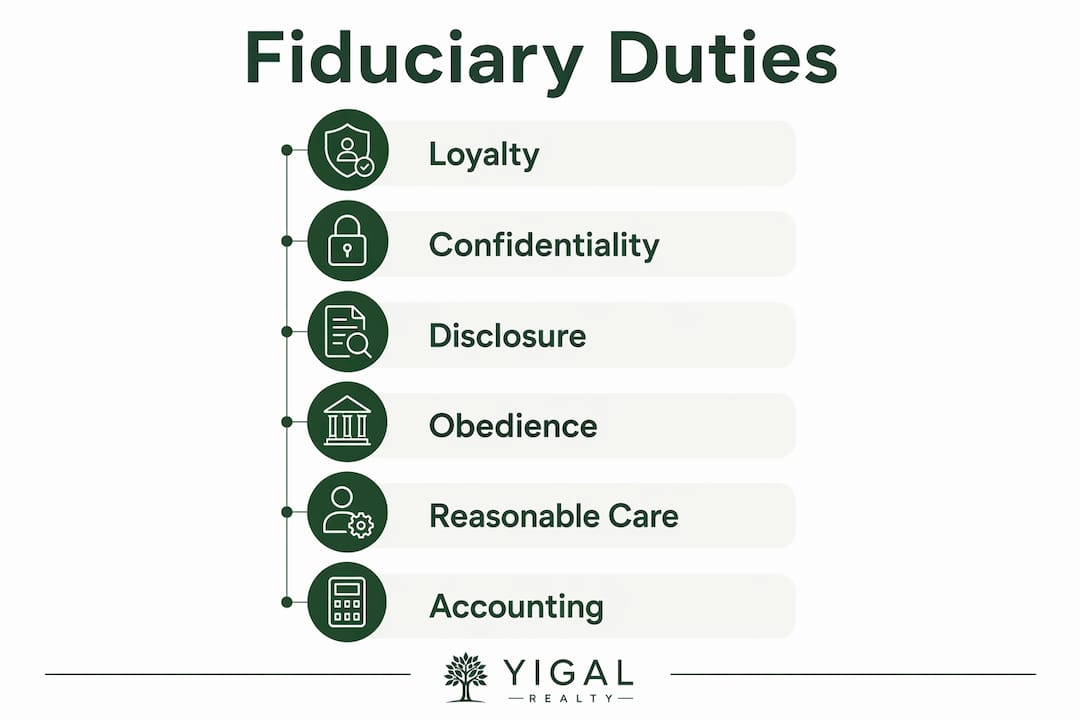
When an agency relationship is established, an agent owes six fiduciary duties to the client. These are not suggestions. They are enforceable legal obligations.
| Duty | What it means in practice |
|---|---|
| Loyalty | The agent puts your interests above their own — no side deals, no steering you toward a listing that earns them a higher commission. |
| Obedience | The agent follows your lawful instructions, even if they personally disagree with your decision. |
| Disclosure | The agent tells you every material fact that could affect your decision, including the seller’s urgency to sell or a buyer’s willingness to pay more. |
| Confidentiality | Your walkaway price, financial limits, and personal motivations stay private — during and after the transaction. |
| Accounting | Earnest money, deposits, and documents are handled properly and accounted for at every step. |
| Reasonable care | The agent performs competently, meets deadlines, and applies professional knowledge to protect your position. |
The American Bar Association describes the disclosure duty as the most critical: a broker “owes a fiduciary duty (1) to use reasonable care, skill, and diligence in procuring the greatest advantage to his client, and (2) to act honestly and in good faith, making full disclosures to his client of all material facts affecting his interest.”
The client vs. customer distinction matters enormously. A client has an agency relationship and receives all six fiduciary duties. A customer receives honest treatment but no fiduciary protections. If you have not signed a representation agreement, you may be a customer — not a client — even if an agent has been showing you homes.
The NAR Code of Ethics reinforces these duties for REALTORS®, requiring them to put client interests above their own and prohibiting steering buyers toward or away from properties for financial gain. Following the 2024 settlement affecting broker commissions, written buyer agreements are now standard practice before touring homes, making the client relationship formal from the start.
A buyer’s agent’s job starts before you ever walk into a house and runs through the day you get the keys. Here is what good service looks like at each stage.
Questions to ask a prospective buyer’s agent:
Pro Tip: Ask about the written buyer agreement and the agent’s compensation policy before you tour a single home. Since the 2024 settlement, many agents require this agreement upfront. Knowing the terms before you fall in love with a property puts you in a far stronger position.
The listing agent’s job is to get the seller the best possible price and terms, with the fewest complications.

Pre-listing. The agent runs a comparative market analysis (CMA) to recommend a list price, advises on staging and repairs, and builds a marketing plan that includes professional photography, MLS entry, and digital promotion.
Active listing. Once live, the agent coordinates showings, hosts open houses, and fields inquiries. They also set the cooperative compensation terms in the MLS listing, which affects how buyer’s agents engage with the property.
Offer evaluation. When offers arrive, the listing agent assesses each buyer’s financing strength, contingencies, and proposed timeline. They advise the seller on which offer is strongest overall, not just highest in price. Protecting the seller’s confidential motivations — urgency, minimum acceptable price — is a core duty throughout.
Negotiation. The agent recommends counteroffers, escalation strategies, and when to hold firm. They present all offers promptly; withholding or delaying an offer is a breach of fiduciary duty.
Closing coordination. The agent works with the title company, escrow officer, and the buyer’s agent to clear title issues, confirm settlement instructions, and meet every deadline. Listing agreements typically include a carryover (or “tail”) period, meaning the agent may still earn a commission if a buyer introduced during the listing period purchases the property shortly after the agreement expires.
A CMA is not just a number — it’s a negotiating foundation. A well-prepared CMA shows comparable sales, active competition, and days-on-market trends. Sellers who understand their CMA negotiate from a position of knowledge, not hope.
Pro Tip: Before signing a listing agreement, request a written marketing plan and a CMA with at least three recent comparable sales. An agent who cannot produce both within 48 hours is telling you something about how they will manage your transaction.
Agency is created by agreement, either express (a signed contract) or implied (conduct that suggests representation). In practice, the two most common written agreements are the listing agreement for sellers and the buyer representation agreement for buyers.
Since the 2024 settlement, written buyer agreements before showings have become standard across most markets. That shift matters: it moves the client relationship from implied to express, which clarifies duties and compensation from day one.
What to confirm in any written agreement:
| Agency model | Who they represent | Advocacy level | Disclosure/consent required |
|---|---|---|---|
| Single agency (buyer’s agent) | Buyer only | Full | Standard agency disclosure |
| Single agency (listing agent) | Seller only | Full | Standard agency disclosure |
| Dual agency | Both parties | Limited/neutral | Written consent from both parties |
| Designated agency | Each agent represents one party | Full per agent | Disclosure of brokerage relationship |
| Transaction broker | Neither party | None | State-specific disclosure |
State rules vary significantly. Some states require specific disclosure forms at first contact; others mandate them before an offer is signed. Check your state real estate commission’s website for the forms and timing that apply to you.
Historically, sellers paid a combined commission of 5%–6% of the sale price, split between the listing broker and the buyer’s broker through a cooperative offer in the MLS. On a $400,000 home at 5%, that totals $20,000.
The 2024 settlement changed how that split is communicated and negotiated. Sellers no longer advertise buyer-agent compensation in the MLS the same way. Buyers must now confirm compensation terms directly with their agent in a written agreement before touring homes. In practice, sellers may still offer to cover the buyer’s agent fee as a negotiating point, but it is no longer automatic.
| Commission component | Typical range | Key variables |
|---|---|---|
| Combined listing + buyer-side | 5%–6% of sale price | Market, price band, services included |
| Listing agent portion | Negotiable | Brokerage policy, competition |
| Buyer’s agent portion | Negotiable | Buyer agreement terms, seller concession |
Commissions are always negotiable. In competitive markets or high-price-band transactions, rates often run lower. In slower markets or for full-service packages, they may hold closer to the top of the range.
Pro Tip: Always get compensation terms in writing before you start working with any agent. Ask your buyer’s agent directly: “Do you expect any fee from me directly, and under what circumstances?” A clear answer up front prevents surprises at closing.
Dual agency limits advocacy: when one agent or brokerage represents both sides, neither party receives full negotiation support. The agent cannot tell the buyer the seller will accept less, and cannot tell the seller the buyer will pay more. Some states ban dual agency outright.
“Steering” is a separate but related problem. The NAR Code of Ethics prohibits REALTORS® from directing buyers toward or away from properties based on financial incentives rather than client needs. Steering is reportable to the local REALTOR® association and to state regulators.
Steps to protect yourself:
Red flags to watch for:
Agents are skilled advocates and transaction managers. They are not lawyers, and they cannot practice law, draft bespoke legal clauses, or give legal advice on contract interpretation.
Hire a real estate attorney when:
The division of labor is practical: the agent handles advocacy, marketing, and coordination; the attorney handles legal review, title work, and contract drafting. In most residential transactions, both are working in parallel, not in competition.
Pro Tip: Ask your agent for attorney referrals at the start of the transaction, not after a problem surfaces. Engaging counsel before you sign anything complex is far cheaper than untangling a legal issue after the fact.
In a U.S. home transaction, your agent’s role and duties depend entirely on which type of agency relationship you have established in writing.
| Point | Details |
|---|---|
| Confirm who represents you | Ask for written agency disclosure at the first meeting; client status gives you six fiduciary protections, customer status does not. |
| Get everything in writing | Buyer agreements, listing agreements, and compensation terms must be documented before work begins, especially after the 2024 settlement changes. |
| Track your deadlines | Missing a contingency deadline can forfeit your earnest money; your agent should calendar every date and alert you well in advance. |
| Know when to call an attorney | Title disputes, unusual contract clauses, and state-required closings need legal counsel, not just an agent. |
| Yigal-realty’s approach | Yigal-realty provides transparent, guided representation for buyers and investors, with clear written agreements and dedicated project guidance from search through closing. |
The part of this job most clients never see is deadline management. A typical transaction has a dozen contractual dates: inspection period, financing contingency, appraisal deadline, title commitment, final walk-through, and closing. Miss one, and the consequences range from a renegotiated contract to a forfeited deposit. Good agents build a transaction timeline on day one and send reminders before every deadline, not after.
The misunderstanding I see most often is buyers assuming the agent at an open house represents them. That agent works for the seller. Anything you say about your budget, your urgency, or your flexibility goes directly to the other side. The moment you walk into an open house without your own representation, you are a customer, not a client.
Questions that reveal whether an agent actually knows their job:
An agent who answers those questions with specifics, not generalities, is worth your time.
Short of consulting a local attorney or your state real estate commission, these are the most authoritative places to verify what applies in your market.
| Source type | Organization | Best used for |
|---|---|---|
| Industry ethics and consumer guides | National Association of REALTORS® (NAR) | Fiduciary duties, buyer agreements, steering rules, Code of Ethics |
| State licensing and regulatory rules | Your state real estate commission | Permitted agency models, required disclosure forms, complaint filing |
| Legal primer on broker duties | American Bar Association | Detailed fiduciary duty analysis, attorney-broker division of labor |
| Federal and state agency law | — | Agency creation, special agency, compensation law |
For state-specific rules, search “[your state] real estate commission agency disclosure” to find the official forms and timing requirements. For shared-ownership arrangements, understanding how buyer protections interact with ownership structures adds another layer of due diligence worth reviewing before you sign.
This article is general information, not legal advice. Confirm current rules with your state real estate commission or a licensed real estate attorney for your specific situation.
Knowing what agents are supposed to do is one thing. Having an agent who actually does it is another. Yigal-realty works with buyers and investors who want clear, written agreements from day one, a dedicated agent who tracks every deadline, and honest guidance on pricing, disclosures, and negotiation, without the vague answers or pressure tactics that show up as red flags in this article.
Whether you are purchasing a first home, relocating, or investing in a new development, Yigal-realty’s team brings the same stage-by-stage discipline described here: needs assessment, offer strategy, inspection coordination, and closing support. Explore current projects and connect with a Yigal-realty agent to get started with a written representation agreement and a clear picture of what your transaction will look like from search to keys.