%20(4).png)
![[background image] image of cityscape background (for an architect firm)](https://cdn.prod.website-files.com/68961ade6feff9cbdffc080d/69384e066e0e9a310b6817f8_061f6bac-48bf-44b8-a689-078dacd8009f.avif)
TL;DR:
- Israel’s communities vary from collective kibbutzim to urban secular neighborhoods, each with unique social and ownership structures. Families should prioritize local schools and community character, visiting regularly to understand daily life before deciding. Ethnic and religious diversity deeply shapes neighborhood options, influencing lifestyle, services, and community values.
Israel organizes its residential communities into distinct legal and social categories, each with its own ownership model, lifestyle expectations, and demographic character. The types of Israeli communities range from collective kibbutzim and cooperative moshavim to Haredi urban enclaves and secular city neighborhoods, giving families a genuinely wide spectrum of choices. Understanding these categories before you search for property saves you from mismatched expectations and costly mistakes. This guide breaks down every major community type, compares their defining features, and helps you identify which model fits your family’s priorities.
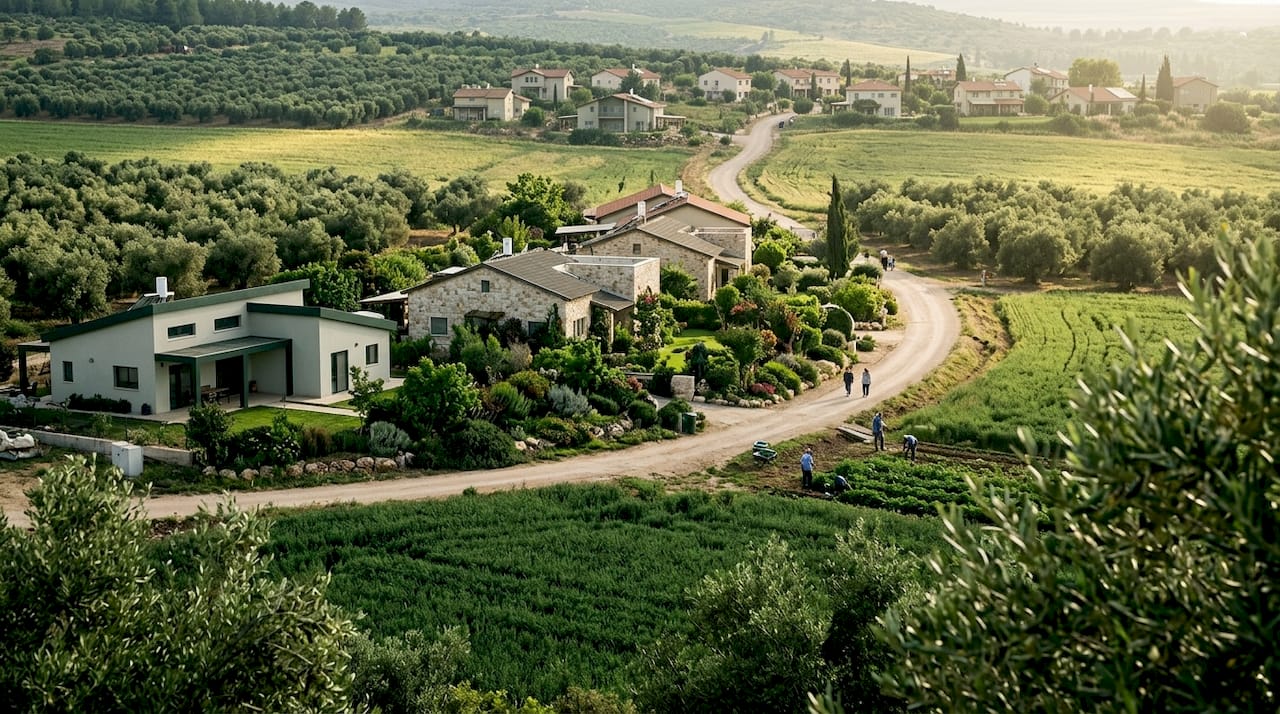
The kibbutz is Israel’s most iconic community structure, founded on principles of collective ownership and shared labor. As of early 2026, roughly 259 kibbutz communities operate across Israel, making the movement one of the most enduring cooperative experiments in modern history. That scale matters because it means you have real geographic variety, from kibbutzim in the Galilee to those in the Negev desert.
Post-1990s privatization transformed most kibbutzim from ideological socialist communes into hybrid models where members earn individual incomes and manage their own household budgets. Some collective business ownership remains, particularly in agriculture and industry, but the days of a single communal dining hall covering all expenses are largely gone. This shift makes kibbutz life far more accessible to families who want community warmth without surrendering financial independence.
The social bonds inside a kibbutz remain its strongest asset. Kibbutzim sustain themselves through family-like ties and shared experience, which proved critical during periods of national crisis. Children grow up with a built-in peer group, shared educational facilities, and a physical environment designed around communal green space.
A moshav combines private land ownership with a cooperative economic framework. Each family owns and works its own farm or plot, but the community pools resources for purchasing supplies, marketing produce, and providing mutual financial guarantees. The Moshavim Movement manages hundreds of villages across Israel, making it the largest rural cooperative network in the country.
The key distinction from a kibbutz is privacy. Your home, your income, and your daily decisions are yours alone. The cooperative layer exists primarily for economic efficiency, not social control. This structure appeals strongly to families who want a rural lifestyle with neighbors they can count on but without the ideological commitments of collective living.
Housing on a moshav is typically more affordable than comparable urban properties, though land transfer rules can be complex for new buyers. Consulting a specialist in Israeli real estate before purchasing on a moshav is strongly recommended, since some plots carry agricultural-use restrictions that affect resale value.
Communal settlements, known in Hebrew as yishuvim kehilatiim, represent the most privacy-oriented rural option in Israel. Residents own their land and homes outright, with no cooperative economic obligations. Community activities and clubs depend entirely on resident initiative, meaning social involvement is genuinely voluntary rather than structurally expected.
Shared services such as security, road maintenance, and local schooling are funded through local taxes, similar to any municipality. The community feel is real but self-selected. If you want to join the neighborhood committee, you can. If you prefer to keep to yourself, no one will pressure you otherwise.
This model suits professionals who work remotely or commute to nearby cities and want a quieter, greener environment without the ideological overlay of a kibbutz or the agricultural obligations of a moshav. Many communal settlements sit within commuting distance of Tel Aviv, Jerusalem, or Beer Sheva.
| Feature | Kibbutz | Moshav | Communal settlement |
|---|---|---|---|
| Land ownership | Collective (some private) | Private per family | Fully private |
| Economic model | Hybrid collective/individual | Cooperative marketing | Fully individual |
| Social involvement | High, structurally embedded | Moderate | Voluntary |
| Housing cost | Low to moderate | Moderate | Moderate to high |
| Best for | Community-first families | Rural entrepreneurs | Privacy-seeking professionals |
Pro Tip: Visit any rural community on a weekday, not just a Shabbat or holiday. The day-to-day rhythm of a kibbutz or moshav tells you far more about actual community life than a curated open house.
Haredi, or ultra-Orthodox, neighborhoods function as near-complete social ecosystems. Areas like Bnei Brak, Mea Shearim in Jerusalem, and parts of Beit Shemesh contain their own schools, synagogues, kosher markets, and social welfare networks. Demographic growth rates among Haredi populations significantly outpace secular urban communities, which drives density and creates consistent housing demand.
Housing costs inside established Haredi urban centers are rising sharply because demand consistently exceeds supply. Families who want this environment but face budget constraints increasingly look at peripheral Haredi communities, where housing costs run 30% to 40% lower than in core cities. The tradeoff is higher transportation costs and less immediate access to the full range of community services.
The lifestyle inside a Haredi neighborhood is highly structured around the Jewish calendar and communal religious practice. Schools are gender-segregated, public spaces follow modesty norms, and the social network is tight. For families seeking this environment, the community infrastructure is unmatched anywhere else in Israel.
Dati Leumi, or religious-Zionist, communities occupy a distinct middle ground between Haredi insularity and secular openness. These neighborhoods combine Orthodox religious observance with full participation in Israeli civic and professional life. Cities like Efrat, Beit Shemesh’s Ramat Beit Shemesh Aleph, and parts of Modi’in Illit attract religious-Zionist families who want strong Torah education alongside university-track schooling.
The community infrastructure in Dati Leumi areas includes hesder yeshivot, national-religious day schools, and synagogues with a range of nusach traditions. English-speaking immigrants, particularly from North America and the UK, concentrate heavily in these communities because the cultural bridge is shorter. You will find shiurim in English, Anglo-friendly synagogues, and neighbors who understand the immigrant experience firsthand.
Property values in established Dati Leumi towns have appreciated steadily, driven by both domestic demand and consistent aliyah from English-speaking countries. Buyers researching new developments for religious families in this sector will find Beit Shemesh among the most active markets in Israel right now.
Secular urban neighborhoods in Tel Aviv, Haifa, and central Israel operate on a completely different social logic. Community identity here is defined by proximity, shared amenities, and economic class rather than religious affiliation. Neighborhoods like Florentin in Tel Aviv or the Carmel area in Haifa attract young professionals, artists, and international residents who prioritize walkability, nightlife, and cultural access.
Housing costs in secular urban centers are the highest in Israel, with Tel Aviv consistently ranking among the most expensive cities in the world for property. The community feel is real but informal. Neighbors connect through shared building committees, local cafes, and neighborhood WhatsApp groups rather than through religious institutions or cooperative economic structures.
For families with children, secular urban neighborhoods offer excellent access to public schools, cultural institutions, and recreational facilities. The tradeoff is space. Apartments are smaller, outdoor areas are shared, and the pace of life is faster than in any rural or suburban alternative.
Peripheral communities in Israel’s north and south are undergoing state-planned expansions that create genuine opportunities for families willing to move beyond the center. Bnei Ayish, for example, is planned to grow from 6,500 to 24,500 residents, a scale of expansion that will reshape its infrastructure and community character entirely over the next decade.
English-speaking immigrants in peripheral areas face a specific challenge: the infrastructure for Anglo community life, including English-language schooling and English-speaking synagogues, often lags behind population growth. Families who move early get lower prices but must invest time in building the community they want rather than joining one that already exists.
The upside is significant. Rural and peripheral parents report stronger place attachment and higher emotional satisfaction with their communities than their urban counterparts. The sense of belonging in a smaller, growing town is qualitatively different from what a large city offers, and many families find it worth the infrastructure tradeoffs.
Pro Tip: Ask the local municipality for the approved master plan (taba). It shows exactly what will be built around your potential home over the next 10 to 20 years, and it is public information.
Israel’s cultural diversity extends well beyond the Jewish-Arab divide. The Samaritan community numbers approximately 900 people, split between roughly 460 in Holon and 380 in Kiryat Luza on Mount Gerizim. The Samaritans maintain a distinct religious tradition, separate from both Judaism and Islam, and their communities are among the most tightly knit in the entire country.
While the Samaritan community is too small to represent a residential option for most families, it illustrates a broader truth about Israeli community life: ethnic and religious identity shapes residential geography in ways that have no real parallel in most Western countries. Druze villages in the Galilee, Bedouin towns in the Negev, and Circassian communities in the north each operate with their own internal social logic and governance culture.
For families researching residential communities for observant buyers, understanding this ethnic and religious layering is not just interesting background. It directly affects which neighborhoods will feel comfortable, which schools will serve your children, and which community services will be available to you.
Israel’s community types are defined by ownership model, religious affiliation, and geographic position, and matching those factors to your family’s priorities is the single most important step in choosing where to live.
| Point | Details |
|---|---|
| Rural cooperative models | Kibbutz, moshav, and communal settlements each offer different balances of privacy and collective support. |
| Religious zoning shapes daily life | Haredi, Dati Leumi, and secular neighborhoods differ in schools, services, and social norms as much as in housing cost. |
| Peripheral areas offer value with tradeoffs | Lower prices and stronger community bonds come with infrastructure gaps that families must plan around. |
| Ethnic diversity is geographically embedded | Samaritan, Druze, and Bedouin communities add cultural layers that affect neighboring residential choices. |
| Visit before you commit | Firsthand experience during a regular week reveals community character that no listing or article can fully capture. |
I have worked with enough families navigating this decision to say clearly: the biggest mistake people make is optimizing for the community type on paper rather than the specific community in practice. Two moshavim 20 kilometers apart can feel like completely different countries. Two Dati Leumi neighborhoods in the same city can have entirely different social cultures depending on which yeshiva or school anchors the community.
The statistics on rural satisfaction versus urban convenience are real, and the paradox of strong community feeling combined with migration intent is something I see play out regularly. Families love their peripheral community deeply but start calculating the commute cost after the second or third year. That calculation is not a failure of community. It is a failure of planning.
My honest recommendation for English-speaking families is to weight the school question above everything else. The community your children attend school in becomes your community, regardless of what the neighborhood looks like on a map. Find the school that fits your educational philosophy and religious level, then find housing within a reasonable distance of it. The community type will follow naturally from that anchor.
Emerging peripheral options are genuinely worth considering, especially in areas with planned Anglo growth. The families who moved to Ramat Beit Shemesh 15 years ago got in early on what is now one of the most established Anglo communities in Israel. The same opportunity exists today in several growing towns, for families willing to be part of building something rather than simply joining it.
— Spiros
Yigal-realty specializes in matching families with properties across Beit Shemesh and surrounding areas, covering the full range of religious and community types discussed in this guide. Whether you are drawn to an established Dati Leumi neighborhood or want to get ahead of a planned peripheral expansion, the team at Yigal-realty brings local knowledge that goes well beyond what any listing portal provides. They work with international buyers through their New York office and offer personalized guidance from initial search through closing. Explore current listings and community insights at info.yigal-realty.com to start your search with a team that understands exactly what observant and religious families need from an Israeli community.
Israel’s main community types are kibbutz, moshav, communal settlement, Haredi urban neighborhood, Dati Leumi neighborhood, secular urban area, and peripheral or emerging town. Each type differs in ownership model, social structure, and religious character.
A kibbutz historically operated on collective ownership and shared income, though most have privatized since the 1990s. A moshav gives each family full ownership of their land and home while sharing cooperative marketing and purchasing infrastructure.
Research shows that parents in rural and peripheral areas report stronger community bonds and higher life satisfaction than urban residents, though infrastructure gaps in schooling and services are a real tradeoff that families must weigh carefully.
Haredi households in peripheral areas spend 30% to 40% less on housing than those in core cities, but they spend more on transportation to compensate for the distance from centralized community services.
School availability is the most critical factor. English-language or Anglo-friendly schools anchor the social network for immigrant families, and the community that forms around those schools will define daily life more than any other single variable.