%20(4).png)
![[background image] image of cityscape background (for an architect firm)](https://cdn.prod.website-files.com/68961ade6feff9cbdffc080d/69384e066e0e9a310b6817f8_061f6bac-48bf-44b8-a689-078dacd8009f.avif)
The role of international representation in real estate is straightforward: a local buyer’s agent acts on your behalf when you’re buying property from another country, handling everything from property search and inspections to negotiation, paperwork, and closing. For a purchase in Beit Shemesh or the surrounding region, that means someone like Yigal Realty stands in for you at every stage you can’t physically attend.
Here’s what that representation covers at a glance:
Non-resident buyers typically face mortgage limits around 50% loan-to-value, and foreign purchase tax starts at 8% on the first tax bracket. For most buyers purchasing remotely, hiring a representative pays for itself by preventing the mistakes that only show up after you’ve already signed.
A local buyer’s representative reduces the financial and logistical risk of purchasing property remotely by managing due diligence, negotiation, and closing coordination that overseas buyers can’t handle alone.
| Point | Details |
|---|---|
| Representation prevents costly mistakes | A representative catches title, permit, and municipal debt issues before you’re contractually locked in. |
| Financing needs early planning | Non-resident mortgages commonly cap near 50% LTV, so budget your cash contribution accordingly. |
| Commission timing differs from other markets | Commission is typically due at contract signature in Israel, not at closing. |
| Vet before you sign anything | Get a written fee agreement and ask for references from past international clients. |
| Yigal Realty manages remote logistics | Offers POA support, coordinated legal and mortgage referrals, and transparent fee agreements for overseas buyers. |
A good representative’s job starts long before any offer gets written. They build a shortlist based on your budget and priorities, then bring street-level knowledge that property portals simply don’t capture. A listing photo can’t tell you that a building has a chronic parking dispute or that a neighboring lot has a pending construction permit. Someone walking the street can.
Beyond search, the representative’s work breaks down into a few concrete jobs:
Preliminary due diligence, meaning verification of ownership rights, seller identity, building permit compliance, and outstanding municipal debts, sits at the center of this work and needs to happen before you’re contractually committed, not after. A representative worth hiring treats this as core process, not an optional add-on. You can review a fuller breakdown of what that due diligence process involves before you start negotiating anything.
Pro Tip: Ask any candidate representative to walk you through a recent remote transaction, start to finish. If they can’t describe how they handled the power of attorney or the video walkthrough, that’s a gap you’ll feel later, not now.
Distance turns small problems into expensive ones. If you’re not in the country, you can’t catch a mismatched signature, a missed municipal debt notice, or a bank request for an extra document until it’s already cost you weeks.
Financing is where this shows up first. Israeli banks apply extra scrutiny to non-resident applicants: proof of assets, translated documentation, and longer approval timelines than local buyers face. Combine that with a mortgage capped near 50% loan-to-value, and cash planning becomes a bigger deal than it would be for a resident buyer.
Tax exposure follows the same pattern. Foreign non-resident buyers generally pay purchase tax starting at 8% on the first bracket, a rate that catches many overseas buyers off guard because it’s higher than what residents pay on a first home.
A few other traps that only surface after signature:
Track record matters more than a polished website. Look for someone with genuine, ongoing activity in Beit Shemesh and the surrounding towns, not just a listing or two. International-client experience matters just as much: has this person actually closed a deal with a buyer who never set foot in the country before the keys changed hands?
A few warning signs worth taking seriously:
When you’re interviewing candidates, ask direct questions: request a recent case study of a remote purchase, a sample transaction timeline, and references from past international clients. Ask specifically how they handle POAs and consular authentication, since that’s where remote deals most often stall.
Pro Tip: Get the fee agreement in writing before any property viewing happens, not after you’ve found something you love. A representative confident in their value will send it without hesitation.
Independence matters too. A written scope of work, covering fees, commission, and what support continues after contract signature, tells you whether you’re dealing with a professional process or an improvised one. Yigal Realty’s approach to buyer support for international clients is built around exactly this kind of documented handoff.
Buying from abroad follows a rhythm different from a local purchase, mostly because so many steps have to happen without you physically present.
Delays cluster around three points: mortgage approval taking longer than expected for non-residents, Tabu registration backlogs, and seller-side issues that surface late, like an unresolved lien. Building a few extra weeks of buffer into your plan avoids most of the stress that comes with these hold points.
Commission in Israel is paid by the party the representative works for, so as the buyer, you pay your own representative directly. That commission is typically due when you sign the purchase agreement, not at closing, which trips up buyers used to different norms elsewhere.
On tax, expect the non-resident purchase tax bracket to start at 8% on roughly the first NIS 6,055,070 of value, a figure worth confirming with a tax adviser since thresholds get updated periodically.
Budget for a few line items beyond commission:
And remember financing math: non-resident mortgages commonly cap near 50% LTV, meaning your cash contribution needs to cover roughly half the purchase price, sometimes more depending on your bank and profile.
Each professional on your team owns a distinct lane, and knowing where one handoff ends and the next begins keeps the deal from stalling.
| Role | Primary Responsibility |
|---|---|
| Representative | Property search, inspection, negotiation, and day-to-day case coordination |
| Lawyer | Legal due diligence, contract review, and confirming Tabu status before funds release |
| Mortgage broker | Financing applications, bank communication, and conditional approval timing |
| Tax adviser | Purchase tax calculation, reporting deadlines, and sign-off before final registration |
The best coordination looks simple from the outside: one shared timeline, one point of contact fielding updates, and a document folder everyone can access. The friction usually shows up at handoffs, like when your lawyer needs Tabu confirmation before releasing funds, or your tax adviser needs to sign off before registration proceeds. A representative who manages that sequence, rather than leaving you to chase each professional separately, is doing the job right.
Most of the international buyers we work with aren’t worried about finding a property. They’re worried about not being there when something needs a decision made in real time. What clients consistently value most is clarity: knowing exactly where the deal stands, what’s due next, and what it’s going to cost before it’s due.
Handling closings for buyers who never step foot in Beit Shemesh before signing isn’t unusual for us. It’s a large share of what we do, backed by our outreach through our New York office for clients who want a face-to-face conversation before committing.
Yigal Realty specializes in exactly the scenario this article covers: buyers who are searching, negotiating, and closing on property in Beit Shemesh and the surrounding area without being physically present for most of it. That means remote case management as standard practice, not a workaround, including power of attorney support, coordinated referrals to trusted lawyers and mortgage brokers, and status updates that don’t require you to chase anyone for information.

Every engagement starts with a written scope covering fees and commission, so you know the terms before any property viewing happens. If you’re weighing whether to start a search now or want to talk through financing limits and tax exposure first, reach out through Yigal Realty’s contact page to set up a short consultation and get a clear next step for your specific situation.
Do I need a local representative if I already have a lawyer handling the purchase? Yes, because the roles differ. Your lawyer manages legal due diligence and contract review, while your representative handles property search, inspections, negotiation, and coordinating everyone else on your behalf.
Can I buy property in Israel without visiting in person? Yes. Many overseas buyers close remotely using a power of attorney, video walkthroughs, and a local representative who inspects properties and manages logistics on their behalf.
When exactly is commission due? Commission is typically due at contract signature, not at closing, which surprises buyers used to different timing in other countries.
How much higher is purchase tax for non-residents?
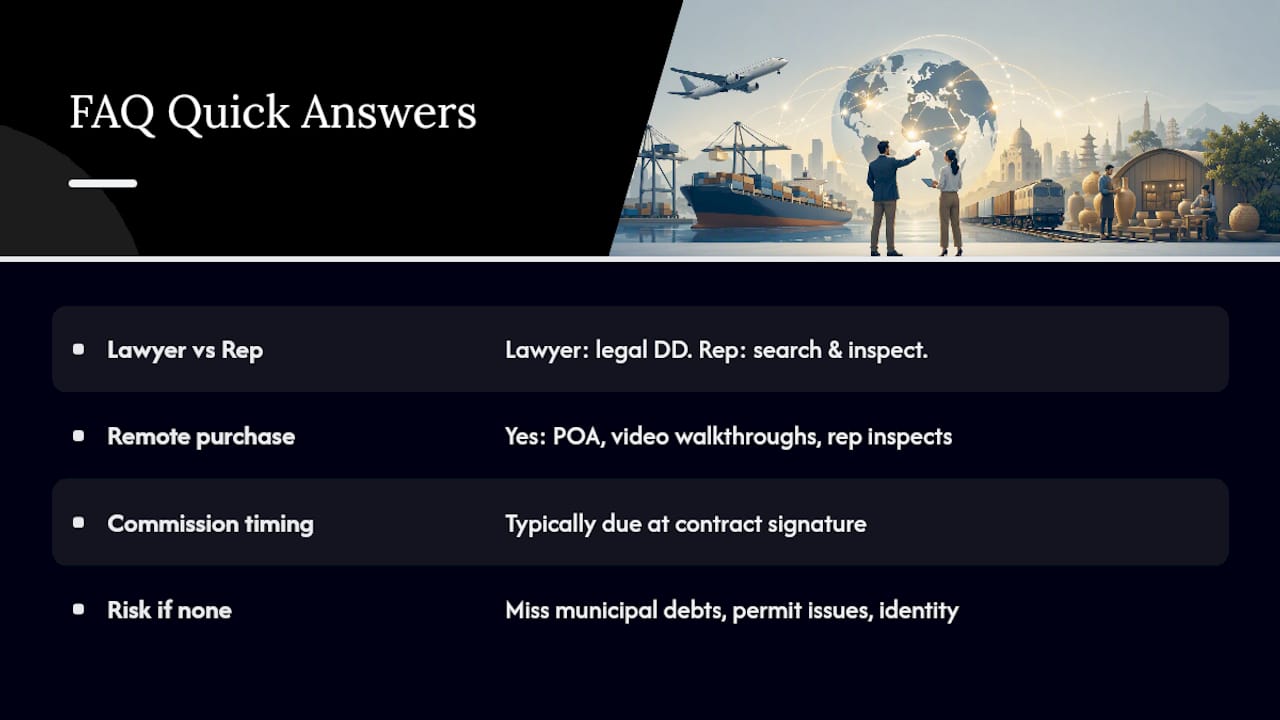
What’s the biggest risk of skipping representation altogether? Missing time-sensitive issues you can’t see from abroad, like municipal debts, permit irregularities, or seller identity problems that only surface after you’ve already signed.