%20(4).png)
![[background image] image of cityscape background (for an architect firm)](https://cdn.prod.website-files.com/68961ade6feff9cbdffc080d/69384e066e0e9a310b6817f8_061f6bac-48bf-44b8-a689-078dacd8009f.avif)
TL;DR:
- Partnering with a local agent in Beit Shemesh is essential for understanding neighborhood nuances like Eruv boundaries, school zones, and community infrastructure. Such expertise helps buyers avoid hidden risks, ensure accurate pricing, and find homes aligned with their religious and lifestyle needs. Genuine local knowledge transforms a complex market into a manageable, protected, and opportunity-rich experience for observant Jewish families.
Browsing listings on a real estate portal feels productive. Prices, square footage, floor plans — it all seems straightforward until you arrive and realize the apartment you loved online sits two streets outside the Eruv, the nearby school closed last year, and the building next door is scheduled for demolition. For observant Jewish families moving to Beit Shemesh from the United States or abroad, the gap between what listings show and what you actually need to know is enormous. This article breaks down exactly why partnering with a truly local agent is the single most important decision you will make in your home search.
| Point | Details |
|---|---|
| Hidden risks revealed | Local agents uncover zoning or neighborhood issues you won’t see online. |
| Smarter pricing decisions | Area sales knowledge helps you avoid paying too much for your home. |
| Community-specific support | Local agents address needs like Shabbat, kosher, and schools for observant families. |
| Seamless home search | Partnering with a local expert streamlines viewings, negotiations, and move-in. |
Beit Shemesh is not one neighborhood. It is a collection of micro-communities that look similar on a map but feel entirely different on the ground. Ramat Beit Shemesh Aleph, Bet, Gimmel, and the newer Daled and Hey developments each have their own character, religious demographic, price dynamics, and communal infrastructure. Two apartments listed at the same price and located just 500 meters apart can represent completely different lifestyle realities for a frum (observant) family.
The benefits of local agents in Beit Shemesh become obvious the moment you start comparing neighborhoods at this granular level. Here is what actually changes across short distances:
As one principle of complex real estate markets captures it well:
“Multiple variables that change significantly across short distances make real estate complex, and only agents with genuine local roots can accurately map those variables for buyers.”
Price comparisons across Beit Shemesh neighborhoods are particularly misleading. A unit in Gimmel may list lower than one in Aleph, but if it requires a car for basic Shabbat functions or lacks the community infrastructure your family needs, the real cost is much higher. Local expertise converts those raw numbers into genuinely useful information.
Now that you understand how complex and nuanced the Beit Shemesh market is, it is time to look at what happens when buyers skip local expertise and rely only on what they can see online.
Local agents surface issues that never appear in standard listings, including zoning restrictions, building code complications, and community-specific constraints that can seriously affect your quality of life and your investment.
For observant families, the stakes are even higher because the checklist goes well beyond physical property condition. Here are the most common hidden risks that catch overseas buyers off guard:
Pro Tip: Before signing any agreement, ask your local agent these specific questions: Is this property inside the active Eruv? What construction is planned within 300 meters? Has the building had any va’ad disputes or major structural issues in the past three years? A local agent will know the answers. An out-of-area agent will have to guess.
The impact of local knowledge on listings is not abstract. Families who skipped this step have signed contracts on apartments they later discovered were located just outside the Eruv, or next to a site that began construction six months after they moved in. These outcomes are preventable with the right local guidance.
A striking data point worth keeping in mind: industry research consistently shows that buyers who use non-local or inexperienced agents are significantly more likely to encounter post-purchase legal or structural surprises. In high-regulation markets like Israel, where purchase contracts, arnona (municipal tax) classifications, and tama (national building plan) designations all interact, that risk multiplies.
Understanding the risks is only half the picture. A skilled local agent does not just protect you from mistakes — they actively find advantages and help you get more for your money.
Local agents use area sales history to refine comparable property analysis so buyers avoid paying inflated premiums for properties with hidden problems. This is the difference between knowing a price and understanding a price.
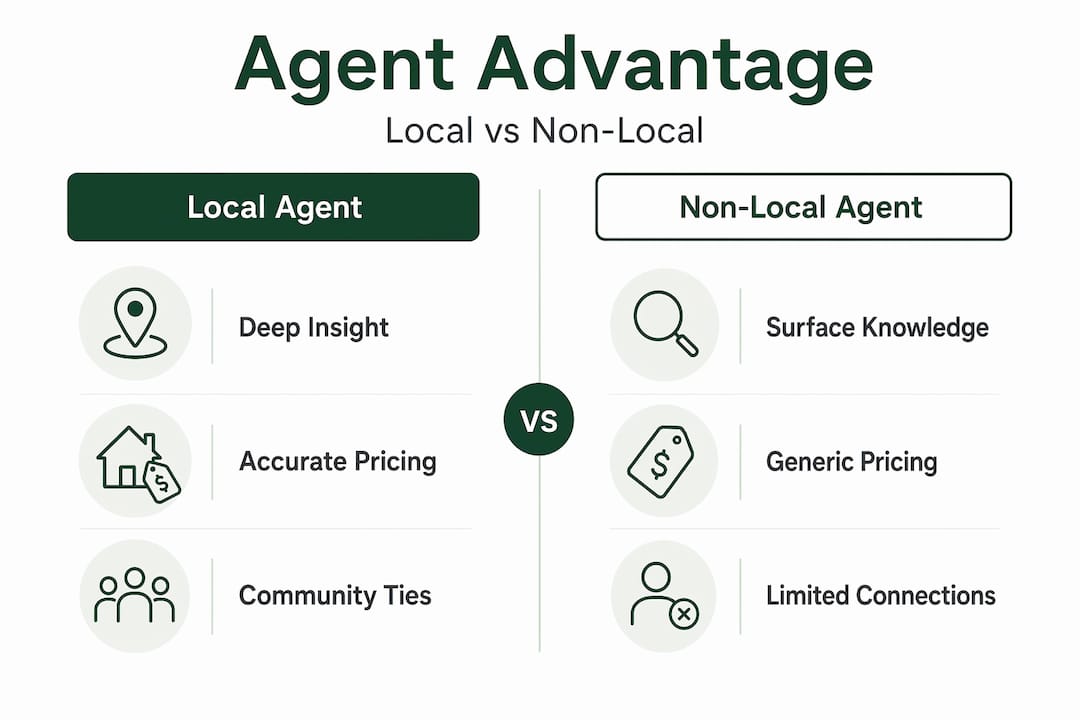
Here is a clear comparison of what your home search looks like with and without genuine local agent support:
| Factor | With local agent | Without local agent |
|---|---|---|
| Pricing accuracy | Based on recent micro-market sales | Based on broad regional averages |
| Legal and contract nuance | Agent flags Israeli contract quirks early | Surprises arise during or after signing |
| Community fit | Agent screens for Eruv, shuls, schools | Buyer discovers gaps after move-in |
| Hidden construction risk | Agent checks municipal plans proactively | Buyer discovers plans after purchase |
| Negotiation leverage | Agent uses local seller knowledge | Negotiation based on limited information |
| Post-purchase support | Agent has local contractor and legal contacts | Buyer starts from scratch |
The detailed benefits of local agents go even further when you consider the auction and pre-sale market in Beit Shemesh. New project launches regularly offer early-access pricing that is significantly lower than post-launch pricing. A local agent who has relationships with developers will know about these windows before they are publicly listed. Buyers working with non-local agents simply never hear about them.
Coordinating viewings is another area where local expertise saves time and money. For overseas buyers flying in for a two-day property visit, every hour counts. A local agent who knows exactly which buildings are worth your time, which sellers are motivated, and which properties have unresolved issues will structure your visit with precision. That efficiency is not possible when your agent is learning the neighborhood alongside you.
Pro Tip: When evaluating whether an agent genuinely knows the local market, ask them to explain the pricing difference between two specific comparable streets or buildings in your target area. A truly local agent will answer immediately and specifically. A generalist will give you a vague regional response.
The insights from Beit Shemesh agents built over years of active work in the city are simply not replicable through online research, no matter how diligent you are.

Understanding the value is one thing. Putting that knowledge into action is where successful buyers distinguish themselves from those who end up with regrets.
Local agents coordinate timing, availability for viewings, and alignment with local legal and contract realities in ways that genuinely protect overseas buyers throughout every stage of the process.
Here is how to get the most out of a local agent relationship, especially when coordinating from the United States:
Here is how local and out-of-area agent services compare across the dimensions that matter most to overseas buyers:
| Service dimension | Local Beit Shemesh agent | Out-of-area or online-only service |
|---|---|---|
| Neighborhood-level community knowledge | Deep and current | Minimal or outdated |
| New project early access | Regular developer relationships | Dependent on public listings |
| Halachic and community guidance | Integrated into property advice | Not available |
| Overseas buyer coordination | Experienced and structured | Inconsistent |
| Legal/contract navigation in Israel | Direct referral network | Generic advice only |
| Post-purchase support network | Local contacts for every need | Buyer is on their own |
The right agent will also be honest with you when a property is not right for your family, even if that means a deal does not close. That kind of candor only comes from someone whose reputation is built entirely within the community you are joining.
Learning how to work with local real estate agents before you start your search is one of the most effective preparation steps you can take.
Here is something most articles will not tell you plainly: a non-local agent who genuinely cares about you still cannot replace a local one. Caring is not the same as knowing.
We have seen families come to Beit Shemesh with an agent they trusted from their home city or from a general Israeli real estate platform. Those agents worked hard. They pulled listings, negotiated offers, and answered calls. But they did not know that the particular building they chose had a reputation in the community as difficult to live in. They did not know that the street, while technically inside the Eruv, required a long detour to reach the shul. They did not know which developers had strong follow-through on construction quality and which ones had a pattern of delays.
That true local insight comes from years of living, working, and selling within a specific community — not from reading about it. For observant Jewish buyers, the stakes are especially concentrated. Your home is not just a financial asset. It is the container for your Shabbat table, your children’s school friendships, your walking route to shul, and your family’s daily communal life. Getting those details wrong has real costs that compound every week.
Buyers who succeed in Beit Shemesh almost always point to the same factor: they found an agent who understood what community life actually means, not just what properties look like. That is not a soft benefit. That is the core of the entire transaction.
The observant Jewish community in Beit Shemesh is large, established, and remarkably self-referential. Word spreads quickly about which agents are trusted, which buildings have strong communities, and which streets represent the best long-term value. A local agent is plugged into that information network in real time. You, as a buyer from abroad, access that network through them.
You now have a clear picture of what local expertise actually looks like in practice and why it matters so much for observant families buying in Beit Shemesh. The difference between a frustrating home search and a smooth, confident one often comes down to having the right person guiding you through a market they know personally, not professionally from a distance. At Yigal Realty, our agents live and work inside the communities you are considering. We understand Eruv boundaries, school zones, developer reputations, and community dynamics because we are part of this world every day. When you are ready to take a real step forward, connect with a Beit Shemesh local agent at Yigal Realty and experience the difference that genuine local knowledge makes from the very first conversation.
Local agents spot neighborhood-specific issues and pricing nuances that outsiders miss, helping you avoid costly surprises that never appear in standard listings.
A local agent uses area sales history and deep knowledge of micro-market trends to ensure you are not paying a premium for a property with hidden problems or an inflated comparable price.
Yes, an experienced local agent in Beit Shemesh knows the layout of synagogues, Eruv boundaries, kosher food access, and mikva locations — all the community details that determine whether a home actually works for your family’s lifestyle.
Ask about their recent sales in your specific target neighborhoods, any known zoning or municipal developments in those areas, and their experience working with observant families who have requirements similar to yours.
Seek recommendations from families who have recently made aliyah or purchased in Beit Shemesh, check for an agent’s active track record in your target neighborhoods, and schedule a detailed interview to test their specific, current knowledge of the streets and communities you care about most.