%20(4).png)
![[background image] image of cityscape background (for an architect firm)](https://cdn.prod.website-files.com/68961ade6feff9cbdffc080d/69384e066e0e9a310b6817f8_061f6bac-48bf-44b8-a689-078dacd8009f.avif)
Most homebuyers and investors in Israel think ROI is simple: divide annual rent by purchase price. This oversimplification misses critical costs and appreciation dynamics that define real returns in Israeli residential real estate, especially in observant communities like Beit Shemesh. Purchase taxes, transaction friction, property management fees, and appreciation rates dramatically reshape your actual profitability. Understanding true ROI in Israeli properties requires modeling all expenses and growth factors over realistic holding periods. This guide breaks down ROI calculations tailored to homebuyers and investors targeting religious neighborhoods, revealing what genuinely drives returns in Israel’s unique market.
| Point | Details |
|---|---|
| ROI includes costs | A complete ROI model accounts for purchase taxes, transaction fees, maintenance, vacancies, and financing alongside rents and appreciation. |
| Israel taxes impact ROI | In Israel the investment taxes and ongoing fees dramatically shrink net returns beyond advertised gross yields. |
| Religious areas appreciate more | Neighborhoods with religious observance often show higher long term appreciation, even when current yields are lower. |
| Long term holding boosts ROI | Holding properties longer lets appreciation compound and costs amortize, improving overall profitability. |
ROI in real estate measures profitability using the formula: (Gain minus Cost) divided by Cost. For residential properties, this calculation can use either total cost or out-of-pocket investment as the denominator. The numerator includes all gains from rental income, property appreciation, and eventual sale proceeds, minus all costs incurred during ownership.
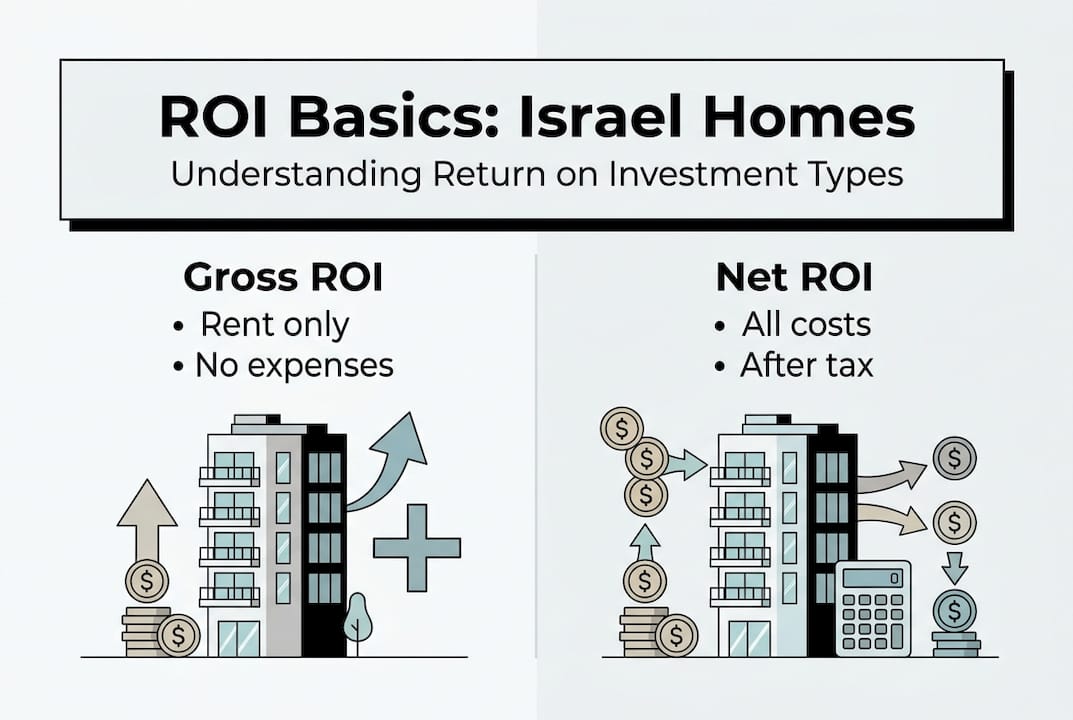
Gross ROI looks only at revenue and purchase price, ignoring expenses. Net ROI subtracts all costs from gains before dividing by investment, giving you a realistic picture of profitability. Common components in ROI calculations include rental income, purchase price, selling price, transaction costs, property taxes, maintenance, vacancy losses, and financing expenses.
Cash-on-cash ROI proves especially useful for leveraged investments. This metric divides annual cash flow by the actual cash you invested, not the full property price. If you put down 30% and finance 70%, your cash-on-cash ROI reflects returns on your down payment, not the total property value. This approach helps you compare leveraged real estate returns against other investment opportunities.
Understanding these basics is critical before considering Israel-specific factors. Israeli residential real estate introduces unique costs and appreciation patterns that fundamentally alter standard ROI formulas. Without grasping these foundational concepts, you cannot accurately model returns in observant community properties or make informed investment decisions in markets like Beit Shemesh.
Pro Tip: Always calculate both gross and net ROI to understand the gap between theoretical and actual returns. The difference reveals hidden costs that can make or break your investment thesis.
For deeper insights into applying these principles in Israeli markets, explore our real estate investment guide tailored to local conditions.
Israel’s residential real estate market introduces costs that dramatically reshape ROI calculations compared to other countries. Purchase tax ranges from 8-10% for investment properties, while total transaction friction hits 12-18% when you include agent fees, legal costs, and registration expenses. These upfront costs immediately reduce your effective investment capital and require years of appreciation to recover.
Ongoing expenses further compress net yields. Arnona (municipal property tax) varies by city and property size but adds significant annual costs. Vaad Bayit (building management fees) covers shared infrastructure and maintenance in apartment buildings. Property maintenance typically runs 1% of property value annually. Vacancy periods cost 5-8% of potential rental income in most markets. Rental income itself faces 10% taxation, further reducing your net cash flow.

Gross yield differs substantially from net yield in Israeli residential properties. While you might see advertised gross yields of 3-4%, actual net yields drop 0.5-1% after accounting for all costs. This gap widens in expensive markets like Tel Aviv and narrows slightly in peripheral cities with lower property values and higher rental ratios.
Historical appreciation averages matter enormously for long-term ROI. Israeli residential properties have delivered 3-5% annual appreciation historically, though religious community markets like Ramat Beit Shemesh have exceeded this significantly. Appreciation often contributes more to total ROI than rental income over multi-year holding periods, especially in high-demand observant neighborhoods.
| Cost Category | Typical Range | Impact on ROI |
|---|---|---|
| Purchase tax | 8-10% | One-time upfront cost |
| Transaction friction | 12-18% total | One-time upfront cost |
| Arnona | Varies by city | Annual ongoing expense |
| Vaad Bayit | Varies by building | Annual ongoing expense |
| Maintenance | 1% of value | Annual ongoing expense |
| Vacancy | 5-8% of rent | Annual income loss |
| Rental tax | 10% | Annual income reduction |
Ignoring these Israel-specific costs leads to severe ROI overestimation. Investors who model only gross rent divided by purchase price miss the reality that transaction friction alone requires 3-4 years of appreciation just to break even on acquisition costs. Net cash flow after all expenses may be zero or negative in early years, even with positive gross yields.
Pro Tip: Build an annual ROI model that factors in all Israeli costs, rental income, appreciation, and eventual sale proceeds over your planned holding period. This reveals whether your investment truly generates positive returns or merely preserves capital.
Understanding these mechanics helps you navigate real estate transaction costs effectively and set realistic return expectations.
Rental yields vary dramatically across Israeli cities and community types. Tel Aviv delivers 2-3.5% gross yields due to high property prices relative to rents. Jerusalem ranges from 2.5-4% gross, with variation between secular and religious neighborhoods. Peripheral cities and Haifa offer 3.5-7% gross yields, reflecting lower property prices. Religious areas like Ramat Beit Shemesh show 3-3.8% gross rental yields, positioning between expensive central cities and cheaper periphery markets.
Net yields after Israel-specific costs drop significantly from gross figures. Markets with net yields exceeding 3% are considered reasonable in Israeli cities. Religious communities often fall in the 2.5-3.5% net yield range after accounting for all expenses, lower than peripheral cities but competitive with Jerusalem and Tel Aviv.
| Location | Gross Yield | Net Yield (est.) | Appreciation |
|---|---|---|---|
| Tel Aviv | 2-3.5% | 1.5-2.5% | 3-5% |
| Jerusalem | 2.5-4% | 2-3% | 3-5% |
| Periphery/Haifa | 3.5-7% | 3-6% | 2-4% |
| Religious areas (Beit Shemesh) | 3-3.8% | 2.5-3.5% | 9-10% |
Appreciation rates in observant communities dramatically shift the ROI equation. Ramat Beit Shemesh achieved 9-10% annual appreciation in 2025, far exceeding national averages. This appreciation premium reflects strong demographic growth, limited supply, and increasing demand from observant families seeking community infrastructure. Over 5-10 year holding periods, this appreciation contributes far more to total ROI than rental income.
Edge cases reveal significant ROI risks in specific property types. Church-leased land in Jerusalem neighborhoods like Rehavia trades at 30% price discounts due to lease expiry uncertainty, with demand dropping 20%. Older buildings require high capital expenditure for renovations, reducing net returns. Short-term holdings under 5 years often produce negative ROI because transaction friction and costs exceed appreciation and rental income. CPI-linked mortgages grow principal balances over time, increasing your debt burden and reducing equity gains.
Key factors to weigh when comparing location-based ROI:
These location dynamics make religious neighborhoods like Beit Shemesh compelling for long-term investors despite lower initial rental yields. The combination of stable rental demand and exceptional appreciation creates superior total ROI compared to higher-yielding peripheral markets with limited growth potential.
For detailed analysis of returns in specific markets, review our insights on Beit Shemesh real estate returns and guidance on assessing Beit Shemesh real estate.
Long-term investment horizons dramatically improve ROI by capturing appreciation and amortizing transaction costs over many years. Holding properties 7-10 years allows 9-10% annual appreciation in religious areas to compound, while spreading 12-18% transaction friction across enough years to reduce its annual impact. ROI mechanics favor long-term holds in religious areas for homebuyers and investors who can wait for appreciation to dominate returns.
Follow these steps to maximize ROI in observant community properties:
Prioritize properties in religious neighborhoods like Beit Shemesh for better appreciation potential. These markets combine stable rental demand from growing observant populations with limited supply due to planning constraints and community preferences. The result is consistent price growth that compounds over long holding periods, generating total returns that exceed higher-yielding but slower-growth peripheral markets.
Avoid short-term speculation in Israeli residential real estate. High transaction friction makes flipping properties economically unviable in most cases. Properties held under 5 years rarely generate positive ROI after accounting for purchase costs, holding expenses, and sale costs. CPI-linked mortgages add risk by growing your principal balance, reducing equity gains if appreciation underperforms inflation.
Pro Tip: Use local market insights to identify undervalued properties with growth potential in developing religious neighborhoods. Properties near planned infrastructure, new schools, or community centers often appreciate faster than neighborhood averages as amenities come online.
Apply these strategies using resources like our observant buyer tips for Beit Shemesh and investment tips for Jewish families to make informed decisions.
Yigal Realty specializes in residential properties serving observant and religious communities in Beit Shemesh and surrounding areas. Our deep local expertise helps homebuyers and investors navigate Israel’s complex real estate market, from understanding true ROI calculations to identifying high-growth neighborhoods. We provide personalized guidance on project selection, transaction processes, and market dynamics specific to religious communities.
Our services include exclusive early access to new developments, transparent cost breakdowns, flexible payment options, and ongoing support throughout your investment journey. Whether you are relocating to Israel or building a rental property portfolio, our team connects you with opportunities that align with your financial goals and community preferences.
Visit Yigal Realty to explore current projects, access detailed market insights, and consult with our experienced agents who understand both the financial and community dimensions of Israeli real estate investment.
ROI measures profitability by calculating total gains minus total costs, divided by your investment. In Israeli residential real estate, this includes rental income, property appreciation, and sale proceeds, minus purchase price, transaction costs, taxes, maintenance, and all holding expenses over your ownership period.
Israeli taxes significantly reduce net ROI through purchase tax of 8-10%, rental income tax of 10%, and municipal Arnona. Transaction friction totaling 12-18% creates a high upfront cost barrier that requires years of appreciation to recover, making short-term investments often unprofitable.
Total ROI is often higher in religious neighborhoods like Ramat Beit Shemesh despite lower rental yields because appreciation rates reach 9-10% annually, far exceeding typical 3-5% national averages. Over 5-10 year periods, this appreciation premium dominates returns compared to higher-yielding but slower-growth markets.
Long-term holding amortizes Israel’s 12-18% transaction friction across many years, reducing its annual impact on returns. It also captures compounding appreciation and allows rental income to accumulate, turning initially negative cash flow into strong positive ROI as property values grow and costs stabilize.
Major costs include purchase tax at 8-10%, transaction friction at 12-18%, annual Arnona, Vaad Bayit fees, 1% maintenance, 5-8% vacancy losses, and 10% rental income tax. These expenses typically reduce gross yields by 0.5-1% or more, making accurate net ROI modeling essential for investment decisions.