%20(4).png)
![[background image] image of cityscape background (for an architect firm)](https://cdn.prod.website-files.com/68961ade6feff9cbdffc080d/69384e066e0e9a310b6817f8_061f6bac-48bf-44b8-a689-078dacd8009f.avif)
TL;DR:
- A genuine luxury development relies on prime location, superior construction, and proven operational standards. Buyers should verify specifications, sustainability certifications, and legal entitlements before investing. Long-term value depends on verified performance, in-house management, and detailed due diligence.
A luxury development is a residential project that pairs market-relative exclusivity with construction standards, site quality, and operational services that demonstrably exceed typical code or market practice. Price alone does not make something luxury. The combination of where it sits, how it is built, and how it is run does.
Quick check before you read further:
Luxury is a moving target, not a fixed price. Realtor.com’s economic research treats it as a relative tier marked by regional price percentiles. Those thresholds shift dramatically by market. A $1.3M home is entry-level luxury in Manhattan; in Boise, it is ultraluxury.
Buyer profiles shape product expectations just as much as price. Primary residents want privacy, acoustic performance, and long-term durability. Second-home buyers prioritize turnkey management and rental capability. International cash buyers focus on resale liquidity and brand recognition. Branded-residence purchasers demand operational consistency between the hotel and residence components, not just a logo on the lobby wall.
Regional product form differs sharply. Legacy coastal markets like New York, Boston, and San Francisco reward historic character and irreplaceable location. Sun Belt and Mountain West markets, by contrast, are driven by new construction, horizontal scale, and modern amenity packages. A buyer evaluating a Denver high-rise against a Miami waterfront tower is comparing two different product philosophies, not just two price tags.
Statistic callout: Sustainability certifications like LEED and BREEAM are shifting from differentiator to baseline expectation in premium U.S. new developments, reflecting buyer demand for verified performance rather than marketing claims.
The spatial markers of a genuine luxury project are measurable. Generous net internal areas, ceiling heights above 10 feet (with 12–14 feet common in ultraluxury), and layouts that separate service zones from living zones are the starting point. Privacy-first circulation, where residents rarely cross paths with staff or deliveries, is a design decision that costs money and signals intent.
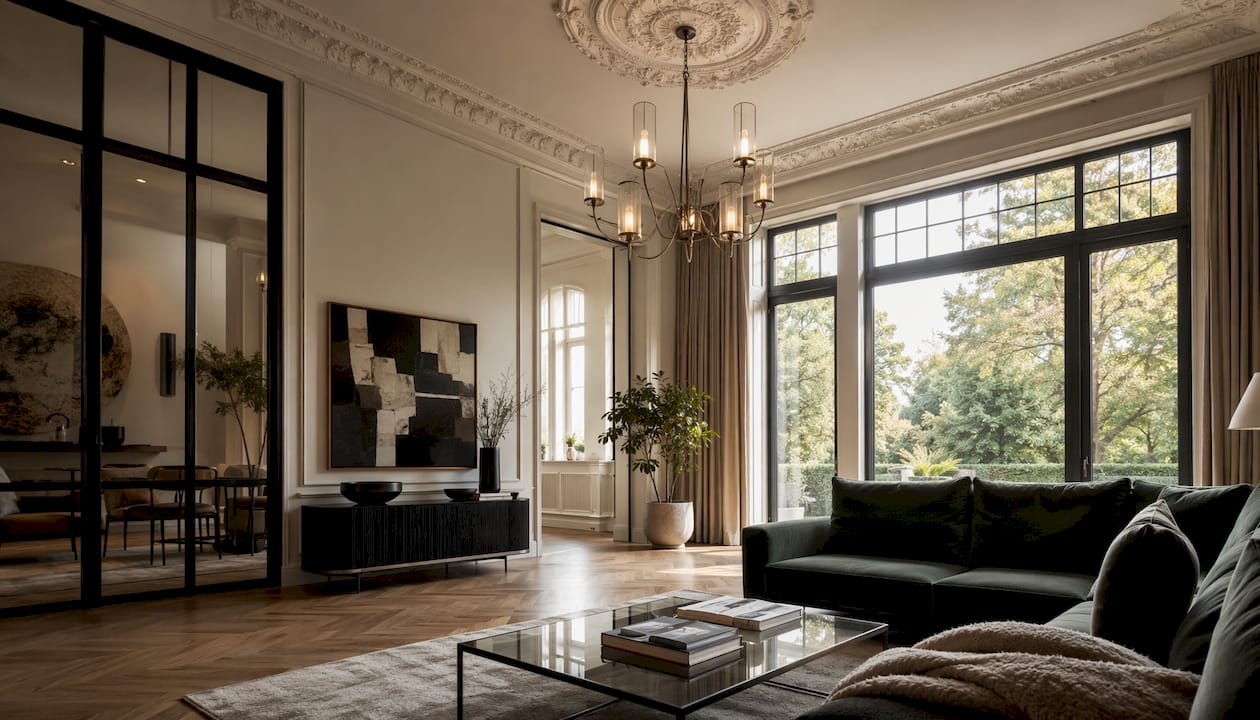
Architectural restraint is a stronger signal than visual drama. Curated sightlines, premium landscape design that frames views rather than blocking them, and a material palette chosen for tactile quality rather than surface flash are what distinguish a genuine luxury project from one that spent its budget on the lobby. Nature-integrated site design in master-planned communities achieves exactly this: the landscape becomes part of the residence’s value, not just its backdrop.
Low-density unit plans, one or two homes per floor with private elevator access, create exclusivity that no amenity package can replicate. Once you have shared a corridor with twelve neighbors, no amount of spa square footage compensates.
On a walkthrough, test these four things:
Pro Tip: Bring a decibel meter app on your phone. A reading above 35 dB in a closed bedroom during the day is a red flag in any development claiming luxury acoustic standards.
Marketing language and specification sheets are not the same document. A genuine high-end development delivers measurable performance: triple-glazed windows with a U-value at or below 0.18, high-performance HVAC with individual zone control, underfloor radiant heating, advanced acoustic insulation between floors and party walls, and structural design that exceeds minimum seismic code where applicable. Smart-home integration via systems like Crestron or Control4 is expected as standard, not an upgrade.
| Specification | Luxury Benchmark |
|---|---|
| Window glazing | Triple-glazed, U-value ≤ 0.18 |
| HVAC | Individual zone control, fresh-air ventilation |
| Acoustic insulation | Impact sound near-silent between floors |
| Flooring | Solid hardwood, natural stone, or equivalent provenance |
| Smart home | Fully integrated BMS (Crestron, Control4, or equivalent) |
| Sustainability | LEED Gold or WELL certification at minimum |
| Appliances | Premium built-in brands (Sub-Zero, Miele, Wolf, or equivalent) |
Certifications like LEED, WELL, and Passive House serve as third-party verification that the spec sheet reflects actual performance. A developer who cannot name their certification body or provide commissioning reports is making marketing claims, not performance guarantees.
Pro Tip: Ask the developer for the names of their glazing and HVAC suppliers, and request the independent commissioning report. A developer confident in their product will hand it over without hesitation.
There is a real difference between amenities and services, and conflating them is how buyers get disappointed. Amenities are physical spaces: spa, pool, gym, private cinema. Services are operational: 24/7 property management, sub-four-hour maintenance response, a concierge team with actual problem-resolution authority. Luxury buyers now expect homes to function like five-star hotels, which means the shift is from feature-based amenity racing to consistent hospitality-style operations.

For multi-residence owners and frequent travelers, the service layer matters more than the spa. A property that manages your unit, handles rental logistics, and coordinates maintenance while you are away is worth more than one with a better pool and a part-time front desk.
Amenity evaluation checklist:
Red flags: a concierge described as “digital-first” with no named in-house staff, amenity spaces shared with non-residents, and service contracts that expire at handover.
The delivery process for a genuine high-end project follows a clear sequence: concept and market positioning, architect selection and detailed design, specialty procurement, construction with third-party quality inspections, commissioning, handover, and ongoing after-sales operations. Each stage has trust signals a buyer can verify.
In-house integrated teams, where design, construction, and management operate under one roof, consistently outperform fragmented subcontracting models on quality consistency. Ask whether the developer manages the building post-handover or hands it to a third-party operator at completion. That handover moment is where many “luxury” projects quietly become standard.
Pro Tip: Request the maintenance reserve study and ask what percentage of the annual service charge funds it. A well-run luxury building typically reserves 15–25% of the annual charge for capital repairs. Anything below 10% is a warning sign.
A structured approach to evaluating a luxury development protects you from the gap between marketing and reality. Work through these steps before signing anything:
Site and title:
Specification verification:
Service and operations review:
Financial and resale:
Red flags to walk away from: vague service promises with no named provider, a spec sheet that lists “premium finishes” without brand names, unusually low service charges that suggest underfunded reserves, and no commissioning documentation at handover.
The U.S. luxury property market continues to show resilience, supported by tight ultra-prime resale inventory and active cash buyers. The product itself is changing. Hospitality-grade service has moved from differentiator to baseline expectation. Sustainability certification is following the same trajectory.
Smart building systems, energy performance monitoring, and EV infrastructure are now expected in new-build luxury, not optional upgrades. Buyers who purchase certified green product today are insulated from future retrofit costs as energy codes tighten.
| Market segment | Approximate price threshold | Product driver |
|---|---|---|
| Entry-level luxury | ~$1.3M nationally | Location + finish quality |
| High-end luxury | — | Services + certification |
| Ultraluxury | — | Exclusivity + operational model |
| Legacy coastal (NYC, SF, Miami) | Well above national thresholds | Site irreplaceability + brand |
| Sun Belt / Mountain West new-build | Below coastal thresholds | Scale + modern amenity package |
Source: Realtor.com Economic Research
Regional divergence is accelerating. Coastal legacy markets reward preservation and irreplaceable location. Growth markets in Texas, Arizona, Colorado, and Florida compete on amenity scale and construction modernity. Neither model is superior; they serve different buyer profiles.
Luxury developments operate in a more complex regulatory environment than standard residential projects, and buyers need to understand that complexity before committing.
Zoning and entitlements are the foundation. High-density luxury towers in urban cores require specific zoning classifications, and any deviation from the approved plan, such as a reduction in unit count or a change in use, can affect the product you contracted for. Verify that all entitlements are fully secured before exchange, not just applied for.
Exclusivity covenants and CC&Rs (Covenants, Conditions, and Restrictions) govern what owners can and cannot do with their units. These documents control rental restrictions, pet policies, renovation rights, and resale obligations. In some luxury communities, CC&Rs require board approval for resale buyers, which can affect liquidity.
Historic preservation overlays apply in legacy coastal markets and can restrict exterior modifications, window replacements, and even HVAC installations. A buyer purchasing in a landmarked building should understand what renovations are permitted before assuming they can customize the unit.
Permit and inspection records are public documents in most U.S. jurisdictions. A clean permit history with no outstanding violations is a basic due-diligence check that many buyers skip. Ask your attorney to pull the full permit record before closing.
This article is general information, not legal advice. Confirm current zoning, covenant, and permit requirements with a qualified real estate attorney for your specific transaction.
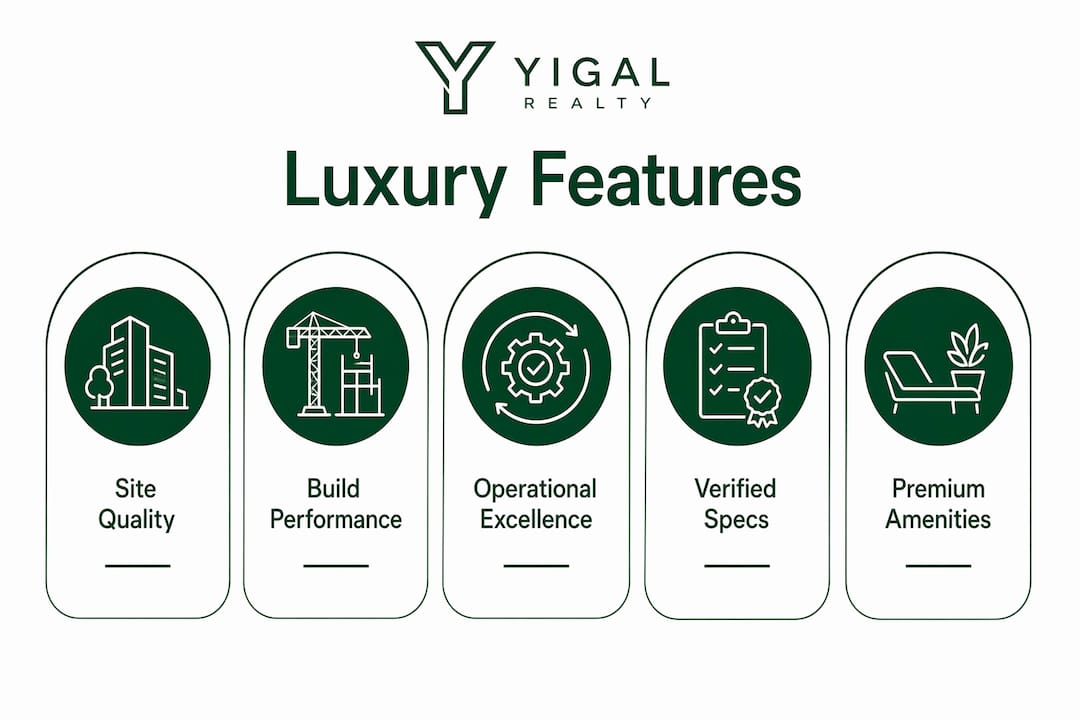
A luxury development earns its label through site quality, verified build performance, and operational infrastructure that sustains the living experience over decades, not just at handover.
| Point | Details |
|---|---|
| Luxury is market-relative | Price thresholds vary by region; use regional percentile benchmarks as a starting framework. |
| Specs must be verifiable | Demand the full spec sheet, supplier names, and third-party commissioning reports before committing. |
| Operations define long-term value | In-house management, funded maintenance reserves, and documented SLAs separate genuine luxury from marketing claims. |
| Legal checks are non-negotiable | Verify zoning entitlements, CC&Rs, and permit records with a real estate attorney before exchange. |
| Yigal-realty guides buyers | Yigal-realty provides early access, transparency, and personalized guidance for buyers evaluating high-end developments. |
The criteria in this guide reflect what Yigal-realty applies when evaluating developments for its clients… The firm’s focus on transparency and early access to new projects means buyers receive specification documentation and operational details before the general market, not after…
Luxury real estate rewards buyers who ask the right questions early. Working with a professional who knows which questions those are, and how to read the answers, is the most practical form of due diligence available.
Buying into a luxury development is one of the highest-stakes decisions a buyer makes, and the gap between a well-specified project and a disappointing one is rarely visible in the brochure. Yigal-realty gives buyers direct access to vetted developments, full specification transparency, and personalized guidance through every stage from shortlisting to closing. The firm’s buyer support process covers specification review, operational due diligence, and early-access introductions to projects before they reach the open market. Contact Yigal-realty to start evaluating developments with the criteria this guide lays out.