%20(4).png)
![[background image] image of cityscape background (for an architect firm)](https://cdn.prod.website-files.com/68961ade6feff9cbdffc080d/69384e066e0e9a310b6817f8_061f6bac-48bf-44b8-a689-078dacd8009f.avif)
Deed registration, more precisely called deed recording, is the act of filing a signed deed with your county’s Recorder of Deeds (or County Clerk) to create a public record of the ownership transfer. That public record is what protects you. It gives the world what lawyers call constructive notice that you own the property, and it establishes your priority over anyone who might later claim a competing interest.
Before you move on, here are the facts that matter most right now:
Deed recording converts a private ownership transfer into a public record that establishes constructive notice and priority, but it does not guarantee clean title or resolve disputes.
| Point | Details |
|---|---|
| Recording creates public notice | Filing with the county recorder gives constructive notice to all future buyers and lenders. |
| Ownership transfers at closing | Delivery and acceptance of the deed transfer title; recording protects priority, not the transfer itself. |
| Title insurance fills the gap | Recording cannot cure hidden defects; title insurance protects against undisclosed claims in the chain of title. |
| Get your instrument number | Request the e-recording receipt or instrument number at closing to verify recording within days. |
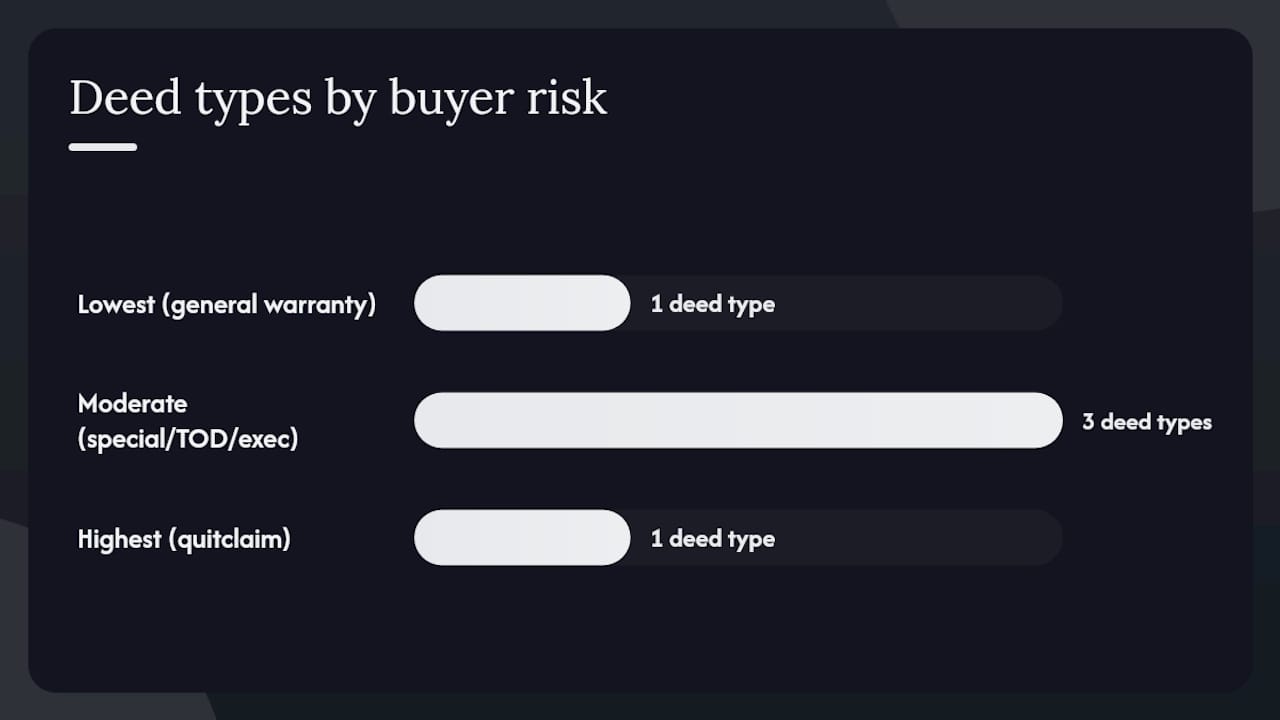
| Deed type determines protection | A general warranty deed offers the strongest buyer protection; a quitclaim deed offers none. |
The word “deed” and the word “title” get used interchangeably in casual conversation, but they describe two different things, and mixing them up causes real confusion at closing.
A deed is a physical legal instrument. Per Cornell Law’s Wex, a valid deed requires a grantor (seller), a grantee (buyer), a legal description of the property, a granting clause, and the grantor’s signature. Delivery of the signed deed to the grantee, and the grantee’s acceptance, is what actually transfers ownership between the two parties.
Title is the legal right to own and use the property. It is not a document you can hold. It is the bundle of rights that flows to you once the deed is delivered and accepted.
Recording comes after both of those events. It converts a private transaction into an indexed public record. As Wikipedia’s entry on deeds registration explains, most U.S. jurisdictions use a recording model rather than a Torrens-style title registration system. Under Torrens, a government certificate guarantees title outright. Under the U.S. recording model, the public record creates notice, but a chain-of-title search and title insurance are still needed to protect against hidden defects.
The office name depends on where the property sits. Cornell Law’s Wex entry on the register of deeds notes that these offices go by several names across the country:
Some of these offices are elected positions; others are appointed. In a handful of states, recording duties are split between a county clerk and a separate recorder. When you are not sure which office covers your property, the county government’s main website is the fastest starting point. The PRIA (Property Records Industry Association) describes these offices as public custodians whose job is to index documents for inspection, not to validate ownership claims.
Deeds are the most familiar, but the recorder’s index holds much more than that. Common recorded documents include:
Each type serves a distinct purpose. A recorded mortgage tells the world the lender has a claim on the property until the loan is repaid. A recorded satisfaction removes that claim. An unrecorded easement may still be legally binding between the original parties, but a buyer who searches the public record and finds nothing has a strong argument for priority. That is exactly why recording matters for anyone with an interest in the property.
The sequence is more straightforward than most buyers expect. Here is how it typically unfolds:
Recording fees vary by county and state. Some counties charge a flat fee per document; others charge by the page. The contract usually specifies who pays, though in most states the buyer covers recording fees for the deed and the lender’s mortgage.
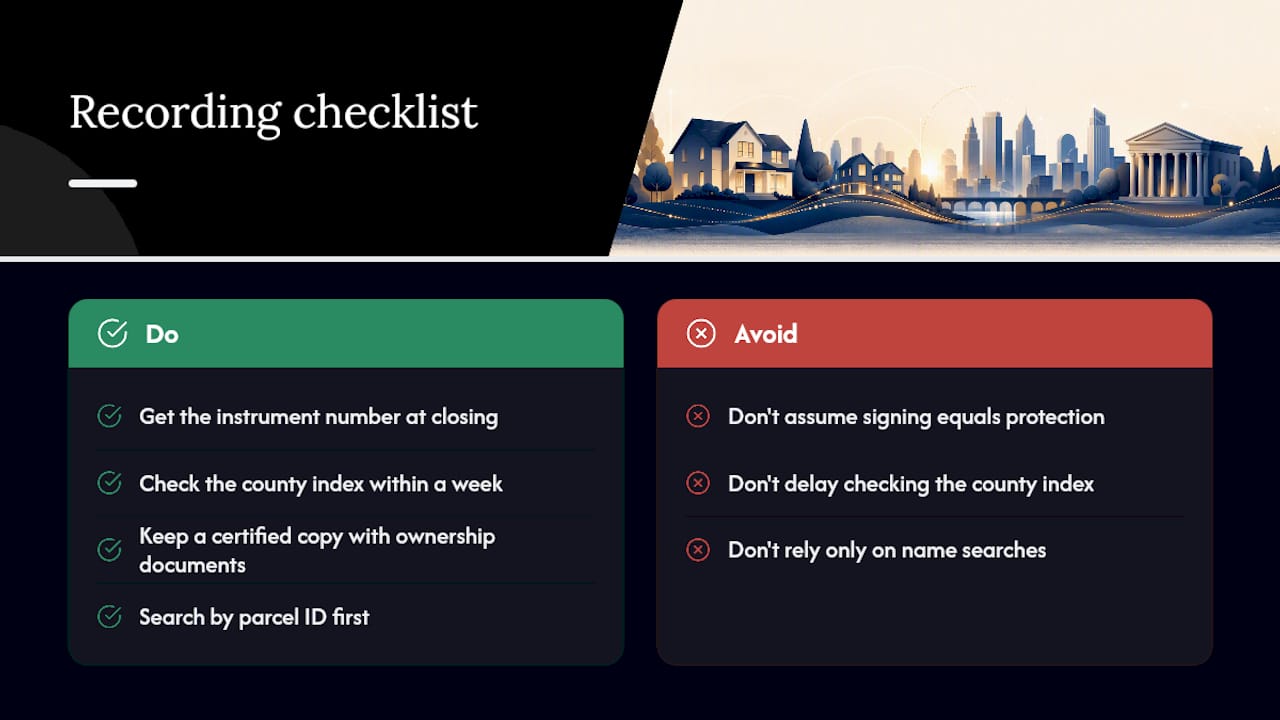
Pro Tip: Ask your title company for the instrument number or e-recording receipt at closing. With that number, you can verify the recorded deed in the county’s online index the same day, rather than waiting weeks for the stamped copy to arrive by mail.
Recording does three things, and understanding all three tells you why skipping it is dangerous.
Constructive notice. Once a deed is in the public index, every subsequent buyer or lender is legally presumed to know about it, whether they actually searched the record or not. You cannot claim ignorance of a properly recorded instrument.
Priority. State recording statutes determine who wins when two parties claim the same property. The three main types are:
Most states use race-notice or notice statutes. The practical takeaway is that recording quickly after closing is not optional if you want to preserve your priority.
What recording does not do. It does not guarantee your title is clean. Courts resolve title disputes, not recorders. As PRIA’s historical overview makes clear, recorders are custodians who index documents for public inspection. Title insurance fills the gap: it protects buyers against hidden chain-of-title defects that recording cannot cure, such as a forged deed in the chain or an undisclosed heir.
Failing to record is not just a paperwork oversight. The consequences can be serious:
Common remedies include immediate recording (if the deed is still valid), a corrective deed to fix errors, a quiet-title action through the courts, or a title insurance claim when a policy is in place. For probate-related situations, Texas Legal Research Guides notes that executor’s deeds, affidavits of heirship, and court orders admitting a will to probate can establish ownership when standard deeds are absent. When the problem is legal rather than clerical, involving a real estate attorney early saves time and money.
Most county recorders now offer online search portals. Here is how to use them:
| Method | How to access | What you get |
|---|---|---|
| County recorder online index | Search by grantor/grantee name, parcel ID, or instrument number | Document image, recording date, instrument number |
| Title or escrow company | Contact your closing agent directly | Stamped original or certified copy |
| In-person county visit | Bring the property address or parcel ID | Certified copy, same-day service in most offices |
| City Register (NYC) | NYC.gov City Register portal | Electronic image and recording confirmation |
A certified copy carries an official seal and is accepted as legal proof for refinancing, probate, and insurance claims. Request one if you cannot locate the stamped original your title company should have returned to you.
Not all deeds offer the same protection. Here is a quick comparison:
| Deed type | Common use | Warranty level | Buyer risk |
|---|---|---|---|
| General warranty deed | Standard residential sale | Full: seller warrants title against all prior claims | Lowest |
| Special warranty deed | Commercial sales, bank-owned properties | Limited: seller warrants only against claims arising during their ownership | Moderate |
| Quitclaim deed | Transfers between family members, divorce settlements | None: seller conveys only whatever interest they happen to have | Highest |
| Transfer-on-death deed | Estate planning, avoiding probate | Varies by state | Moderate |
| Executor’s deed | Probate sales | Limited: estate warrants only against estate’s own acts | Moderate |
Texas Legal Research Guides covers executor’s and transfer-on-death deeds in detail, including how they interact with probate filings. Not every state uses the same labels, and some states provide statutory deed forms that carry specific implied warranties. A general warranty deed is the strongest protection a buyer can receive in a standard residential transaction.
Most buyers treat deed recording as a formality handled by the title company, and in a smooth closing, it is. But the moment something goes wrong, whether a prior lien surfaces, a seller’s creditor files a judgment, or a clerical error puts the wrong parcel number on the deed, the recorded instrument is the first thing every attorney, lender, and court examines.
The confusion between recording and transfer is the most common misunderstanding I see. Buyers assume that because they signed papers at closing and got the keys, they are fully protected. They are not, not until that deed hits the public index. A seller’s creditor can file a judgment lien against the property in the gap between closing and recording, and in a race-notice state, that lien may take priority.
The practical fix is simple: get the instrument number at closing, check the county index within a week, and keep a certified copy with your other ownership documents. If your county uses parcel-based indexing rather than a name-based index, search by parcel ID first because name searches can miss documents filed under a slightly different spelling. For buyers working across jurisdictions or navigating an international purchase alongside a U.S. transaction, Yigal-realty’s property registration guides offer a useful cross-reference.
A short list of authoritative starting points:
If you are working with a lender and want to understand how recording intersects with mortgage pre-approval or refinancing requirements, David Mordue’s mortgage resource is a practical next step.