

“שנת בדק” refers to the statutory inspection periods that begin the day you take possession of your apartment, covering different building elements for terms that range from one to seven years, each followed by a further three-year warranty window. The single most important thing to do when you find a defect is simple: keep your possession protocol safe and notify the developer in formal writing right away.
TL;DR:
- Finishes and painting receive one year of inspection coverage, flooring two years, plumbing and waterproofing three to four, and structural elements up to seven.
- During the inspection period, the developer is presumed responsible; in the next warranty window, you must prove faulty design, workmanship, or materials caused the defect.
- Send notice by registered mail or courier with delivery proof, describe the defect precisely, and allow a reasonable repair period, typically 30 to 60 days.
- Older contracts, especially those signed before the 2011 amendments, may set different terms, while any clause that shortens statutory protections is void.
- If you sell before a protection period ends, the remaining coverage typically passes to the next buyer rather than ending with the sale.
The Sale (Apartments) Law and its amendments set out a legal framework of inspection periods, often called “בדק” periods, that protect buyers against construction defects discovered after they move in. The clock for every one of these periods starts on the day the developer hands over the keys, documented in the possession protocol known as “protocol mesira,” and not on the date you signed the sales contract or paid your deposit, according to Kolzchut’s guide to contractor warranty periods.
That distinction matters because a delayed handover can push the start date months past the original contract schedule, and because the possession protocol is the document that proves exactly when your clock started, according to LT Law’s guide for apartment buyers. If you sell your apartment before an inspection period ends, the remaining time typically transfers to the next buyer, so these protections do not simply expire at resale.
Not every part of your apartment carries the same statutory protection. The law splits building components into categories, and each one carries its own inspection period measured from possession, according to the Sale (Apartments) Law amendments and Kolzchut’s breakdown of these periods.
| Building element | Statutory inspection period |
|---|---|
| Finishes and painting | 1 year |
| Flooring and cladding | 2 years |
| Plumbing and waterproofing | 3 to 4 years |
| Structural and external cladding | Up to 7 years |
After each specific period closes, a further three-year warranty window opens on top of it, which is the real deadline for filing a claim tied to that element.
Apartments sold under older contracts, particularly those predating the 2011 amendments, may carry different wording or slightly different durations, so checking the exact contract date against the amendment history is worth doing before you assume a period has closed.
During the inspection period itself, the law presumes the developer is responsible for a defect unless the developer can show it resulted from something the buyer did, according to Israellaw. That presumption is the buyer’s biggest advantage: you do not need to prove the developer’s workmanship caused the problem, only that the defect exists and falls within the relevant period.
Once that specific inspection period ends and you move into the three-year warranty window, the burden flips. You now need to show the defect stems from faulty design, poor workmanship, or substandard materials, and that usually means commissioning an engineering opinion. An independent structural or waterproofing assessment carries real weight in a dispute once self-reported observations alone are not enough.
One protection holds throughout both periods: any contract clause that tries to shorten these statutory timeframes is void, according to LT Law’s complete guide. A developer cannot write you out of rights the law grants automatically.

A defect claim lives or dies on documentation. Following a clear sequence from the moment you spot a problem gives you the strongest position if the developer pushes back or stalls.
Pro Tip: Never sign the possession protocol as “accepted without reservations.” Note every visible flaw on the protocol itself, even minor ones, before you sign.
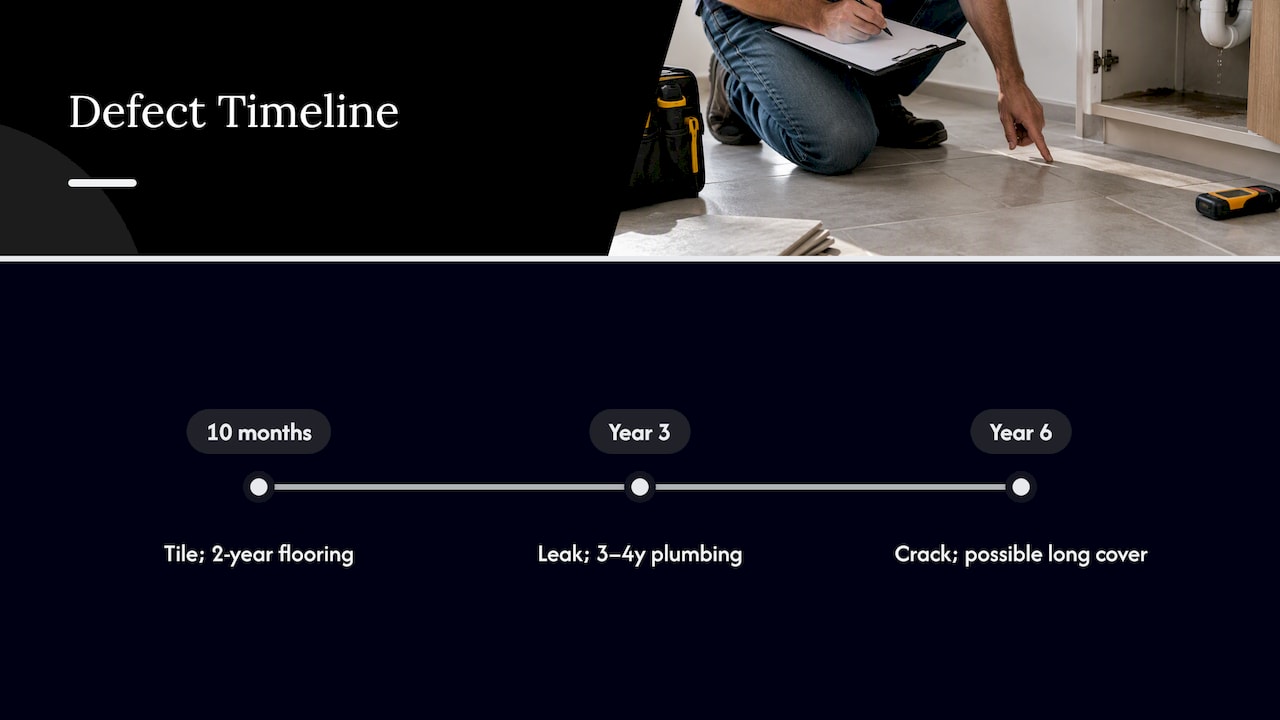
A loose tile at 10 months sits squarely inside the 2-year flooring period, so the developer’s repair obligation is still fully active and a written notice with a 30-day repair request is reasonable.
A recurring leak that shows up in year 3 maps to the plumbing and waterproofing window of 3 to 4 years, so you are still within statutory coverage, but a leak this far along often benefits from a plumber’s or engineer’s written assessment to pin down the source before you send notice.
A structural crack that appears late, say in year 6, can still fall under the longer structural protection, particularly if it qualifies as a serious non-conformity. At that stage, getting legal counsel involved alongside an engineer is worth the cost given what is at stake.
Handover day moves fast, and a missed note on the possession protocol can cost you leverage later. We help buyers walk through the handover appointment with a property inspection checklist built for exactly this moment, and we explain what every buyer should know about handover before the keys change hands.
We also help buyers compare the delivered apartment against the original technical specifications and compile a written notice file if defects turn up later. This support covers the practical side of a claim, documentation, timing, and coordination, not legal representation, so a lawyer remains the right call for contested or complex disputes.
The buyers who come out ahead in a defect dispute are rarely the ones with the worst damage. They are the ones who wrote everything down the week it happened. I have seen a single missing signature on a possession protocol turn a straightforward tile claim into a months-long argument over when the clock even started.
— Spiros
Walking into a handover appointment without a checklist can cause buyers to lose the paper trail that protects them later. Our concierge project guidance service exists to close that gap for buyers purchasing in certain residential projects whether you are buying in Neve Amim, Eucalyptus, or another local project.
With our guidance, you get:
For a related process perspective, a practical snagging checklist covers the same documentation habits from a construction angle, and condo buyer inspection guidance offers similar process tips worth comparing.
If you want local, hands-on support through handover and beyond, reach out through our concierge project guidance page and we will walk you through what to expect before you ever pick up the keys.
This article is general information, not a substitute for advice from a qualified lawyer. Consult a qualified legal professional about your own circumstances before acting on anything here.
The inspection period is the element-specific window, one to seven years depending on the component, during which the developer is presumed responsible for a defect. The warranty period is the additional three-year window that follows, during which you carry the burden of proving the defect’s cause, according to Kolzchut’s guide.
It starts on the date of actual possession, when the developer hands over the keys and you sign the possession protocol, not the date of your sales contract. Keeping this protocol is the clearest way to prove your start date if a dispute ever arises, according to LT Law’s buyer guide.
Send formal written notice by registered mail or courier with proof of delivery, describing the defect’s exact location and nature and citing the applicable statutory period. Give a reasonable repair deadline, typically 30 to 60 days, according to LT Law’s guidance.
No. Any clause attempting to reduce the statutory inspection or warranty periods is void under the Sale (Apartments) Law, according to LT Law’s complete guide. Your rights under the law apply regardless of what the contract states.
During the inspection period itself, the developer is presumed responsible unless they prove otherwise. Once that period ends and you enter the three-year warranty window, you must show the defect stems from faulty design, workmanship, or materials, usually with an engineer’s report, according to IsraelLaw.info.