

The right way to approach בחירת פרויקט חדש בית שמש is to rank priorities before you fall in love with a floor plan: developer track record, bank guarantees, and Tabu and permit verification matter more than finishes or a nice rendering. Before signing anything or wiring a deposit, hire an independent Israeli real estate lawyer and bring in a local project guide who knows Beit Shemesh developers by reputation, not just by brochure.
TL;DR:
- Confirm the developer’s track record and whether previous projects had bank guarantees to reduce construction and financing risks.
- Verify the land title through a recent Tabu extract and confirm the specific building permit number tied to the plot for accurate legal due diligence.
- Ensure that a bank guarantee is in place for each payment milestone to protect large deposits, and avoid contracts asking for early payments without secure backing.
- Review the technical specifications carefully to identify discrepancies between marketed layouts and actual permit drawings, possibly consulting a structural engineer if needed.
- Use an independent lawyer and project guide to verify documents, assess neighborhood suitability, and manage process complexities, especially from abroad.
Choosing a new project in Beit Shemesh comes down to a sequence of checks, not a gut feeling about the lobby design. Skip a step and you inherit someone else’s risk.
Pro Tip: Never rely on the developer’s own lawyer to explain a clause to you. That lawyer represents the seller, and developer contracts are typically drafted to favor the seller’s interests, not yours.
Matching a project to a neighborhood matters as much as matching it to a budget, especially for observant and family buyers who plan around synagogue walking distance and school logistics.
Rental and price data help separate an emotional decision from a financial one. Beit Shemesh’s median monthly rent sits around ₪6,500 as of August 2026, though the spread between neighborhoods is wide enough that a unit’s rental yield in one pocket of the city can look nothing like a similar unit two neighborhoods over. If you’re buying to hold as an investment, that variance should shape which project you shortlist more than the sales brochure does. If you’re buying to live in it, weigh rent comparisons less and weigh the walk to the closest minyan more.
Most new Beit Shemesh projects run on a construction timeline of multiple years from groundbreaking to keys, with payments released at each milestone rather than all at once.
Build a defect list during your pre-handover walkthrough, and hold back the final payment tranche until the developer addresses it in writing.
Running every one of these checks yourself, especially from abroad, is where most buyers lose time or miss something. Concierge project guidance exists to close that gap: shortlisting projects against your actual priorities, coordinating the lawyer and engineer reviews, attending inspections on your behalf, and keeping remote buyers looped in with updates instead of guesswork.
Engage the service and you get a shortlist, a verification timeline, and a single point of contact through signing.
The biggest mistake I see is buyers negotiating hard over kitchen finishes while skipping the Tabu and permit check entirely, trusting the marketing plan as if it were a legal document. For observant families, the second most common miss is assuming a synagogue or school shown on a site map is actually operating on the schedule you need. Confirm both before you sign, not after.
— Spiros
This service offers an alternative to hunting through listings alone: instead of chasing developers for documents yourself, you get one concierge who coordinates the lawyer, the engineer, and the paperwork while you focus on the decision itself. That’s the practical edge for anyone weighing a new project in Beit Shemesh, especially buyers coordinating from overseas. Explore project dossiers for Rotshtein Heights, Neve Amim, or Eucalyptus, or start with Yigal Realty’s concierge project guidance to get a shortlist built around your actual checklist, not the developer’s marketing deck.

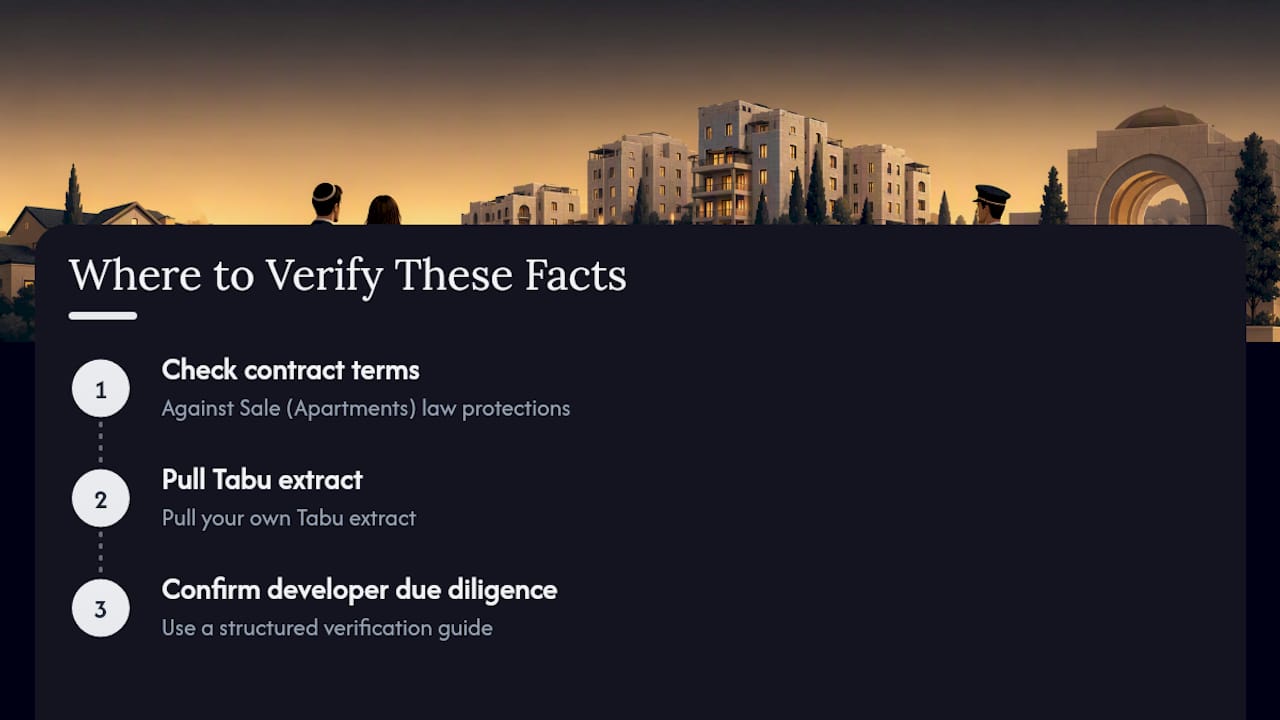
Cross-check contract terms against the Sale (Apartments) law protections, pull your own Tabu extract, and confirm developer due diligence practices with a structured verification guide.
Yes. Under the Sale (Apartments) law, developers must secure staged payments, and a bank guarantee tied to each milestone is the standard mechanism. Confirm the guarantee amount matches each payment before you transfer funds, not after.
Most projects run roughly two to four years from groundbreaking to handover, with payments tied to construction milestones rather than a flat schedule. Delays trigger statutory compensation clauses if they’re written into your contract, so confirm that language before signing.
No. Receiving Tofes 4 occupancy approval and moving in is a separate step from final Tabu registration of your ownership, which can take additional months to complete. Ask your lawyer to track this step even after you’ve moved in.
Yigal Realty coordinates project shortlisting, connects you with an independent lawyer and engineer for verification, attends inspections, and supports remote buyers through signing. Pricing details are available directly through Yigal Realty’s site rather than published rates.
Yes, always. The developer’s lawyer represents the seller, and contracts are typically written to favor the seller’s position, so independent representation changes your leverage before you sign.